Catena is now Pearl Talent! Same mission, new name.
Your engineering team is shipping code much faster than last quarter. But there’s a problem. Your production incidents have increased and your technical debt backlog is compounding faster than you can pay it down. Now, your senior engineers are spending more time fixing AI-generated bugs than they save using AI tools.
There’s a clear gap between teams that use AI strategically versus those that use it recklessly. And it keeps widening.
Here’s the reality most won't tell you:
AI accelerates great engineers and exposes weak ones. The same tool that helps an experienced developer refactor a legacy service in hours can help an undertrained engineer ship insecure code that passes review but fails at scale.
In this article we’ll discuss:
How AI Fits Into the Modern Development Workflow
AI coding tools have evolved. Today's AI assistants participate across the entire software development lifecycle, fundamentally changing how engineering teams work.
Where AI Shows Up Today:
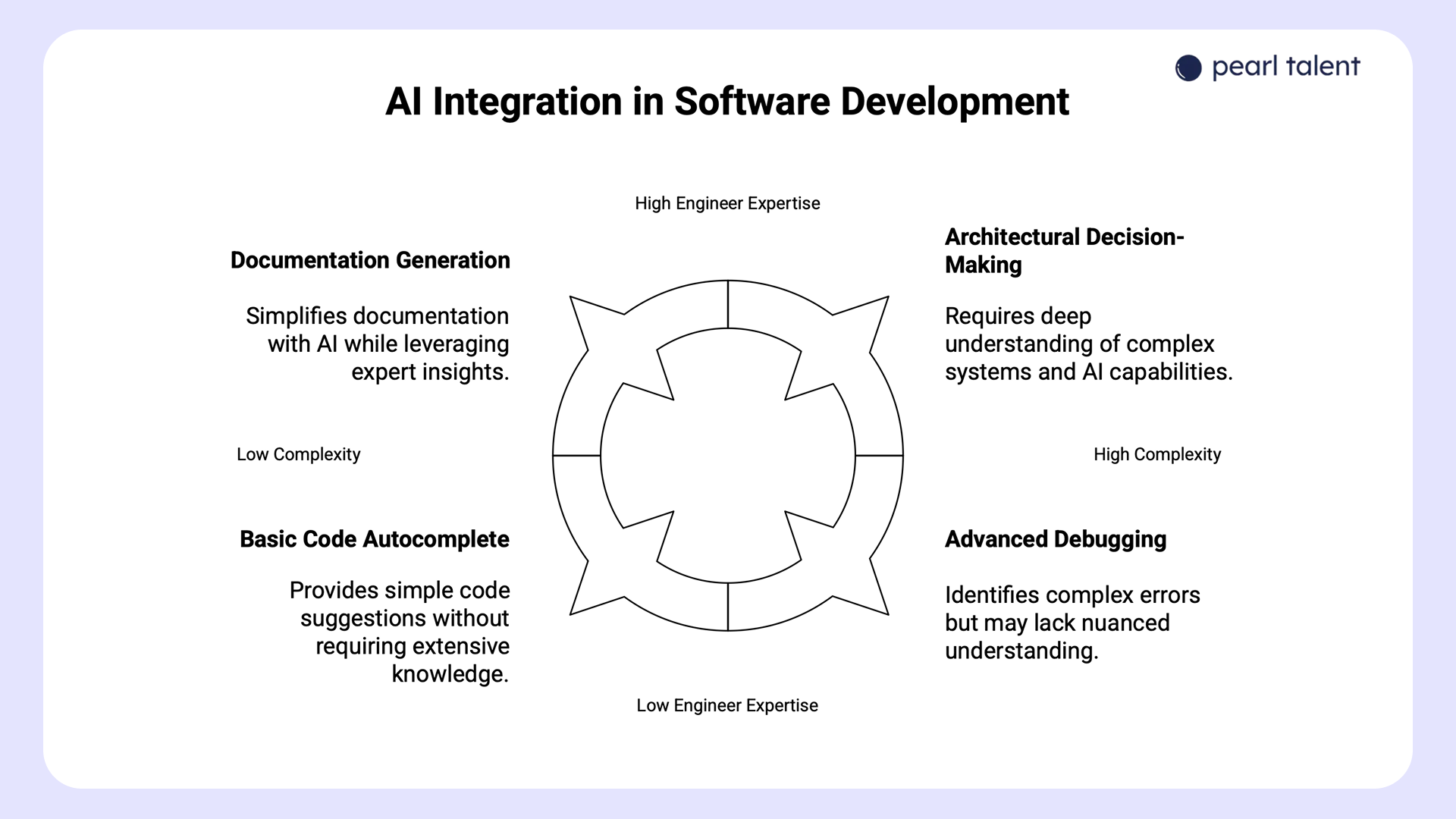
Code Writing - Senior engineers use these tools to eliminate repetitive work and focus on architecture decisions. Junior engineers use them to learn patterns. But without learning the proper fundamentals, they may copy without understanding.
Debugging - These tools review changes in context, instead of acting like a spellcheck for developers. They flag hidden logic errors, security risks, and performance issues, and explain why a fix matters.
Refactoring - These tools understand repository structure, maintain consistent patterns across codebases, and handle dependency updates that ripple through dozens of files.
Documentation - Other tools can generate documentation from code, maintaining sync between implementation and explanation. And again, AI can describe what code does, but only experienced engineers can explain why architectural decisions matter.
GitHub Copilot - The category leader, deeply integrated into VS Code, JetBrains, Neovim, and Xcode. Copilot provides in-editor completions, chat-based assistance, PR summaries, and code review help across dozens of languages. It's the default choice for most development teams and the baseline against which other tools are measured.
Codeium - The popular free alternative with strong autocomplete, refactoring, and chat capabilities. Often recommended alongside Copilot as a low-friction starting point for developers evaluating AI coding tools. Particularly strong for teams wanting to experiment before committing their budget.
Cursor - A fork of VS Code built specifically around AI workflows. Excels at understanding large, complex projects—particularly C++, Java, and enterprise codebases. Handles multi-file changes with repository-level context that simpler tools miss. Power users on complex codebases consistently cite Cursor as their preferred environment.
Windsurf - AI-first editor with strong context handling and "agentic" coding flows praised by early adopters. More resource- and token-intensive than alternatives, but delivers superior results for developers working on architecture-heavy changes across sprawling repositories.
Tabnine - Mature AI autocomplete with wide language support and stylistic adaptation to your codebase. Often used as a focused completion engine with straightforward IDE integrations.
Amazon Q Developer - Best fit if your infrastructure lives in AWS. Integrates into IDEs and the AWS console to answer AWS-specific questions and scaffold infrastructure or application code.
Snyk - Security-focused code analysis that identifies vulnerabilities in dependencies, container images, and infrastructure-as-code. Goes beyond basic scanning to provide context about exploit likelihood and suggested fixes.
DeepAI - AI-powered code review that learns from millions of open-source repositories. Flags patterns associated with bugs, performance issues, and maintainability problems before they reach production.
CodiumAI - Generates meaningful test cases based on code behavior, helping catch edge cases that manual testing misses. Particularly valuable for refactoring legacy code where test coverage is sparse.
Testomat.io - AI-powered test management that generates test cases, self-heals UI tests as interfaces change, and integrates with CI/CD pipelines and issue trackers like Jira and GitHub. Reduces maintenance burden for automated test suites.
Testsigma - Agentic automation platform that generates test cases, executes them, and creates bug reports. Well-suited for agile teams wanting end-to-end AI support without building custom frameworks.
Testim - AI-driven functional testing for web applications, using machine learning to create stable, self-healing tests that adapt to UI changes.
Diffblue - Automatically generates unit tests for Java code, covering edge cases and maintaining test coverage as codebases evolve.
Mabl - Low-code test automation with AI-powered auto-healing and intelligent test creation for web applications.
Mintlify - Generates documentation from code, maintaining sync between implementation and explanation as codebases evolve.
Swimm - Creates living documentation that updates automatically with code changes, helping new engineers understand complex systems.
ChatGPT-Powered Docs - Custom GPT models trained on internal codebases to answer developer questions about architecture, patterns, and implementation details.
The best teams use AI tools to raise the bar:
Junior engineers spend less time memorizing syntax and more time understanding system design, while senior engineers focus on complex architectural decisions and judgment calls. Code ships faster, but human expertise still determines whether it’s secure, scalable, and maintainable.
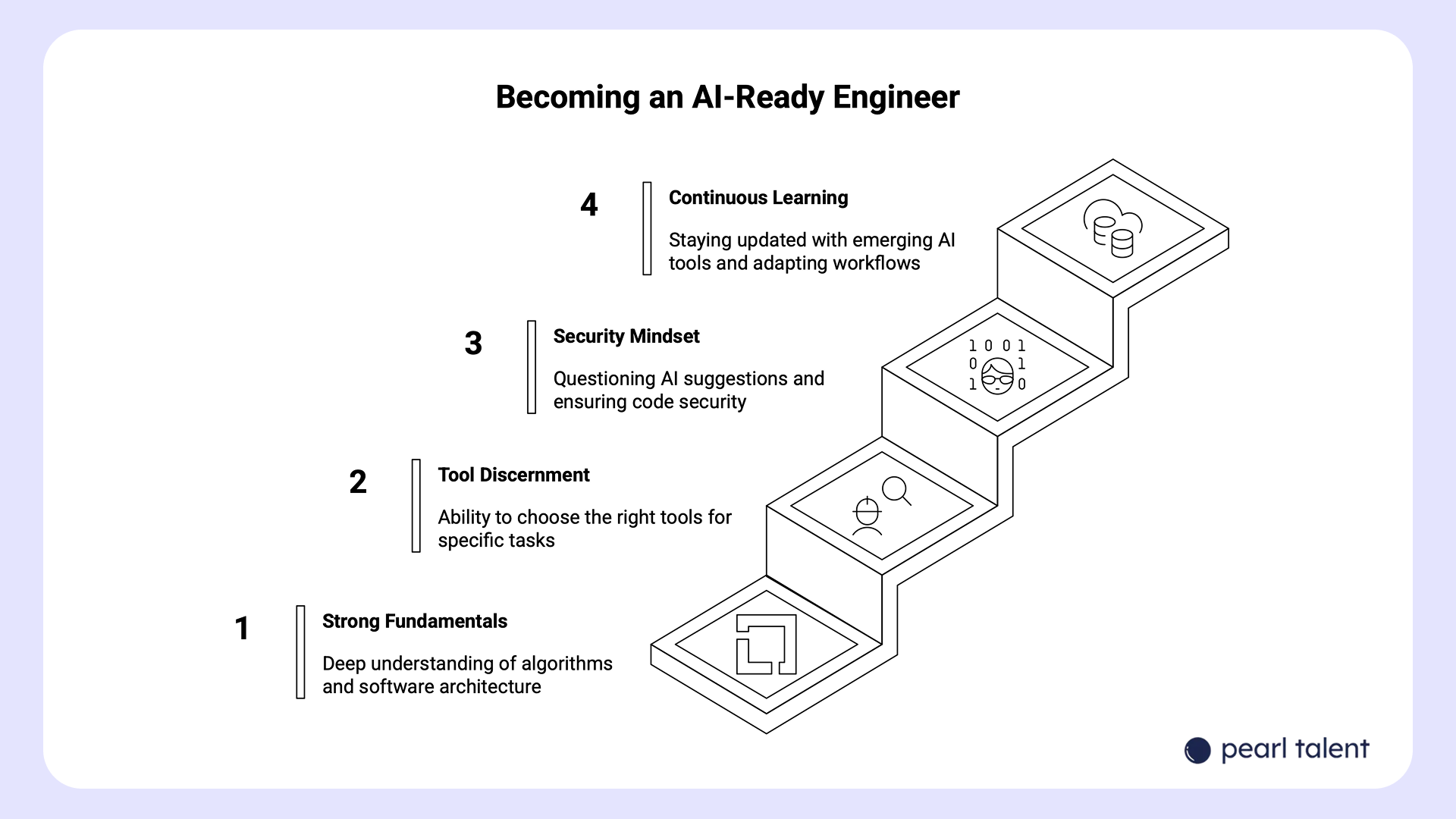
But not all engineers are equipped to handle AI coding tools effectively. The best AI-ready engineers share specific traits that separate strategic tool users from indiscriminate copy-pasters.
Pearl specifically sources the top 1% of software engineers and AI engineers who demonstrate these traits. Our vetting process tests both technical fundamentals and AI tool proficiency. You get engineers who accelerate with AI rather than accumulate debt.
Most companies face a “this or that” dilemma:
Hire engineers who know AI tools but lack fundamentals, or hire experienced engineers who are skeptical of AI and slow to adapt.
Pearl Talent eliminates this trade-off entirely.
Our engineers have the technical depth to evaluate AI output critically and the continuous training to wield ever-evolving tools effectively. When you hire through Pearl, you get someone who's been trained specifically for this new paradigm. No need to gamble or invest in false hope.
Here's what separates Pearl from traditional IT staffing agencies: we don't just match you with elite talent. We also continuously train our top 1% talent pool to stay ahead of rapidly evolving AI capabilities.
Traditional IT staffing firms focus on filling roles. Pearl focuses on building engineering teams that will remain effective as AI reshapes software development.
We know AI coding tools are powerful. And we also know they don’t replace engineering judgment.
Teams succeed when experienced engineers know how to evaluate AI-generated code, make sound architectural decisions, and use new tools without accumulating technical debt.
Pearl engineers are rigorously vetted for strong fundamentals, embedded directly into your team, and continuously trained through Pearl’s AI School.
They work in your time zone, use your tools, and report to your engineering leads — with no account managers, handoffs, or vendor friction. You receive elite global talent at up to 60% lower cost, onboarded in under two weeks.
You don’t have to choose between AI tools and human engineers. You can and should have both.
If you’re evaluating AI-enabled engineering talent, explore Pearl’s vetted software engineers and see how embedded, AI-ready talent can accelerate your roadmap without sacrificing quality.

.svg)