Catena is now Pearl Talent! Same mission, new name.
Most companies don't design an outsourcing strategy. They reactively outsource when something isn’t working.
Your inbox is chaos, and you're three weeks behind on hiring. You post on Upwork, hire someone cheap, cross your fingers, and hope it works out. Using this strategy may work for a while.
However, a long-term scaling strategy requires a long-term outsourcing strategy. Because, more growth creates complexity, and complexity is the silent killer of growth.
A scalable outsourcing strategy anticipates growth instead of scrambling to keep up. It reduces decision fatigue, maintains quality as volume increases, and creates systems that compound value over time. An unbreakable, yet flexible outsourcing strategy will grow with you as your business scales.
In this article, you'll learn:
Hiring more people doesn’t mean you’re scaling your business. Most of the time, it means you’re compounding complexity.
Meaning: You hired 10 people, but still can’t seem to streamline your workflows. Or, you hired an assortment of offshore freelancers who don’t seem to understand your business as well as they should.
If you actually want to scale, you need to maintain quality as volume increases and find ways to reduce friction. No more “one-off” solutions for large complex issues.
The last thing you want as a founder is to create more work for yourself. That’s why it’s a shame that most outsourcing strategies add to your plate.
Your outsourcing strategy should look like this:
If your outsourcing strategy requires you to work harder as you grow, it's not scalable. It's just expensive.
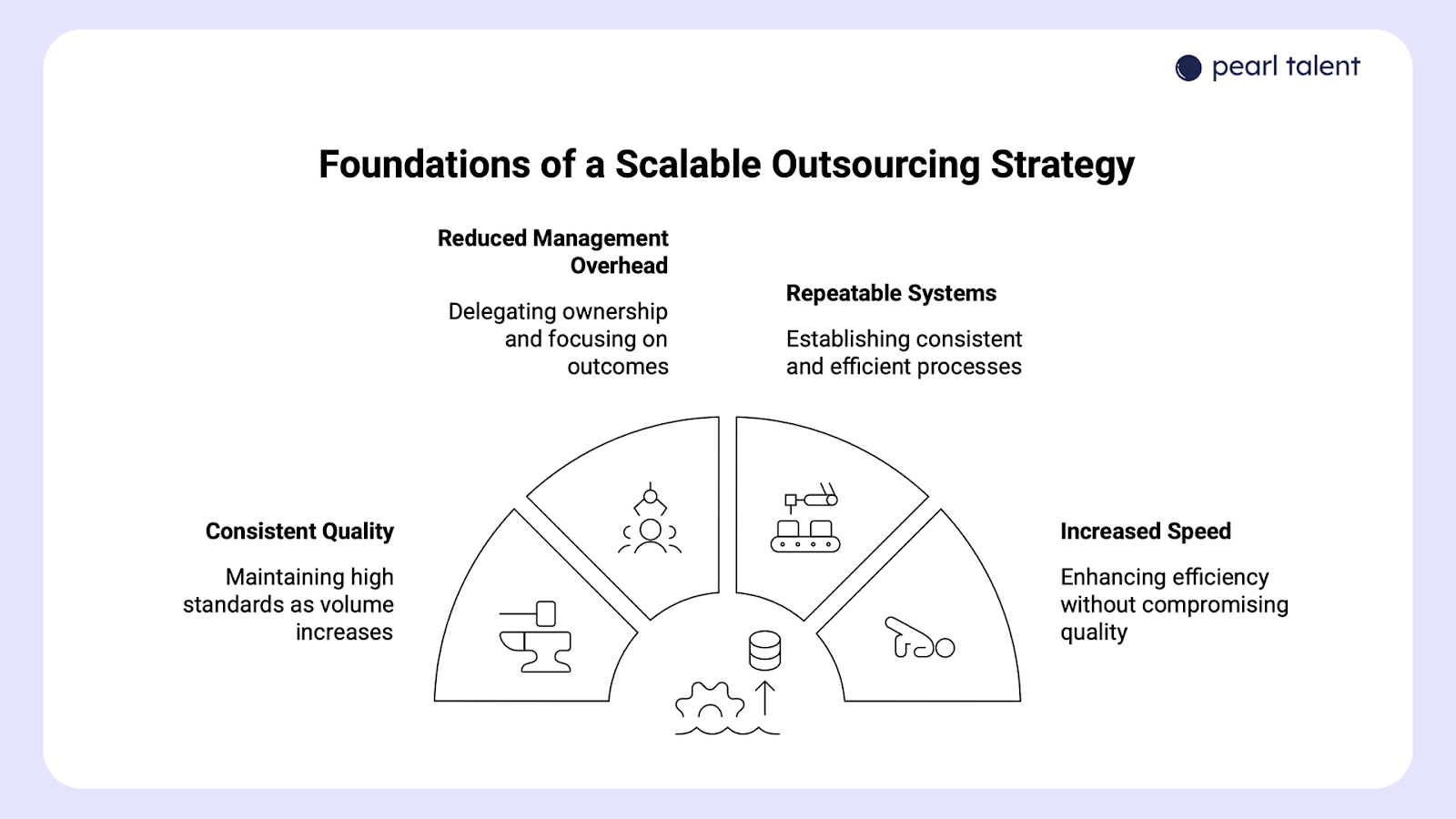
At the early stage, your outsourcing strategy has one primary goal: move fast without burning out.
You're doing everything yourself. Customer support, scheduling, inbox management, basic operations, and documentation. The work isn't complex, but it's endless. Every hour spent on administrative tasks is an hour not spent on product development, sales, or fundraising efforts.
At this stage, keeping burnout low will pay off.
Common early-stage outsourcing moves that work:
Risks if done poorly:
Hiring purely on cost creates more problems than it solves. The cheapest freelancer requires the most oversight. You spend more time explaining tasks than it would've taken to do them yourself.
At this stage, your outsourcing strategy should be simple: find reliable talent that reduces your workload without creating new management overhead.
Growth changes everything about how outsourcing works. You have more customers, more internal communication, and more systems.
Which means there are more opportunities for systems and flows to break. The scrappy, "figure it out" approach that got you here won't work as effectively.
This is where most companies break their outsourcing strategy. They hire faster than they document. They add capacity without adding structure. And six months later, they're managing pure chaos.
That’s why your outsourcing focus should shift from speed to consistency.
What changes at the growth stage:
Common mistakes companies make:
A simple mindset shift can help fix this:
An owner-activist mindset increases the odds of sustained results. It focuses on quickly lifting the business on all fronts: customer advocacy, core revenue growth, and efficiency.
At this stage, your outsourcing strategy must emphasize process clarity, not just capacity. The goal should be better systems that make each person more effective.
At scale, outsourcing is no longer "extra help,” it’s leverage.
What scalable outsourcing looks like:
At this stage, cheap talent breaks your scaling strategy. Quality compounds. Every exceptional hire makes the next hire more effective. Your systems improve, standards rise, and momentum builds.
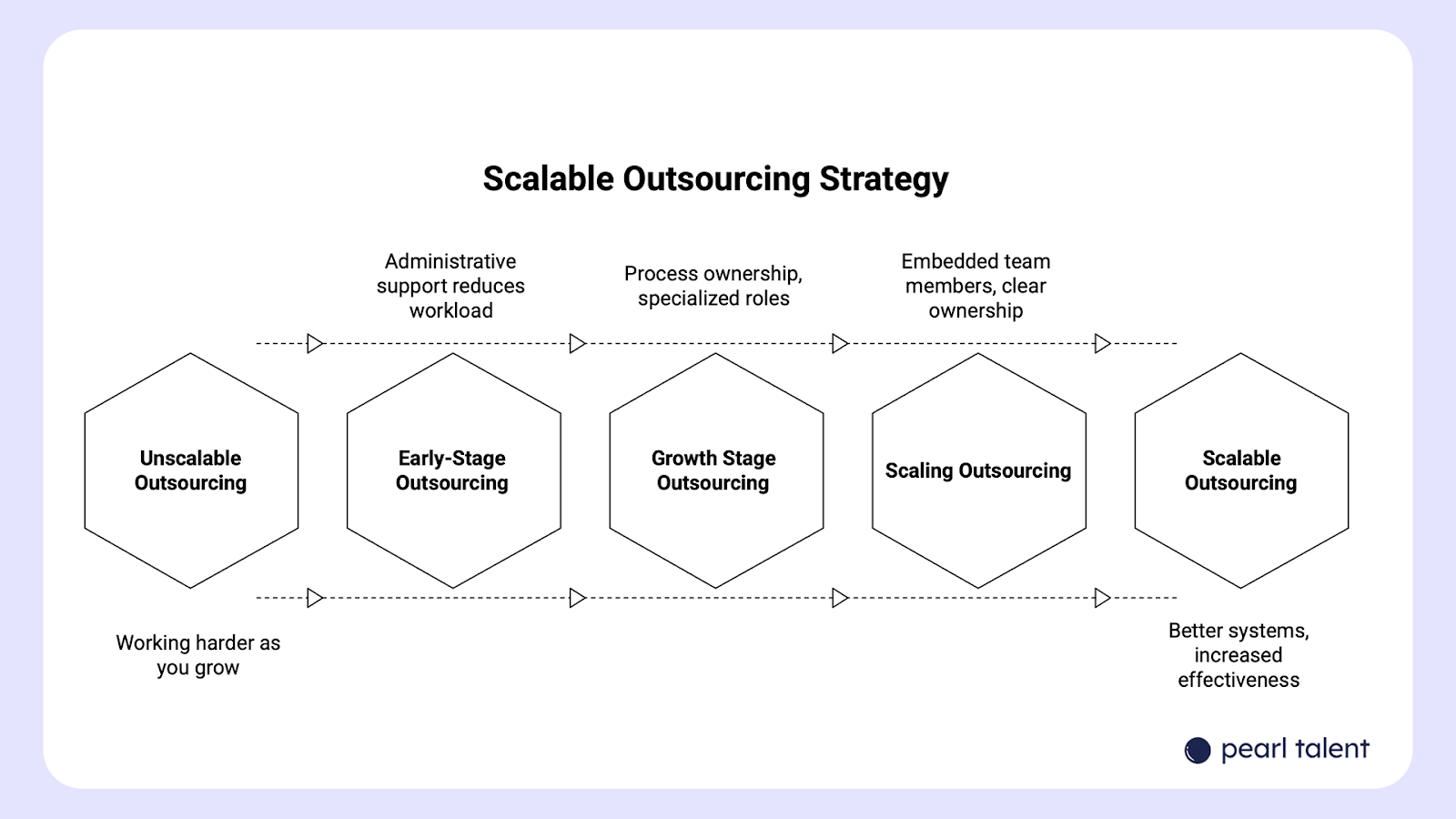
A scalable outsourcing strategy rests on four pillars. Miss any of them, and your strategy breaks under growth pressure.
1. Roles Clearly Defined
Define what success looks like, not just what to do. Include metrics, quality standards, and decision authority. This creates zero confusion upfront and prevents hiring the wrong person.
2. Process Documentation
Have standard operating procedures that capture institutional knowledge. How we handle escalations. How we prioritize feature requests. How we communicate with customers.
3. Integration
Have outsourced team members treated as part of the company, not vendors. They're in team meetings, company announcements, and strategic discussions.
Give them access to tools, systems, and context. They use the same project management tools, CRM, and communication channels as everyone else.
4. Talent Quality
High-quality talent compounds value over time. They identify improvements, solve problems proactively, and raise the bar for everyone around them. Your outsourcing strategy should optimize for quality, not cost. The cheapest hire is rarely the best investment.
Most outsourcing strategies fail predictably. The same mistakes, different companies.
The companies that break their outsourcing strategies share a pattern: they overcomplicate it early, then spend years cleaning up the mess.
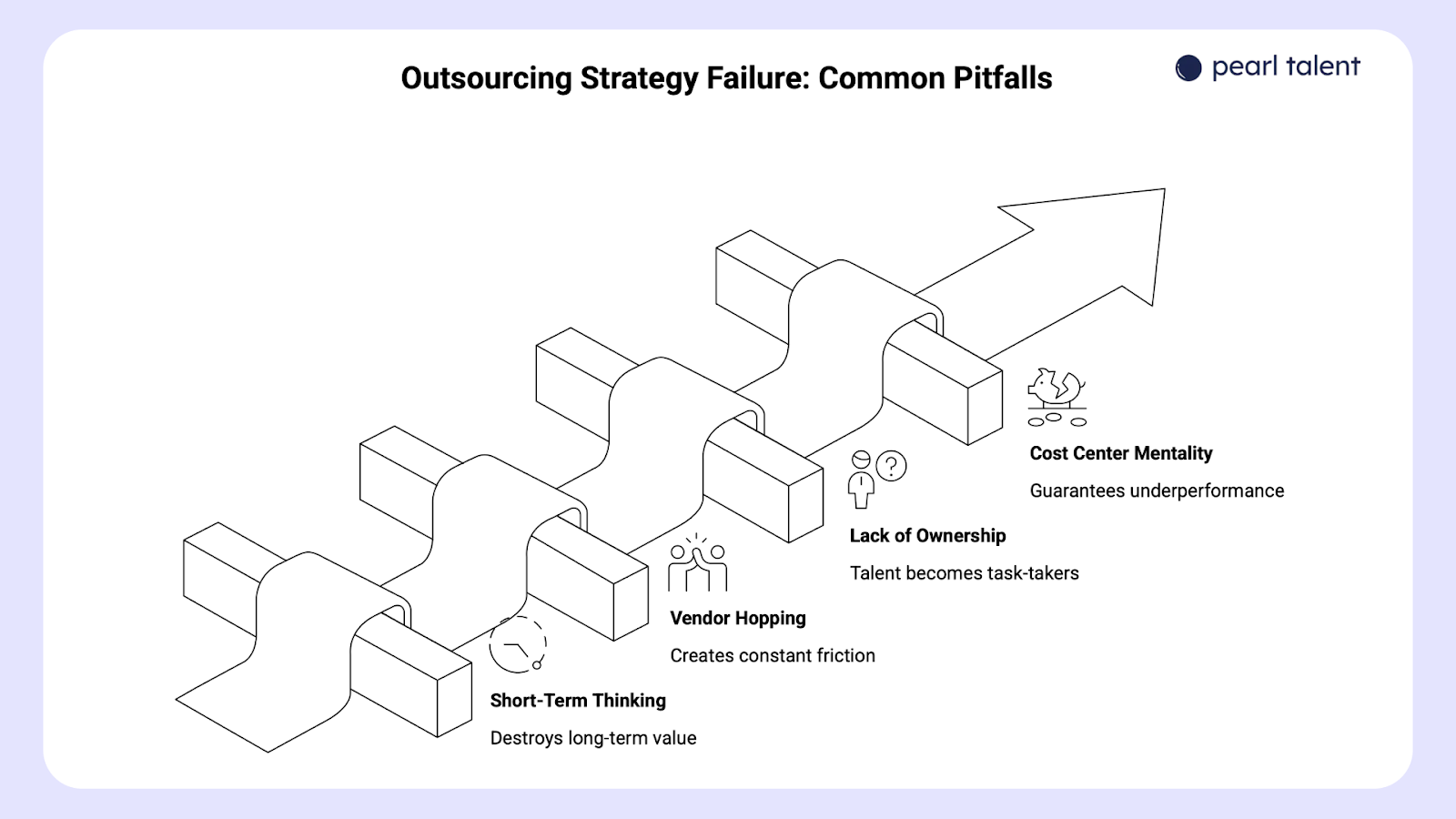
Your outsourcing strategy also needs regular evaluation.
Ask yourself these questions:
Outsourcing isn't “one and done.”
It's an evolving strategy that changes as your company scales. That’s why Pearl Talent isn't a staffing marketplace or a traditional outsourcing vendor. We're a talent partner built for companies that want outsourcing to scale with them.
We handle compliance, payroll, and onboarding logistics so you're not navigating international employment law. Your team member starts in under two weeks, fully integrated and ready to contribute.
Pearl supports scalable outsourcing by removing the friction that breaks most strategies: quality uncertainty, integration complexity, and operational overhead.
Ready to build a scalable outsourcing strategy? Explore how Pearl Talent supports long-term growth with pre-vetted, embedded talent that scales with your business.

.svg)