Hiring across borders isn’t just about saving money anymore. And if I'm honest, that’s actually the easy part. The harder part, the part founders actually lose sleep over, is figuring out how to build teams that feel like one team. You don’t want a group of strangers scattered across the globe; you want people who understand your pace, your culture, and your goals. If you don't have that, then it just doesn't make sense.
That’s why the nearshoring vs offshoring debate matters. Both unlock talent, but they’re not interchangeable. Think of it like picking a co‑founder: one brings scale and savings, the other brings alignment and speed. Which one you choose depends on what you value most.
Now, here’s the kicker: sometimes the “cheaper” option ends up costing you more in headaches, so you really need to be intentional when choosing.
What Is Nearshoring?
Let's start from scratch: Nearshoring is outsourcing to a nearby country (close enough that you share time zones, cultural rhythms, even holidays). For U.S. companies, this often means Latin America; for European firms, it is Eastern Europe; for Asian Companies, the Philippines is one of the sweetest spots.
The appeal? You get the benefits of outsourcing without the headaches of extreme distance. Instead of battling 12‑hour time differences, you’re working with teams who can hop on a Zoom call at the same time you do. It’s like outsourcing with a shorter commute.
Why is Nearshoring a good option?
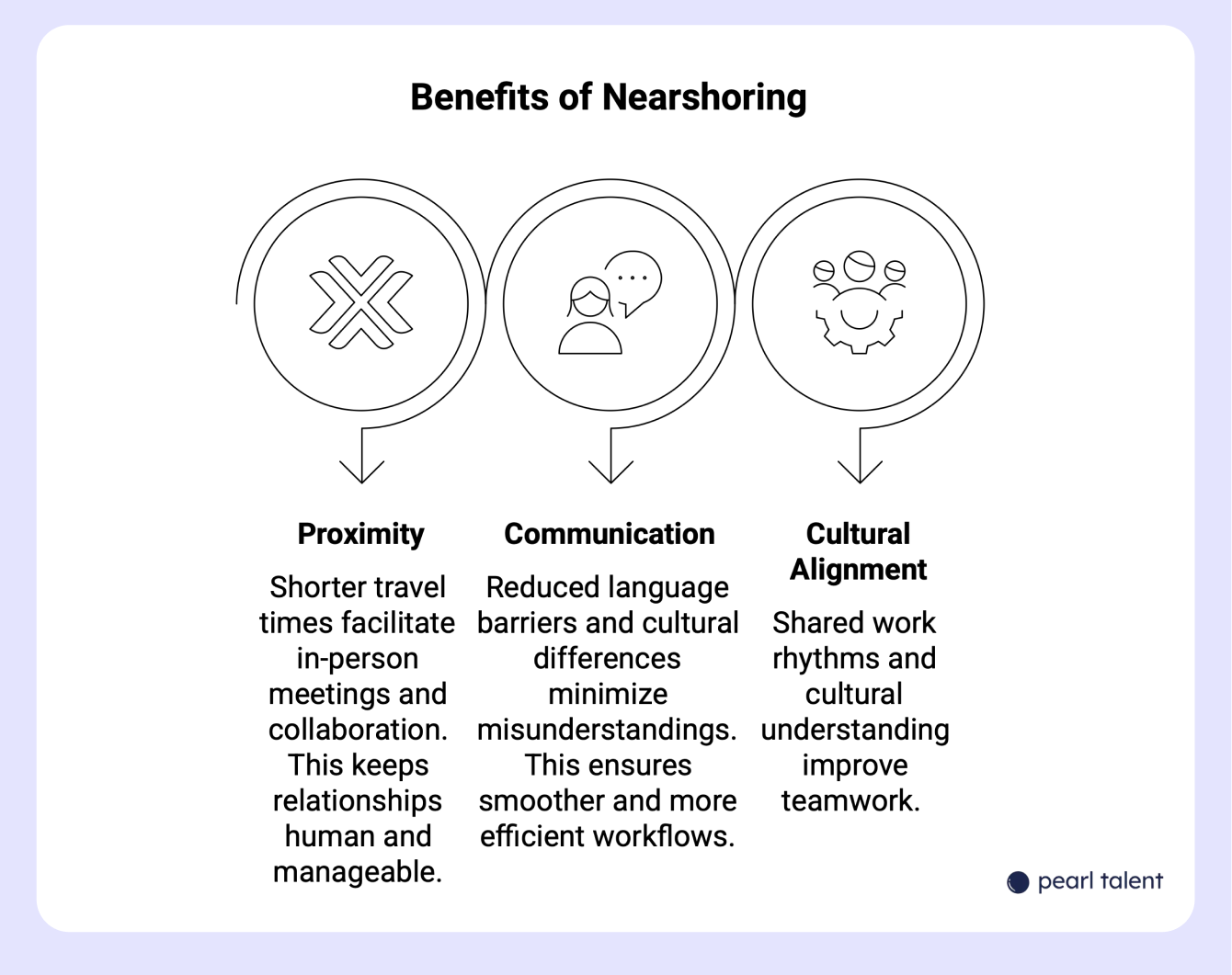
Proximity: Imagine needing to meet your team in person. A three‑hour flight to Mexico City feels doable; a 26‑hour trek to Manila? Not so much. Proximity makes collaboration easier and keeps relationships human. You can actually plan quarterly meetups without blowing the travel budget.
Communication: Slack threads don’t get lost in translation. Many professionals in Latin America are fluent in English and tuned into U.S. business culture, same with Asian companies and nearby countries. That means fewer “wait, what did they mean by that?” moments.
Cultural Alignment: Shared work rhythms mean fewer awkward pauses. Your developer in Poland gets the urgency of a European product launch without you spelling it out. Your EA in Bogotá understands the pace of a U.S. startup founder. These little cultural overlaps make teamwork smoother than you’d expect.
Challenges of Nearshoring
Talent Pool Size: Nearshoring markets are growing, but they don’t yet match the sheer scale of offshore hubs like India or the Philippines. If you’re hiring for niche roles, say, a machine learning engineer with five years of fintech experience... well, options may be thinner.
Regulatory Nuances: Every country has its own labor laws, tax structures, and compliance quirks. Proximity helps with collaboration, but it doesn’t erase the need to navigate local rules. Founders often lean on partners who know the terrain, because the last thing you want is to get tripped up by a compliance issue you didn’t see coming.
What Is Offshoring?
Ok, we get nearshoring now. What about offshoring? Offshoring is outsourcing work to distant countries, often across continents. Think U.S. companies hiring in India or the Philippines, or European firms tapping into talent in Asia. The model has been around for decades, and it’s built on scale and cost efficiency. If nearshoring is about closeness and collaboration, offshoring is about reach, stretching your business across the globe to tap into massive talent pools and lower costs.
For many enterprises, offshoring was the original playbook for globalization. It’s why you can call customer support at midnight and still get someone on the line, or why tech giants can run development cycles around the clock. But while the benefits are real, the distance introduces challenges that founders need to weigh very carefully.
Why is Offshoring a good option?
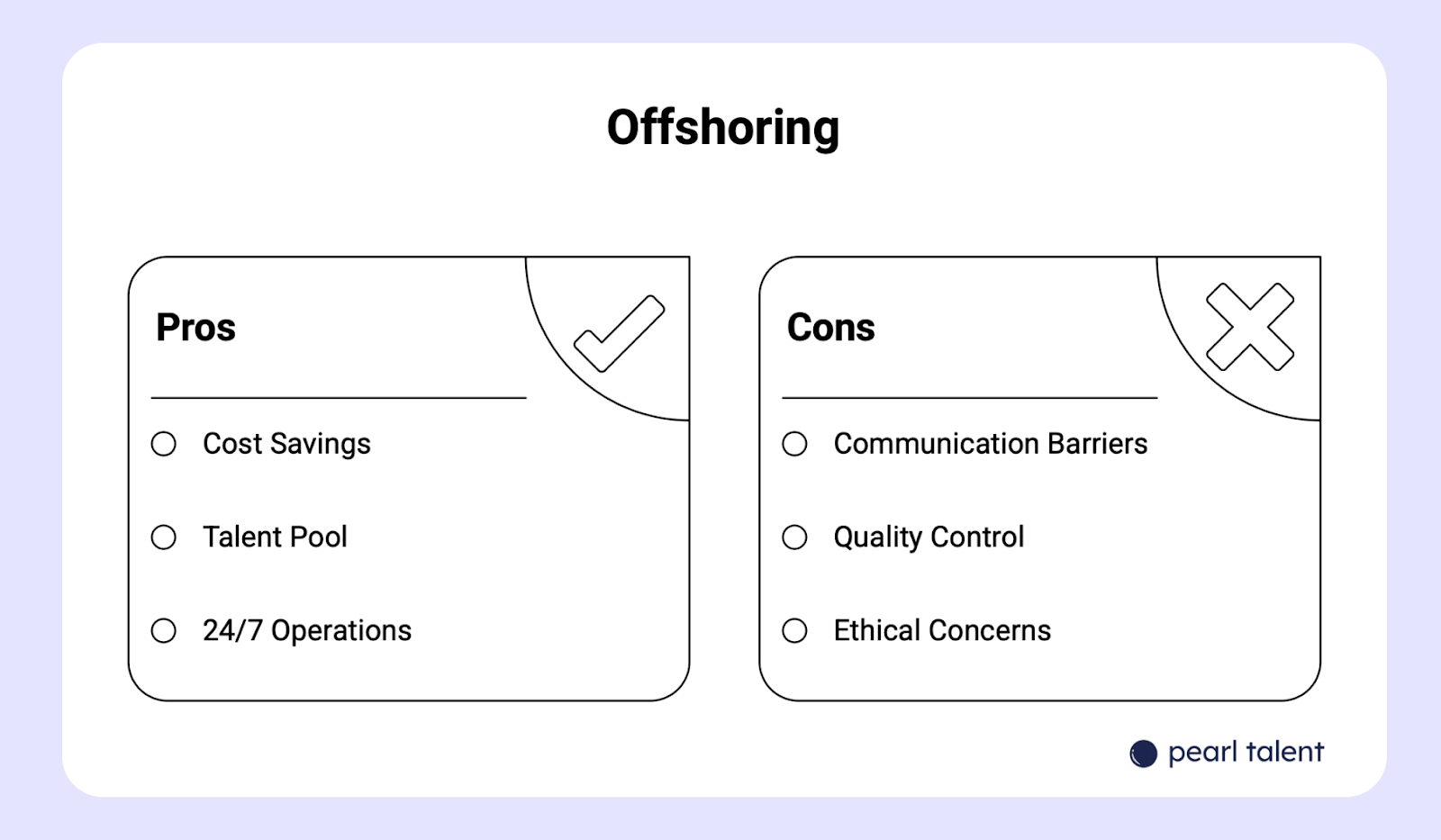
Cost Savings: Offshore markets often have significantly lower wages compared to the U.S. or Western Europe. For companies under pressure to scale fast without ballooning payroll, offshoring can feel like a financial lifesaver.
Large Talent Pools: Offshore hubs like India and the Philippines aren’t just about cost; they’re about scale. We’re talking millions of skilled professionals across industries: developers, accountants, customer support reps, you name it. If you need volume, offshoring delivers.
24/7 Operations: Time zone differences can actually become an advantage. While your team in New York is asleep, your offshore team in Bangalore is pushing code, answering tickets, or processing data. It’s like having a business that never shuts down.
Challenges of Offshoring
Communication Barriers: Here’s the catch: distance often means language differences, cultural gaps, and time zone headaches. If you’ve ever tried scheduling a call across 12 time zones, you know the pain. Miscommunication can slow projects and frustrate teams.
Quality Control: Managing work across continents isn’t easy, of course. Oversight becomes harder when you can’t just walk down the hall to check in. Processes need to be airtight, or you risk inconsistency in deliverables.
Data Security: Compliance and privacy risks increase when operations span continents. Different countries have different regulations, and sensitive data crossing borders can raise red flags. Founders need to think about not just cost savings, but also risk management.
Which Is Better: Nearshoring or Offshoring?
Here’s the truth: there’s no one‑size‑fits‑all answer. Choosing between nearshoring and offshoring is less about “better” in the abstract and more about better for you. It’s like asking whether a startup should raise venture capital or bootstrap— the right move depends on your priorities, your stage, and your appetite for trade‑offs.
Key Differences
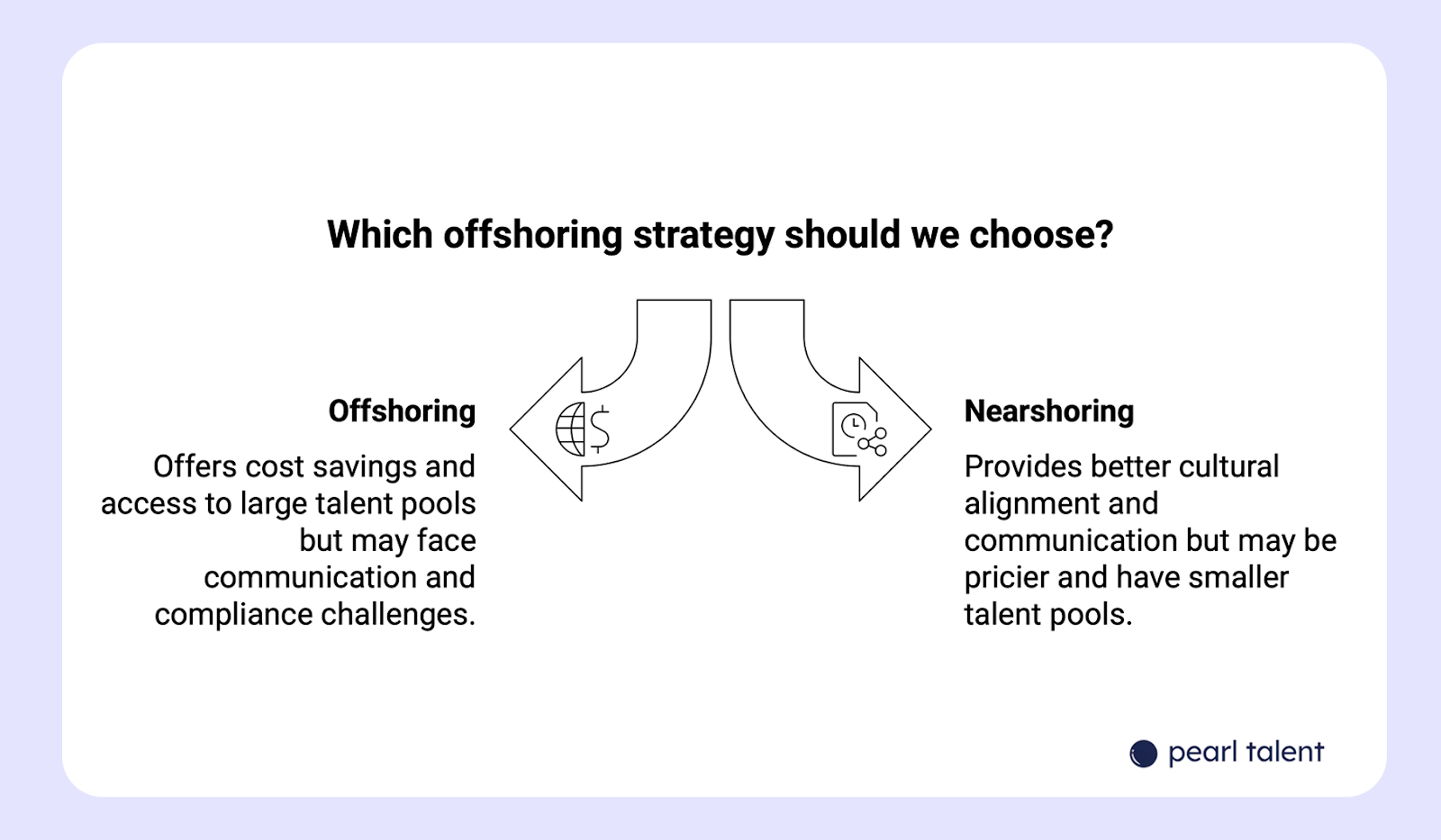
Nearshoring is all about collaboration and cultural fit. You’re working with teams who share your time zones, understand your business rhythms, and can jump on a call without anyone sacrificing sleep. It’s outsourcing that feels closer to home.
Offshoring, on the other hand, is built for scale and cost efficiency. You tap into massive talent pools across Asia or other distant regions, often at a fraction of the cost. It’s the model that gave rise to 24/7 customer support and global development cycles.
Think of it this way: nearshoring is like hiring a neighbor who gets your vibe; offshoring is like hiring a global powerhouse that can deliver sheer volume.
Factors to Consider
Founders HAVE TO weigh four big levers:
Cost: Offshoring usually wins on raw savings. But beware hidden costs: compliance, FX spreads, or the time lost to miscommunication. Nearshoring may look pricier on paper, but smoother collaboration can save money in the long run.
Talent: Offshore hubs offer enormous talent pools. Nearshore regions are smaller but often deliver candidates with stronger cultural alignment and communication skills, which can be a huge win.
Communication: Try scheduling a call across 12 time zones; you guessed it... It's painful! Nearshoring minimizes that friction. Offshoring requires more process discipline to keep everyone aligned.
Scalability: Enterprises chasing thousands of hires lean offshore. Startups scaling lean teams often prefer nearshore, where agility matters more than sheer numbers.
Industry Context Matters More Than You Think
Tech: Collaboration and time zones are critical. Developers need to sync in real time, which makes nearshoring a strong fit.
Manufacturing: Supply chain scale often favors offshoring. Large factories and production hubs thrive in offshore markets.
Customer Support: Cost efficiency and 24/7 coverage lean offshore. Offshore hubs are built to handle massive support operations around the clock.
Here’s the kicker: many companies end up blending both. Nearshore for collaboration, offshore for scale. Not a binary choice, really, it’s a strategy mix.
Nearshoring vs Offshoring Costs
When founders talk about outsourcing, the first question is almost always: “Okay, but how much does it cost?” And fair enough, budgets matter, we know that. But here’s the thing: the headline numbers don’t tell the whole story. Costs in nearshoring and offshoring aren’t just about hourly rates; they’re shaped by models, geography, skill levels, and sometimes those sneaky hidden fees that creep up when you least expect them.
Pricing Models
Agencies and providers structure pricing in different ways, and each model has its own trade‑offs:
Per‑hour: The classic model. You pay for the hours worked, which feels flexible but can get messy if projects drag on. Great for short‑term tasks, less ideal for ongoing roles.
Per‑project: A fixed fee for a defined scope. Predictable, but only if the scope is airtight. (Founders know how often “quick projects” balloon into something bigger.)
Per‑employee/monthly: You essentially “rent” a full‑time employee through the agency. This is common in nearshoring setups where you want someone embedded in your team but still technically on the agency’s payroll.
The model you choose should match your growth stage. Early‑stage startups often prefer project‑based pricing to keep things contained, while scaling companies lean toward monthly per‑employee costs for stability.
What Drives Cost Differences?
Not all outsourcing dollars are created equal. Costs swing based on:
Location: Hiring a developer in Mexico City isn’t the same as hiring one in Bangalore. Wages, living costs, and market demand all play a role.
Skill Level: Junior talent is cheaper, but senior specialists command higher rates no matter where they’re based. If you need niche expertise, say, a machine learning engineer, expect to pay more, whether nearshore or offshore.
Benefits & Compliance: Some agencies bundle benefits, healthcare, or compliance support into their pricing. Others leave it to you. That difference can add up fast.
Think of it like buying a car: the sticker price matters, but so do the extras: insurance, maintenance, fuel. Outsourcing is no different.
Hidden Costs to Watch
Here’s where founders often get blindsided. The “cheap” option can suddenly feel expensive when hidden costs creep in:
FX spreads: Currency fluctuations can eat into savings. One month, your offshore team feels like a bargain, the next month exchange rates shift and payroll jumps.
Compliance fees: Different countries have different labor laws, tax obligations, and reporting requirements. Miss a detail, and you’re paying penalties or scrambling to fix paperwork.
Turnover: This one hurts. If your offshore team churns, you’re back to square one: recruiting, onboarding, training. Nearshoring often has lower turnover because of cultural alignment, but it’s not immune.
Founders should treat outsourcing costs like iceberg math: the visible part (hourly rates) is just the tip. The real weight is hidden beneath the surface.
Final Thoughts
There’s no universal “winner” here, it’s about what fits your company. Nearshoring gives you closeness, smoother communication, and cultural alignment. Offshoring delivers scale, savings, and round‑the‑clock operations.
Startups often lean nearshore for agility and collaboration, while enterprises use offshore hubs for volume and specialized talent. Many smart teams mix both: nearshore for the work that needs tight collaboration, offshore for the heavy lifting.
The real takeaway? Don’t just chase the cheapest option; chase the model that makes your leadership’s life easier and your growth more sustainable. At Pearl Talent, we design outsourcing strategies built for founders: combining deep nearshoring and offshoring expertise with rigorously vetted talent. We prioritize strong communication skills, cultural alignment, and U.S. time zone coverage, ensuring teams integrate seamlessly with your operations and are ready to scale as your business grows.
Isaac is a leader in the staffing and remote talent space, originally from Venezuela and now based in the US. With 7 years of experience launching and scaling multiple ventures, he has hired and led 20+ person teams globally, covering sales development, customer service, marketing, and operations. Passionate about global talent, Isaac helps founders see how hiring abroad can fuel sustainable growth without compromising quality. He offers a wealth of knowledge on delegation frameworks, team performance, and sustainable business scaling.
Since my hire started, my workflow rhythm has become five times more efficient. I'm genuinely excited about the growth of our partnership
Director, Science Startup Company
Working with Pearl Talent has been a fantastic experience! They helped us hire a candidate who's not just very intelligent but also kind and professional.
Co-Founder and CEO, Kiwi Biosciences
Pearl Talent truly took charge of the entire process and with their personalized approach, they found individuals specifically tailored to my requirements.
Founder, ASRA
Pearl Talent helped us quickly fill an executive assistant role. She onboarded quickly and since then, has taken over running the logistics of my and other C-suite executives' lives at our company.
VP of Sales & Marketing, Arcus Power Corp.
We've really enjoyed working with you and were very satisfied with the quality of applicants you proposed.
Investor, Lorentz Bio
I appreciate the patience and flexibility that Pearl Talent displays throughout their selection process.
Head of Talent Strategy and Culture, Next Step Talent
Our Pearl Talent-sourced EA+ has been a force-multiplier to our team, enabling us to shore up our back-end and day-to-day operations to focus on growth.
Investor, Climate Capital
Our hire was able to pick things up quickly and has become accustomed to our company’s needs in such a short period of time.
HR and Recruiting, IF Labs
Pearl Talent takes care of all the work you would normally invest in screening and hiring an assistant. They make the process easy, and provide support step by step along the way.
Partner, Darnel Fabrics
My assistant is doing great - she's independent, a quick learner, and positively impacting some of our big projects.
Co-Founder, CEAD Group
Pearl Talent has been brilliant. I was unsure about what would happen but they spent a lot of time discussing my issues. They sent me two candidates for interview, both had been well screened and they have videos of themselves talking about what they have done.
Founder, CEO
I wish I found you guys years ago, because they [Pearl Talent] are way better than the sourcing I've been able to do on my own accord.
Founder, Pearl Technologies
With Pearl Talent, they started out by really understanding our needs with a thorough but also fast intake process.
CEO, Medra AI
I cannot recommend Pearl Talent’s services enough. The quality of candidates they were able to provide us with was unmatched.
Co-Founder, Ambience Healthcare
Our Ops Associate has added immense value from day one, leaving us wishing we had hired her sooner!
Head of Lab Operations, Vital
Just interviewed a candidate and WOW you guys source fantastic people!
Co-Founder and CEO, Fella Health
Pearl Talent gave us an impressive pool of candidates, which made our decision-making process pleasantly challenging.
Co-Founder, ATC Research
The hiring process with Pearl Talent has been straightforward and seamless. Their attentive approach to understanding our specific needs and preferences truly stood out.
Head of Care Operations, AB Healthcare
The hiring process with Pearl Talent has been straightforward and seamless. Their attentive approach to understanding our specific needs and preferences truly stood out.
Head of Care Operations, AB Healthcare
Pearl Talent gave us an impressive pool of candidates, which made our decision-making process pleasantly challenging.
Co-Founder, ATC Research
Just interviewed a candidate and WOW you guys source fantastic people!
Co-Founder and CEO, Fella Health
Our Ops Associate has added immense value from day one, leaving us wishing we had hired her sooner!
Head of Lab Operations, Vital
I cannot recommend Pearl Talent’s services enough. The quality of candidates they were able to provide us with was unmatched.
Co-Founder, Ambience Healthcare
With Pearl Talent, they started out by really understanding our needs with a thorough but also fast intake process.
CEO, Medra AI
I wish I found you guys years ago, because they [Pearl Talent] are way better than the sourcing I've been able to do on my own accord.
Founder, Pearl Technologies
Pearl Talent has been brilliant. I was unsure about what would happen but they spent a lot of time discussing my issues. They sent me two candidates for interview, both had been well screened and they have videos of themselves talking about what they have done.
Founder, CEO
My assistant is doing great - she's independent, a quick learner, and positively impacting some of our big projects.
Co-Founder, CEAD Group
Pearl Talent takes care of all the work you would normally invest in screening and hiring an assistant. They make the process easy, and provide support step by step along the way.
Partner, Darnel Fabrics
Our hire was able to pick things up quickly and has become accustomed to our company’s needs in such a short period of time.
HR and Recruiting, IF Labs
Our Pearl Talent-sourced EA+ has been a force-multiplier to our team, enabling us to shore up our back-end and day-to-day operations to focus on growth.
Investor, Climate Capital
I appreciate the patience and flexibility that Pearl Talent displays throughout their selection process.
Head of Talent Strategy and Culture, Next Step Talent
We've really enjoyed working with you and were very satisfied with the quality of applicants you proposed.
Investor, Lorentz Bio
Pearl Talent helped us quickly fill an executive assistant role. She onboarded quickly and since then, has taken over running the logistics of my and other C-suite executives' lives at our company.
VP of Sales & Marketing, Arcus Power Corp.
Pearl Talent truly took charge of the entire process and with their personalized approach, they found individuals specifically tailored to my requirements.
Founder, ASRA
Working with Pearl Talent has been a fantastic experience! They helped us hire a candidate who's not just very intelligent but also kind and professional.
Co-Founder and CEO, Kiwi Biosciences
Since my hire started, my workflow rhythm has become five times more efficient. I'm genuinely excited about the growth of our partnership
Director, Science Startup Company
Pearl Talent has been brilliant. I was unsure about what would happen but they spent a lot of time discussing my issues. They sent me two candidates for interview, both had been well screened and they have videos of themselves talking about what they have done.
Founder, CEO
We've really enjoyed working with you and were very satisfied with the quality of applicants you proposed.
Investor, Lorentz Bio
Pearl Talent truly took charge of the entire process and with their personalized approach, they found individuals specifically tailored to my requirements.
Founder, ASRA
My assistant is doing great - she's independent, a quick learner, and positively impacting some of our big projects.
Co-Founder, CEAD Group
I cannot recommend Pearl Talent’s services enough. The quality of candidates they were able to provide us with was unmatched.
Co-Founder, Ambience Healthcare
Our Pearl Talent-sourced EA+ has been a force-multiplier to our team, enabling us to shore up our back-end and day-to-day operations to focus on growth.
Investor, Climate Capital
Working with Pearl Talent has been a fantastic experience! They helped us hire a candidate who's not just very intelligent but also kind and professional.
Co-Founder and CEO, Kiwi Biosciences
Since my hire started, my workflow rhythm has become five times more efficient. I'm genuinely excited about the growth of our partnership
Director, Science Startup Company
Our Ops Associate has added immense value from day one, leaving us wishing we had hired her sooner!
Head of Lab Operations, Vital
The hiring process with Pearl Talent has been straightforward and seamless. Their attentive approach to understanding our specific needs and preferences truly stood out.
Head of Care Operations, AB Healthcare
I appreciate the patience and flexibility that Pearl Talent displays throughout their selection process.
Head of Talent Strategy and Culture, Next Step Talent
Pearl Talent gave us an impressive pool of candidates, which made our decision-making process pleasantly challenging.
Co-Founder, ATC Research
I wish I found you guys years ago, because they [Pearl Talent] are way better than the sourcing I've been able to do on my own accord.
Founder, Pearl Technologies
With Pearl Talent, they started out by really understanding our needs with a thorough but also fast intake process.
CEO, Medra AI
Just interviewed a candidate and WOW you guys source fantastic people!
Co-Founder and CEO, Fella Health
Our hire was able to pick things up quickly and has become accustomed to our company’s needs in such a short period of time.
HR and Recruiting, IF Labs
Pearl Talent helped us quickly fill an executive assistant role. She onboarded quickly and since then, has taken over running the logistics of my and other C-suite executives' lives at our company.
VP of Sales & Marketing, Arcus Power Corp.
Pearl Talent takes care of all the work you would normally invest in screening and hiring an assistant. They make the process easy, and provide support step by step along the way.


.svg)