Catena is now Pearl Talent! Same mission, new name.
Hiring internationally is the way to stay competitive now. The best engineer for your product might be in Bogotá, the designer who nails your brand could be in Warsaw, and your most cost‑effective support team might be in Manila. Talent is global, but the legal and HR side of hiring abroad? That’s a maze. Every country has its own payroll quirks, tax laws, benefits requirements, and compliance risks. Miss one regulation, and suddenly you’re facing fines, lawsuits, or worse...losing the trust of your team.
That’s where Employer of Record (EOR) service providers step in. They act as the legal employer for your international hires, taking on the messy, country‑specific responsibilities while you stay focused on building products and growing revenue. In practice, this means you can hire in new markets without setting up a local entity, saving months of paperwork, thousands in legal fees, and countless headaches.
An Employer of Record (EOR) is a company that legally employs your international team members on your behalf. They handle payroll, taxes, benefits, and compliance, while you remain in charge of the day‑to‑day work, culture, and strategy. Think of it as splitting the roles: you lead the team, they handle the paperwork.
For founders, this distinction is EVERYTHING. You don’t lose control of your people; you still direct their tasks, set goals, and manage performance. What you outsource is the legal employer function: the contracts, the filings, the compliance.
An EOR’s responsibilities go far beyond “running payroll.” They’re essentially your compliance shield in every country where you hire. Typical responsibilities include:
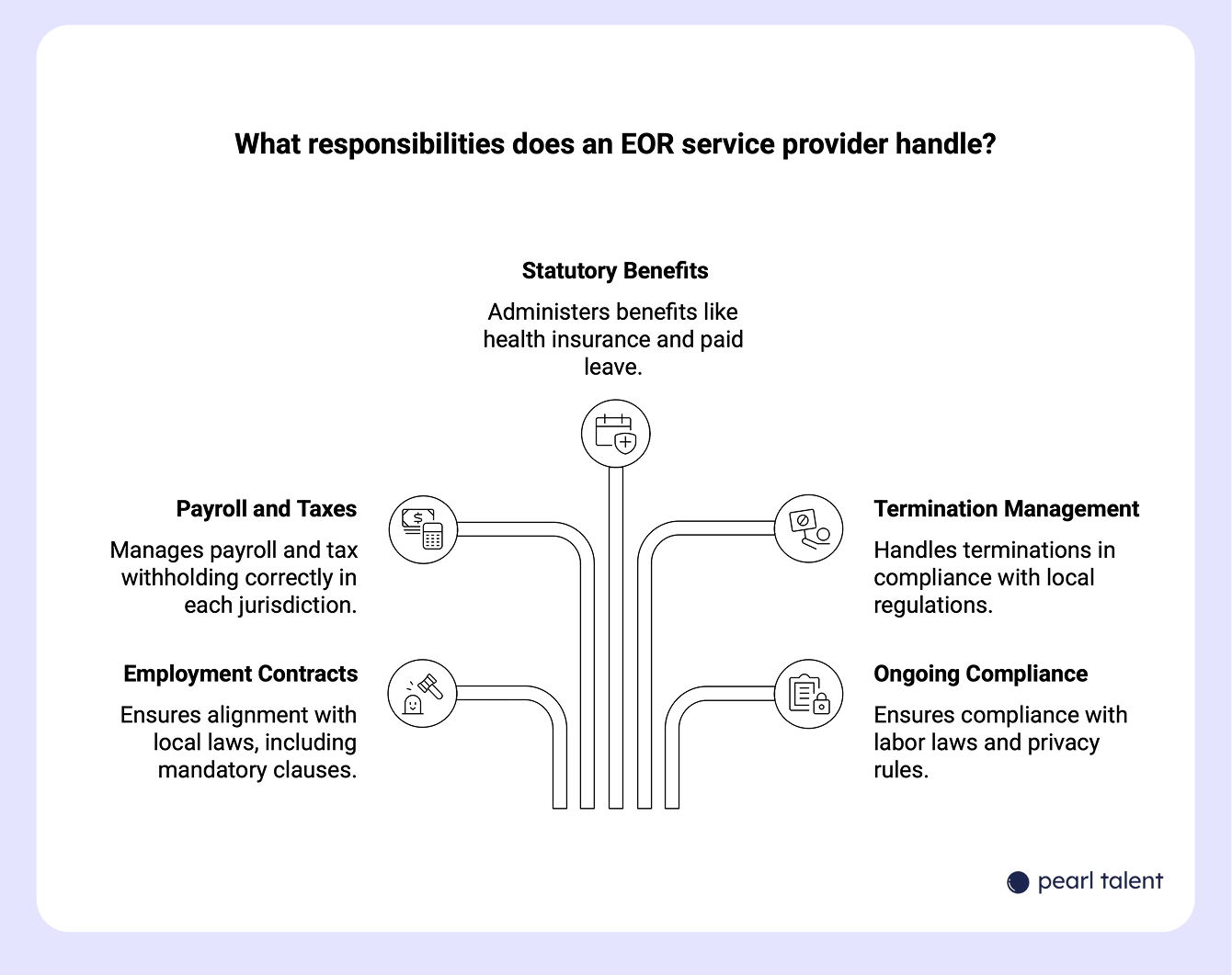
In short, they take on the legal and administrative burden of being the employer, so you don’t have to become an expert in every country’s labor code.
Founders often confuse EORs with other outsourcing models, but the differences matter:
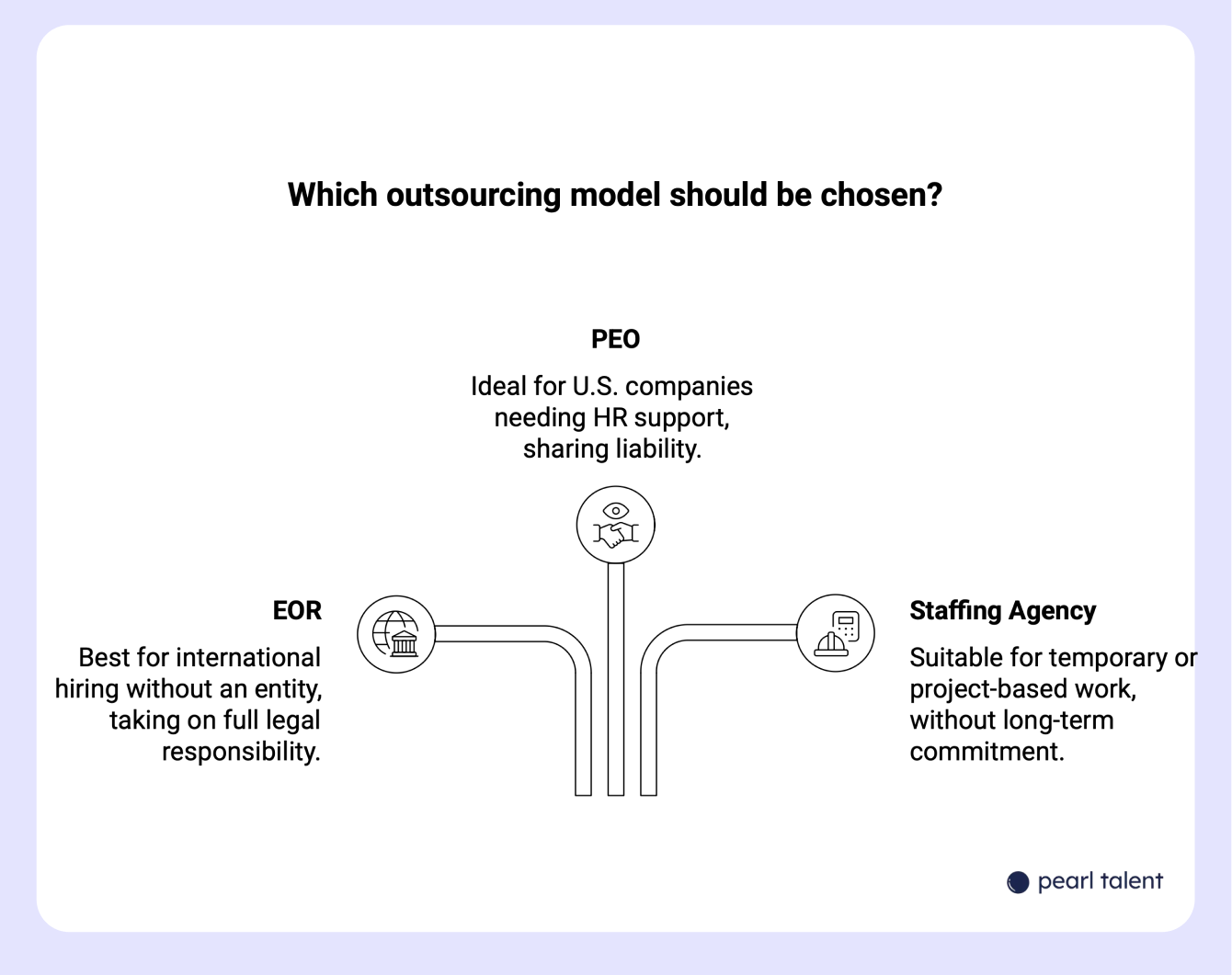
Staffing agencies can actually be the smartest option in far more situations than people realize. When you need good talent quickly, staffing partners shine. They give you immediate access to vetted workers, handle the administrative lift, and let you scale your workforce up or down without friction.
EORs still matter when you’re hiring abroad and don’t want to establish a local entity, and PEOs can help with domestic HR support. But neither offers the speed or adaptability that staffing agencies provide.
Confusing these models can get expensive fast: assuming a PEO can legally employ someone in Mexico (they can’t) or expecting a staffing agency to deliver full employee benefits (that’s not their role). When agility and rapid deployment are the priority, staffing agencies are often the strongest choice.
Ok, now, hiring abroad sounds exciting, huh? New markets, diverse talent, global reach. But the mechanics behind it? They’re messy. Every country has its own rules about how employees must be hired, paid, and protected. If you try to do it yourself, you’re suddenly buried in incorporation paperwork, tax registrations, and compliance audits. That’s why the Employer of Record (EOR) model exists: it’s the shortcut through the maze.
With an EOR, you’re not just outsourcing payroll; you’re outsourcing the legal employer function. On paper, the EOR is the employer. They sign the contracts, file the taxes, and administer benefits. In reality, you’re still the one directing the work, setting goals, and building culture.
Think of it like this: you’re the coach, setting the plays and motivating the team. The EOR is the referee, making sure the game follows the rules. You don’t lose control of your people; you still decide what they build, how they collaborate, and what success looks like. What you hand off is the legal responsibility of employing them in a country where you don’t have a footprint.
This split identity matters because it shields you from liability. If a country requires specific severance rules or mandates overtime pay, the EOR is responsible for compliance. You don’t have to memorize every labor code; they do.
Normally, to hire in a new country, you’d need to incorporate locally. That process can take months, cost tens of thousands in legal fees, and require ongoing filings. With an EOR, you skip all of that. You can hire in days, not months.
For founders, this is game‑changing. Imagine testing demand in Brazil without waiting six months to set up a subsidiary. Or hiring a single engineer in Germany without committing to a full GmbH entity. EORs make “try before you buy” possible at the country level.
It’s about flexibility. You can dip into new markets, validate demand, and pull back if things don’t pan out, all without the sunk cost of incorporation. That’s a perk founders love: agility without bureaucracy.
Every country has quirks. In Mexico, employees expect a Christmas bonus (aguinaldo). In France, pensions and healthcare contributions are mandatory. In Japan, overtime rules are strict and closely monitored. An EOR handles all of this.
They run payroll in local currency, withhold the right taxes, and administer benefits that match local expectations. For employees, this feels seamless; they get paid correctly, receive standard benefits, and feel secure. For founders, it’s invisible. You don’t have to learn the difference between a 401(k) and a French pension plan.
This is where the human perk comes in: employees feel taken care of. They don’t worry about whether their paycheck will arrive on time or if their benefits are legitimate. That trust translates into loyalty, which is priceless when you’re building a distributed team.
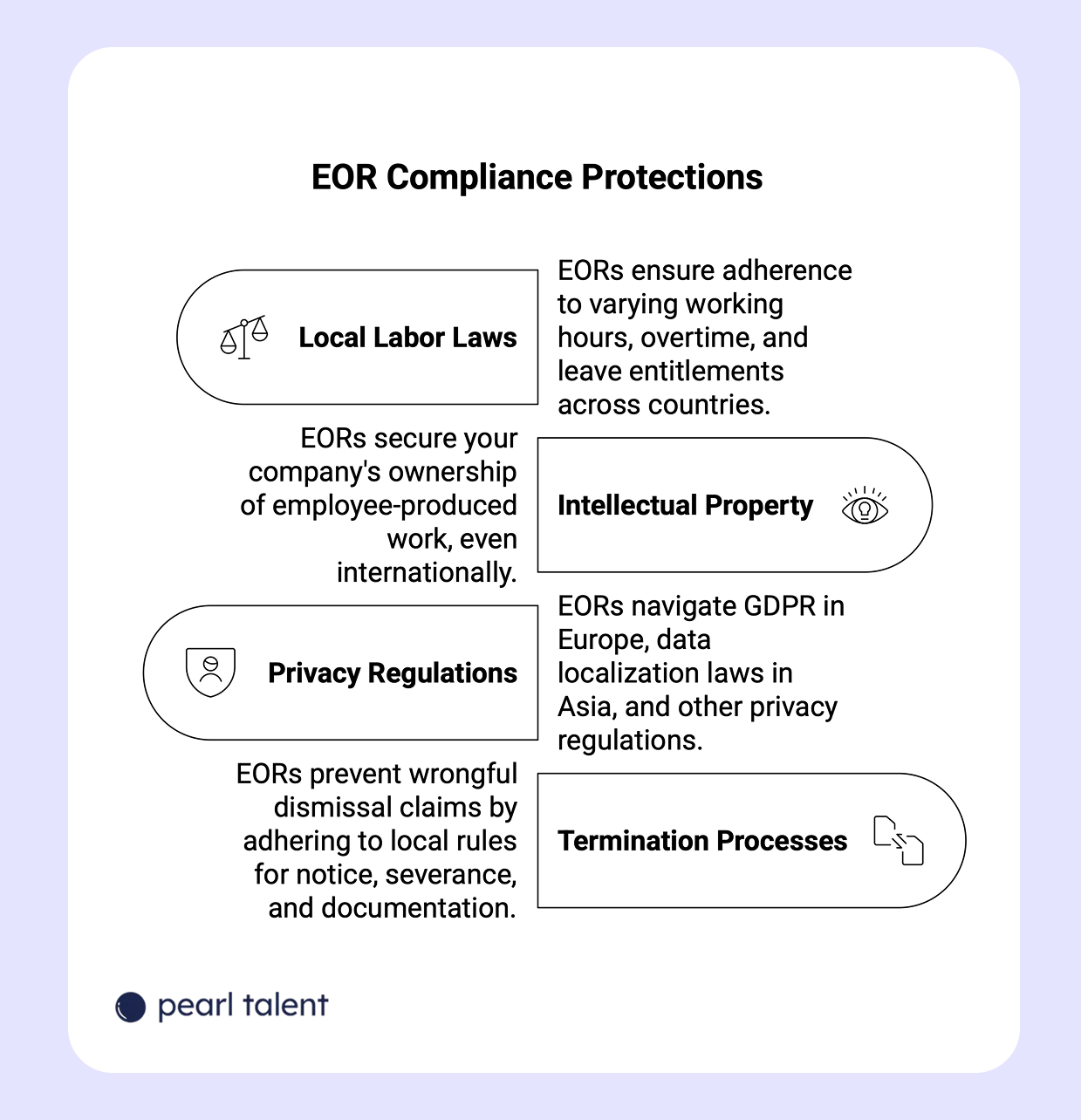
Beyond payroll, EORs protect you from compliance pitfalls:
For founders, this is peace of mind. You don’t have to become a global employment lawyer. The EOR takes on that burden, so you can focus on building. And for employees, it means they’re protected by local standards. They know their rights are respected, even when working for a company headquartered halfway across the world.
The real magic of an EOR is that it unlocks opportunities you’d otherwise have to delay or abandon. For founders, the benefits show up in ways that feel tangible: faster hiring, less legal stress, happier employees, and more time to focus on growth. Let’s break down the biggest advantages.
Instead of waiting months to set up an entity, you can hire in days. This speed is critical for founders chasing opportunities in new markets. It’s the difference between landing a client with local support or losing them to a competitor who already has boots on the ground.
The EOR shoulders compliance risk. They’re responsible for keeping you aligned with local laws, reducing the chance of fines or lawsuits. Avoiding penalties and sleeping at night knowing you’re not accidentally breaking labor laws in five different countries.
Employees expect benefits that match local standards. EORs provide market‑appropriate health, leave, and pension plans, which improves retention and makes you competitive. This is a human perk: your team feels like they’re truly employed, not just “contracted.” They get the same protections their peers do, which builds trust and loyalty.
By outsourcing HR and legal overhead, your team can focus on shipping product and growing revenue. Founders spend less time on admin and more time on strategy. This is the hidden perk: you get your time back. Instead of chasing down tax filings, you’re chasing growth. Instead of worrying about compliance, you’re worrying about customers.
No solution is perfect. EORs can be a lifesaver when you’re trying to hire abroad quickly, but they also come with trade‑offs that every founder should weigh. Some are minor inconveniences you can live with, others can feel like deal‑breakers depending on your stage, culture, and growth plans. Here are the most common challenges, explained:
Choosing an EOR isn’t just a procurement decision; you are literally choosing who will legally employ your people abroad. That’s a big deal. The right provider feels like an extension of your team, keeping things smooth and compliant. The wrong one can create friction, slow down hiring, or even put you at risk. So, how to evaluate with confidence? Check this:
Start with the basics: coverage, compliance, flexibility, and support.
Founders often rush into contracts without asking the hard questions. Slow down and dig deeper:
These aren’t just legal questions, they’re founder questions. They determine whether your employees feel secure and whether you sleep at night.
Watch for warning signs that signal trouble down the road:
Don’t go all‑in on day one. Start small.
This pilot gives you a real‑world test before scaling. Employees will tell you quickly if the provider feels responsive and trustworthy. Founders often describe this as “dating before marriage”, you want to see how they handle the relationship before committing long‑term.
EORs make global hiring simple: they let you expand into new markets fast, without drowning in legal setup or compliance risk. For founders, that speed and peace of mind can be game‑changing. But the trade‑off, they can make or break: control and cost. You’re relying on a third party’s systems, and at scale, fees can outweigh the convenience. The key is knowing when an EOR is the right bridge, and when other option might be the actual game changer for your company.
As stated earlier, staffing agencies can actually be the smartest option in far more situations than people realize. If you are looking for good talent quickly, without the drawbacks and risks of EORs and PEOs, a staffing partner is the sweet spot.
Pearl Talent, is an all around provider, with nearshore and offshore expertise. That means you can hire globally with confidence, while keeping the human touch that makes your culture unique.
Global hiring isn’t just paperwork; it’s people. Pearl Talent makes sure you get it right.
Get in touch with Pearl Talent Today!

.svg)