Hiring Tips
March 19, 2026

15 Sales Representative Interview Questions (And How to Answer Them)

Written by  
Isaac Kassab
Book cover titled 'Day Plan Template' with icons showing 30, 60, and 90 days and the logo 'pearl talent' at the top.
30-60-90 Day Plan Template
Set up your new hire for success in their first 3 months
Get my Template
GET STARTED
Get free candidate profiles in 24 hours
Find your next hire

Sales interviews are different from most other job interviews because the interviewer is evaluating you the same way a buyer would evaluate a product. They're watching how you communicate, how you handle pressure, and whether you can think on your feet while staying structured. The questions tend to be situational and specific, designed to surface real experience rather than rehearsed answers.

This guide covers 15 common sales representative interview questions, explains what the interviewer is really trying to assess with each one, and walks you through how to approach your answers in a way that's honest, specific, and effective.

1. Walk me through how you'd research a prospect before reaching out for the first time.

Interviewers ask this because they want to see if you actually do the homework before picking up the phone or sending that first email. A lot of reps skip research entirely and blast generic messages, and hiring managers know that approach burns through leads fast. They're looking for someone who understands that the quality of your outreach depends on the quality of your preparation.

When you answer, walk through your actual process. Talk about where you go to find information, whether that's LinkedIn, the company's website, recent news, job postings, or their tech stack. Mention what specific things you're looking for, like pain points their company might have, recent funding rounds, or a trigger event that makes your product relevant right now. The more concrete you are, the better. Interviewers can tell the difference between someone who has a real research habit and someone who's just describing what they think the interviewer wants to hear.

2. Tell me about a deal you lost. What happened, and what did you take away from it?

This question is designed to test two things at once: self-awareness and resilience. Sales is full of losses, and interviewers know that. What they're really evaluating is whether you can talk about failure honestly, without deflecting blame onto the prospect, the product, or your manager. They also want to see that you actually learned something useful from the experience, not just moved on and forgot about it.

The best way to handle this is to pick a real deal, describe the situation briefly, and be honest about where things went wrong. Maybe you misjudged the decision-maker, maybe you didn't build enough urgency, or maybe you let the deal stall by not following up at the right time. Then explain what you changed in your approach going forward. Keep the focus on what you control, not external factors. That's the part the interviewer cares about most.

3. How do you decide which accounts or leads to prioritize when your pipeline is full?

Hiring managers ask this because they want to understand how you manage your time when everything feels urgent. In most sales roles, you'll have dozens of leads at different stages, and not all of them deserve the same attention. The interviewer is trying to figure out whether you have a system for sorting through them or whether you just go with your gut.
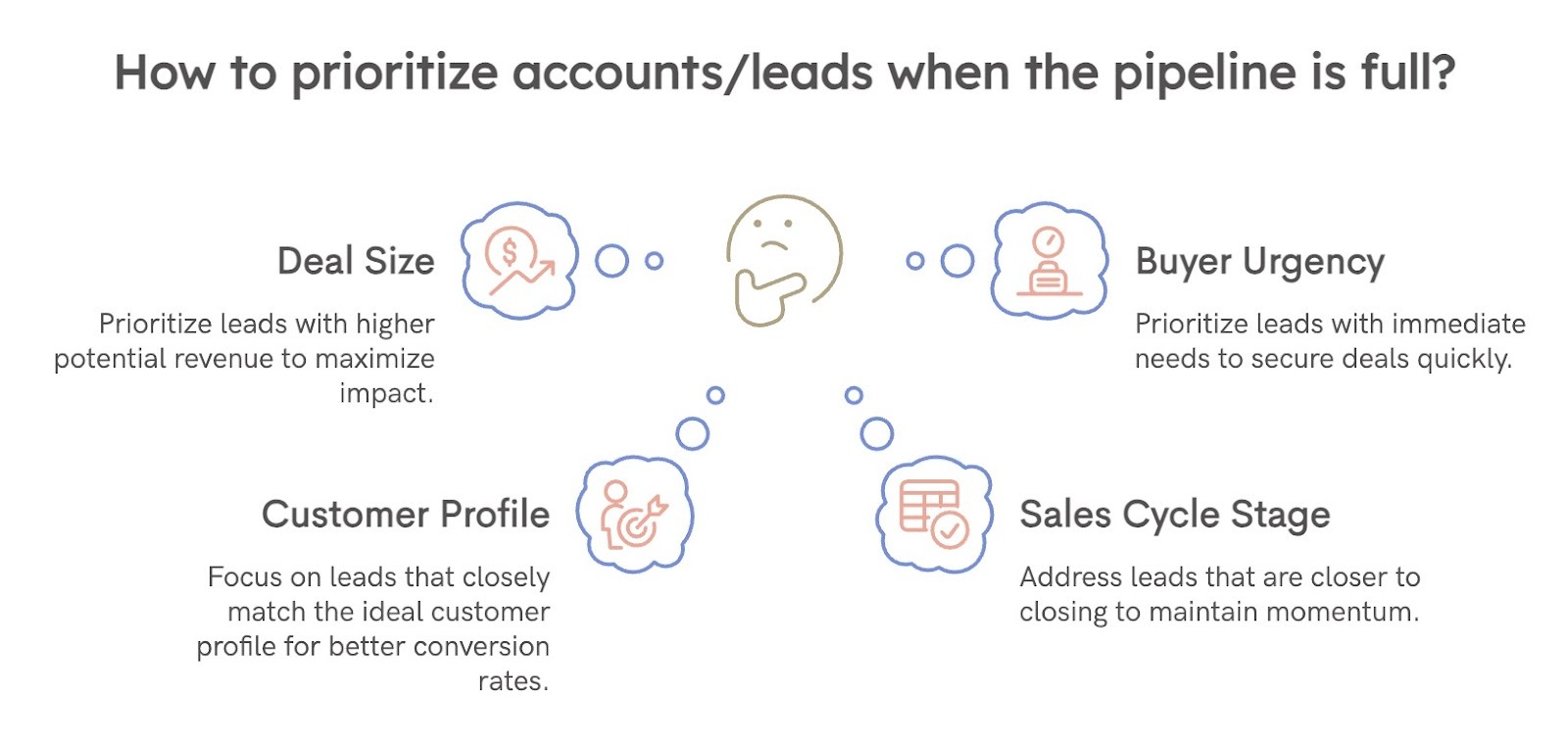
How to prioritize leads when the pipeline is full 

In your answer, explain the criteria you use to rank opportunities.  This could include things like:

  • Deal size and potential revenue
  • How closely the prospect matches your ideal customer profile
  • Where the deal sits in the sales cycle and what's needed to move it forward
  • Timeline and urgency on the buyer's side

4. Describe a time when a prospect raised an objection you weren't expecting. How did you handle it?

Objection handling is one of the core skills in sales, and this question specifically targets the moments where you didn't have a ready-made answer. The interviewer isn't interested in hearing about objections you've handled a hundred times. They want to see how you react when you're genuinely caught off guard.

Pick an example where the objection surprised you. Talk about what the prospect said, why it threw you off, and how you responded in the moment. Maybe you paused and asked a clarifying question. Maybe you acknowledged the concern and asked for time to come back with more information. Either approach is fine as long as you stay composed.

Then explain what happened after that conversation. Did you close the deal eventually, or did you lose it? And what did you change about your preparation so you'd be ready for that type of objection the next time around?

5. If I gave you a list of 200 cold leads tomorrow, how would you approach working through them?

This is a practical question about how you think about outbound at scale. The interviewer wants to see a structured approach, not just "I'd start calling." Here's what they're really listening for:
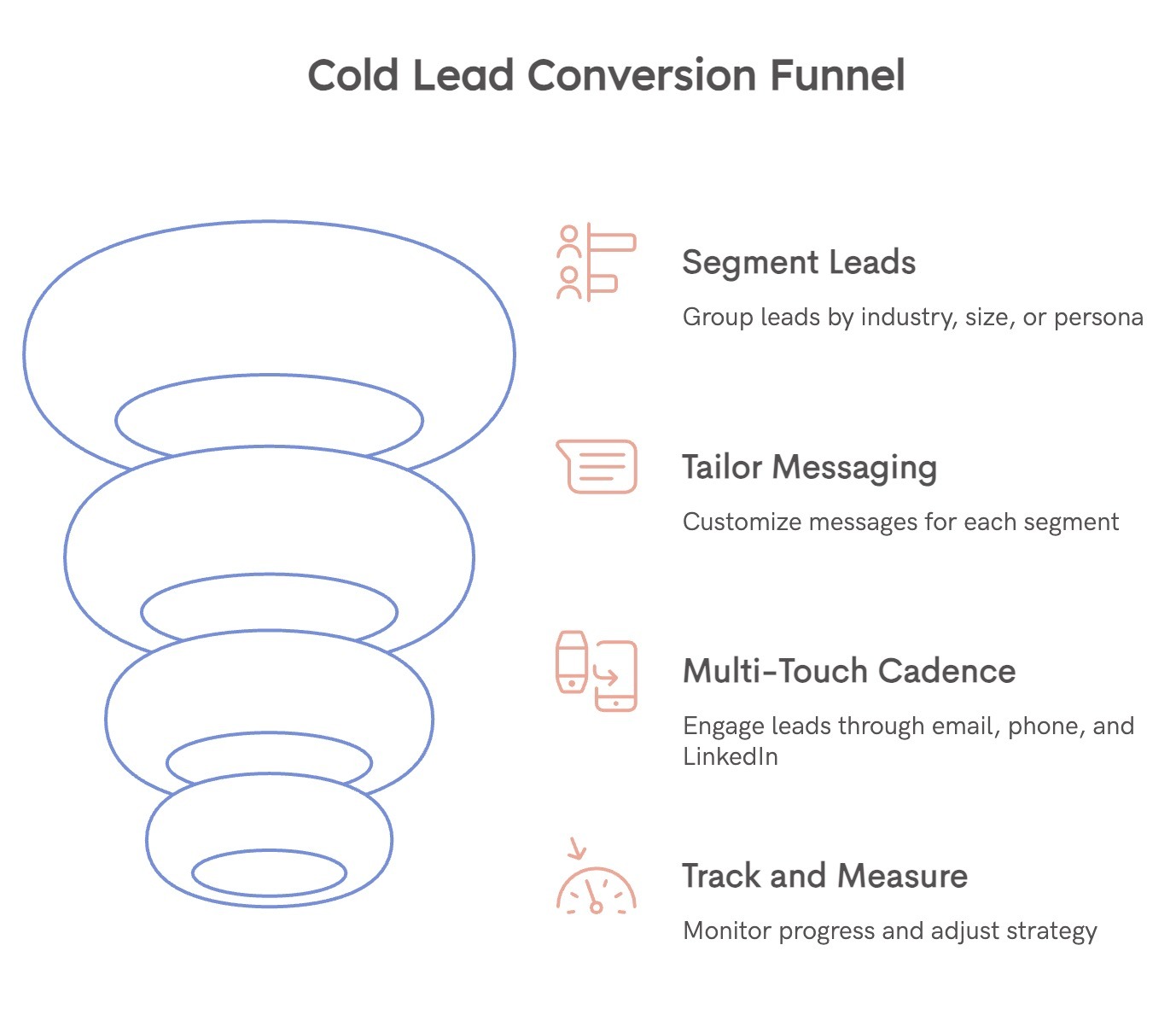
  • Whether you'd segment the list before doing anything else, grouping leads by industry, company size, or persona
  • Whether you'd tailor your messaging to different segments instead of blasting the same template
  • How you'd build a multi-touch cadence across email, phone, and LinkedIn
  • How you'd track and measure what's working as you go
Approaching a list of 200 cold leads as a sales representative 

You don't need to describe a perfect system. The point is to show that you approach cold outreach with a plan and that you think about efficiency and relevance, not just volume. If you've done something like this before, reference the actual numbers, like how many leads you worked, what your response rate was, and how many converted to meetings.

6. What's your process for following up with a prospect who's gone quiet after an initial conversation?

Going dark after an initial call is one of the most common situations in sales. Interviewers ask about it because they want to see if you have a deliberate follow-up strategy or if you just send "checking in" emails until you give up. They're evaluating your persistence, your creativity, and whether you know how to add value at every touchpoint.

A good answer walks through specific tactics. Maybe you send a relevant case study a few days after the call. Maybe you share a short article related to something they mentioned, or you reach out through a different channel like LinkedIn or even a short video message. Explain how you space out your follow-ups, because timing matters just as much as content. And be clear about when you decide to move on. Interviewers appreciate reps who know the difference between being persistent and wasting time on a dead lead.

7. How do you typically prepare for a discovery call with a new prospect?

A rep who wings discovery calls tends to miss critical information and struggles to build a strong business case later. Here's what a solid answer usually covers:

  • Researching the company and the specific person you're meeting with
  • Preparing tailored questions based on their likely challenges, not generic questions you ask everyone
  • Having a loose agenda in mind so you cover the key topics without making the call feel scripted

Beyond preparation, talk about how you run the actual call. Good discovery isn't an interrogation. It's a conversation where you're genuinely trying to understand the prospect's situation. If you can describe how you balance asking questions with actively listening and adapting in the moment, that tells the interviewer you've done this enough times to have developed a real feel for it.

8. Tell me about a time you had to sell to multiple stakeholders with different priorities. How did you manage that?

Multi-stakeholder deals are common in B2B sales, and they're hard. The person who loves your product might not control the budget. The CFO cares about completely different things than the end user. And sometimes there's a stakeholder you never even get to meet who quietly vetoes the deal in an internal meeting. Interviewers ask this because navigating buying committees is one of the clearest signals that a rep can handle complex sales cycles rather than just transactional ones.

Pick a specific deal. Describe who the stakeholders were and what each of them cared about. Explain how you adjusted your messaging or materials for different audiences within the same deal, and if one person was a blocker, walk through how you addressed their concerns. The more detail you give, the more credible your answer becomes.

9. How do you handle a situation where a prospect is interested but keeps pushing the timeline out?

Deals that stall are one of the biggest pipeline killers, and interviewers want to know how you deal with them. Often, when a prospect says "let's revisit next quarter," there's something else going on underneath. It could be a budget issue, a competing priority, internal politics, or they just haven't felt enough urgency to act now. This question tests whether you can figure out what's really happening and respond to that, rather than just accepting the delay at face value.

When you answer, talk about the specific steps you take:

  • Asking direct questions to uncover the real reason for the delay
  • Reframing the conversation around what they lose by waiting, not just what they gain by buying
  • Offering to restructure the deal or adjust the scope if budget is the real issue

If you've pulled a stalled deal back on track before, walk through exactly what happened. A concrete example is always more convincing than a hypothetical approach.

10. What CRM tools have you used, and how do you keep your pipeline data accurate and up to date?

This seems like a straightforward logistics question, but it actually reveals a lot about your discipline as a sales rep. Managers rely on CRM data for forecasting, pipeline reviews, and resource allocation. When a rep doesn't maintain clean data, it creates problems for the entire team because the forecast is off, deals fall through the cracks, and managers can't tell what's actually in the pipeline versus what's just sitting there stale. The interviewer is trying to find out if you treat your CRM as a core part of your daily workflow or as something you update right before a pipeline review.

Name the specific tools you've used, whether that's Salesforce, HubSpot, Pipedrive, or something else. Then talk about your habits. When do you update deal stages? How do you log activity? Do you block time to clean your pipeline, or do you update in real time? These small details signal that you take pipeline hygiene seriously, which matters to managers more than most candidates realize.

11. How do you approach learning a new product or industry when you're starting a sales role?

Sales reps switch companies and industries more often than most other roles, so interviewers want to know how quickly you can ramp up. They're assessing whether you wait to be trained or whether you go out and learn independently while onboarding is still happening.

Talk about what you do in the first few weeks. Maybe you shadow top performers on calls, listen to recorded demos and discovery conversations, study competitor websites and positioning, or spend time reading industry content to understand the buyer's world better. If you've ramped up quickly in a previous role, explain what that looked like in practice: how long it took before you booked your first meeting, closed your first deal, or started consistently hitting activity targets. Concrete timelines and examples are much more useful here than vague statements about being a fast learner.

12. Walk me through how you'd handle a prospect who says your product is too expensive.

Price objections are probably the most common thing you'll face in sales, and interviewers ask about them specifically because how you respond says a lot about how well you understand value selling. A rep who immediately offers a discount is very different from one who digs into why the prospect feels that way and reframes the conversation around ROI.

Explain the steps you'd take. Start with how you'd acknowledge the concern without being dismissive, then how you'd ask questions to understand what they're comparing against, whether that's a competitor, their current solution, or just an internal budget constraint. From there, talk about how you'd bring the conversation back to value, using things like:

  • Specific outcomes or results that other customers have achieved
  • Cost of sticking with the status quo
  • A breakdown of what the pricing actually includes

The goal is to show that you don't panic when someone pushes back on price and that you know how to have a productive conversation around it.

13. Tell me about a time you exceeded your sales quota. What did you do that quarter or year differently?

This is a results question, but the interviewer isn't just looking for the number. They want to understand what you did to get there, because that's what predicts whether you'll be able to repeat it. A lot of reps can point to a strong quarter but struggle to explain what specifically drove it. The interviewer wants to see if your success was intentional or coincidental.

Be specific about the actions you took. Maybe you focused on a particular segment that was underserved, improved your outbound cadence, built stronger relationships with existing accounts, or partnered with marketing on a campaign that generated high-quality leads. Talk about the numbers, including your quota, what you actually hit, and the percentage over target. Then connect it back to the repeatable behaviors or decisions that made the difference. That's the part that gives the interviewer confidence in your ability to perform consistently.

14. How do you stay motivated during a slow month when deals aren't closing?

Every sales rep goes through dry spells, and interviewers know that. This question isn't about whether you've struggled. It's about whether you have coping mechanisms and work habits that keep you productive even when the scoreboard isn't moving. Reps who only perform well when things are going well tend to be inconsistent over time, and that's a risk for the hiring manager.

Be honest about how slow months affect you, because pretending they don't isn't believable. Then talk about what you actually do during those stretches. Maybe you go back to basics with higher outbound activity, revisit old leads, sharpen your skills by reviewing call recordings, or focus on pipeline building for the next quarter. The interviewer wants to see that you have a playbook for tough times, not just good times.

15. If you joined our team next week, what would you want to understand about our customers in the first 30 days?

This is the one question where you get to stop talking about your past and start showing how you'd actually operate in the role. Interviewers use it to test your curiosity, your understanding of what drives sales performance, and whether you've bothered to research their company before walking into the conversation.

A strong answer goes beyond generic things like "I'd want to learn the product." 

Talk about the specific customer knowledge that actually drives sales performance, things like why customers buy (not just what they buy), what their alternatives are, what objections come up most frequently, which verticals convert best, and what the typical buying process looks like.

This question separates candidates who are preparing for a job interview from candidates who are already thinking like someone on the team. The more specific your answer, the harder it is for the interviewer to picture someone else in the seat.

Tips for Preparing for a Sales Rep Interview

Beyond practicing individual answers, there are a few things worth doing before any sales interview that will make the whole conversation smoother.
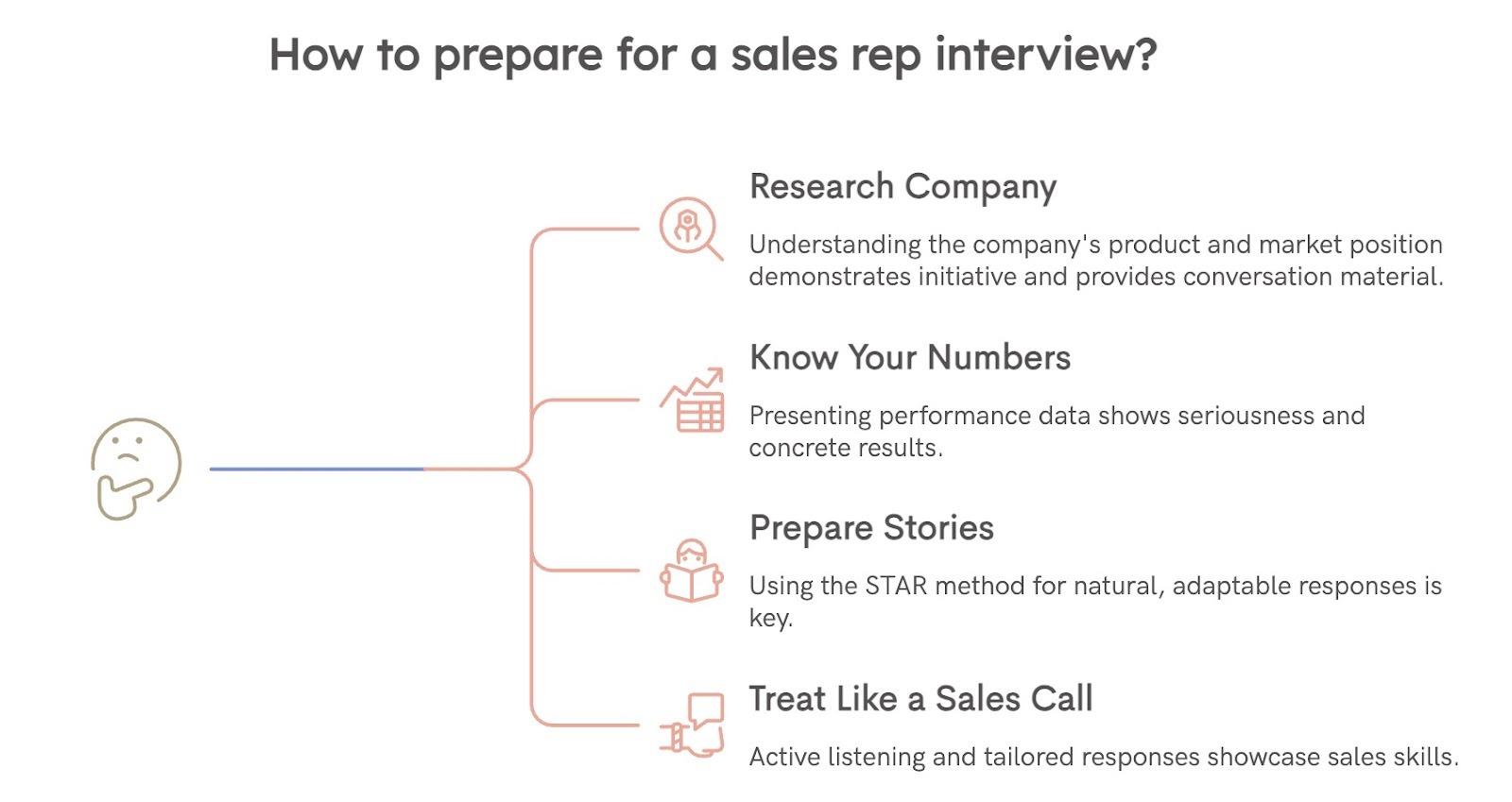
4 tips to prepare for a sales rep interview
  • Research the company’s product and market position. Read their website, look at recent press coverage, and check what their customers say on review sites like G2 or Trustpilot. Understanding the product you’d be selling demonstrates initiative and gives you material to reference during the conversation.
  • Know your numbers. Sales is a metrics-driven profession. Before the interview, review your own performance data: quota attainment, average deal size, win rate, and sales cycle length. Having these ready shows that you take your results seriously and can speak about your performance in concrete terms.
  • Prepare stories, not scripts. The STAR method (situation, task, action, result) is a useful framework for structuring your answers to behavioral questions, but your responses shouldn’t sound rehearsed. Practice telling your stories out loud until they feel natural, then trust yourself to adapt them in the moment.
  • Treat the interview like a sales call. Listen carefully to what the interviewer is asking, ask clarifying questions when something is ambiguous, and tailor your responses to what they seem to care about most. The interview itself is a chance to demonstrate the skills you’re claiming to have.

Apply for Sales Roles With Pearl Talent

If you’re a sales professional in the Philippines, Latin America, or South Africa, landing the right role at a US or EU company can be the difference between steady growth and staying stuck. The challenge isn’t usually ability; it’s access. Most job boards bury strong candidates in a pool of thousands, and most agencies move on after placement without looking back.

That’s where Pearl Talent can help. 

Pearl connects remote professionals with long-term, full-time roles at high-growth US and EU startups. Many of them are backed by firms like Y Combinator, Sequoia, and a16z. Sales roles, including SDR, BDR, account manager, and customer success positions, are among Pearl’s most active placements.

Here’s what you get when you’re placed through Pearl:

  • Competitive pay: Pearl candidates earn up to 2x local market rates, so your compensation reflects the caliber of work you’re doing, not just where you happen to live.
  • Roles that actually grow your career: These aren’t generic BPO contracts. You’ll work directly with founders and leadership teams at companies where your output has real visibility and where there’s a path to take on more responsibility over time.
  • Support that continues after placement: Pearl runs 30/60/90-day check-ins, ongoing performance coaching, and career development support so you’re not left to figure things out alone.
  • AI training included: Every Pearl placement gets access to hands-on AI upskilling at no cost, covering tools and workflows that top companies are actively hiring for.

View open roles and apply today.

Frequently Asked Questions
How much experience should a Sales Representative have?
How long does it take for a new Sales Representative to show results?
Should I hire a full-time employee or work with a freelance Sales Representative?
What are the most important soft skills for a Sales Representative?
What tools and technologies should a Sales Representative be proficient in?
Book titled '30 60 90 Day Plan Template' with icons of calendars showing 30, 60, and 90 days.
30-60-90 Day Plan Template
Set up your new hire for success in their first 3 months
Get my Template
GET STARTED
Browse available hires & get free candidate profiles
Find your next hire
Get Free Candidate Profiles in

24 hours

Menna A.
Executive Assistant from Mexico
5
Years experience
Egypt
Previously Growth Manager
Toni S.
QA Automation Engineer from Mexico
5
Years experience
Latam
Javascript
Typescript
Angel B.
Executive Assistant from The Philippines
7
Years experience
Asia
Previously EA @ Wonderstruck
Azel R.
Executive Assistant from The Philippines
7
Years experience
Asia
Zapier
Asana
Canva
Allan C.
Insurance Billing Specialist from The Philippines
13
Years experience
Asia
cigna
uhc
medicare
Jennifer D.
Telemedicine Patient Care Coordinator from Argentina
7
Years experience
Latam
AdvancedMD
ims
Eduard D.
Project Manager from The Philippines
7
Years experience
Asia
Previously COO @ Fitmedia
Marco M.
Patient Care Coordinator from The Philippines
11
Years experience
Asia
Previously @ Sprout therapy
Tricia R.
Virtual Assistant from The Philippines
5
Years experience
Asia
previously @ DCx inc.
Ezekiel P.
Technical Recruiter from The Philippines
10
Years experience
Asia
Bamboohr
salesforce recrutiment

You're less than 2 weeks away from your
perfect hire

Get Started - No Commitment
Since my hire started, my workflow rhythm has become five times more efficient. I'm genuinely excited about the growth of our partnership
Director, Science Startup Company
Working with Pearl Talent has been a fantastic experience! They helped us hire a candidate who's not just very intelligent but also kind and professional.
Co-Founder and CEO, Kiwi Biosciences
Pearl Talent truly took charge of the entire process and with their personalized approach, they found individuals specifically tailored to my requirements.
Founder, ASRA
Pearl Talent helped us quickly fill an executive assistant role. She onboarded quickly and since then, has taken over running the logistics of my and other C-suite executives' lives at our company.
VP of Sales & Marketing, Arcus Power Corp.
We've really enjoyed working with you and were very satisfied with the quality of applicants you proposed.
Investor, Lorentz Bio
I appreciate the patience and flexibility that Pearl Talent displays throughout their selection process.
Head of Talent Strategy and Culture, Next Step Talent
Our Pearl Talent-sourced EA+ has been a force-multiplier to our team, enabling us to shore up our back-end and day-to-day operations to focus on growth.
Investor, Climate Capital
Our hire was able to pick things up quickly and has become accustomed to our company’s needs in such a short period of time.
HR and Recruiting, IF Labs
Pearl Talent takes care of all the work you would normally invest in screening and hiring an assistant. They make the process easy, and provide support step by step along the way.
Partner, Darnel Fabrics
My assistant is doing great - she's independent, a quick learner, and positively impacting some of our big projects.
Co-Founder, CEAD Group
Pearl Talent has been brilliant. I was unsure about what would happen but they spent a lot of time discussing my issues. They sent me two candidates for interview, both had been well screened and they have videos of themselves talking about what they have done.
Founder, CEO
I wish I found you guys years ago, because they [Pearl Talent] are way better than the sourcing I've been able to do on my own accord.
Founder, Pearl Technologies
With Pearl Talent, they started out by really understanding our needs with a thorough but also fast intake process.
CEO, Medra AI
I cannot recommend Pearl Talent’s services enough. The quality of candidates they were able to provide us with was unmatched.
Co-Founder, Ambience Healthcare
Our Ops Associate has added immense value from day one, leaving us wishing we had hired her sooner!
Head of Lab Operations, Vital
Just interviewed a candidate and WOW you guys source fantastic people!
Co-Founder and CEO, Fella Health
Pearl Talent gave us an impressive pool of candidates, which made our decision-making process pleasantly challenging.
Co-Founder, ATC Research
The hiring process with Pearl Talent has been straightforward and seamless. Their attentive approach to understanding our specific needs and preferences truly stood out.
Head of Care Operations, AB Healthcare
The hiring process with Pearl Talent has been straightforward and seamless. Their attentive approach to understanding our specific needs and preferences truly stood out.
Head of Care Operations, AB Healthcare
Pearl Talent gave us an impressive pool of candidates, which made our decision-making process pleasantly challenging.
Co-Founder, ATC Research
Just interviewed a candidate and WOW you guys source fantastic people!
Co-Founder and CEO, Fella Health
Our Ops Associate has added immense value from day one, leaving us wishing we had hired her sooner!
Head of Lab Operations, Vital
I cannot recommend Pearl Talent’s services enough. The quality of candidates they were able to provide us with was unmatched.
Co-Founder, Ambience Healthcare
With Pearl Talent, they started out by really understanding our needs with a thorough but also fast intake process.
CEO, Medra AI
I wish I found you guys years ago, because they [Pearl Talent] are way better than the sourcing I've been able to do on my own accord.
Founder, Pearl Technologies
Pearl Talent has been brilliant. I was unsure about what would happen but they spent a lot of time discussing my issues. They sent me two candidates for interview, both had been well screened and they have videos of themselves talking about what they have done.
Founder, CEO
My assistant is doing great - she's independent, a quick learner, and positively impacting some of our big projects.
Co-Founder, CEAD Group
Pearl Talent takes care of all the work you would normally invest in screening and hiring an assistant. They make the process easy, and provide support step by step along the way.
Partner, Darnel Fabrics
Our hire was able to pick things up quickly and has become accustomed to our company’s needs in such a short period of time.
HR and Recruiting, IF Labs
Our Pearl Talent-sourced EA+ has been a force-multiplier to our team, enabling us to shore up our back-end and day-to-day operations to focus on growth.
Investor, Climate Capital
I appreciate the patience and flexibility that Pearl Talent displays throughout their selection process.
Head of Talent Strategy and Culture, Next Step Talent
We've really enjoyed working with you and were very satisfied with the quality of applicants you proposed.
Investor, Lorentz Bio
Pearl Talent helped us quickly fill an executive assistant role. She onboarded quickly and since then, has taken over running the logistics of my and other C-suite executives' lives at our company.
VP of Sales & Marketing, Arcus Power Corp.
Pearl Talent truly took charge of the entire process and with their personalized approach, they found individuals specifically tailored to my requirements.
Founder, ASRA
Working with Pearl Talent has been a fantastic experience! They helped us hire a candidate who's not just very intelligent but also kind and professional.
Co-Founder and CEO, Kiwi Biosciences
Since my hire started, my workflow rhythm has become five times more efficient. I'm genuinely excited about the growth of our partnership
Director, Science Startup Company
Pearl Talent has been brilliant. I was unsure about what would happen but they spent a lot of time discussing my issues. They sent me two candidates for interview, both had been well screened and they have videos of themselves talking about what they have done.
Founder, CEO
We've really enjoyed working with you and were very satisfied with the quality of applicants you proposed.
Investor, Lorentz Bio
Pearl Talent truly took charge of the entire process and with their personalized approach, they found individuals specifically tailored to my requirements.
Founder, ASRA
My assistant is doing great - she's independent, a quick learner, and positively impacting some of our big projects.
Co-Founder, CEAD Group
I cannot recommend Pearl Talent’s services enough. The quality of candidates they were able to provide us with was unmatched.
Co-Founder, Ambience Healthcare
Our Pearl Talent-sourced EA+ has been a force-multiplier to our team, enabling us to shore up our back-end and day-to-day operations to focus on growth.
Investor, Climate Capital
Working with Pearl Talent has been a fantastic experience! They helped us hire a candidate who's not just very intelligent but also kind and professional.
Co-Founder and CEO, Kiwi Biosciences
Since my hire started, my workflow rhythm has become five times more efficient. I'm genuinely excited about the growth of our partnership
Director, Science Startup Company
Our Ops Associate has added immense value from day one, leaving us wishing we had hired her sooner!
Head of Lab Operations, Vital
The hiring process with Pearl Talent has been straightforward and seamless. Their attentive approach to understanding our specific needs and preferences truly stood out.
Head of Care Operations, AB Healthcare
I appreciate the patience and flexibility that Pearl Talent displays throughout their selection process.
Head of Talent Strategy and Culture, Next Step Talent
Pearl Talent gave us an impressive pool of candidates, which made our decision-making process pleasantly challenging.
Co-Founder, ATC Research
I wish I found you guys years ago, because they [Pearl Talent] are way better than the sourcing I've been able to do on my own accord.
Founder, Pearl Technologies
With Pearl Talent, they started out by really understanding our needs with a thorough but also fast intake process.
CEO, Medra AI
Just interviewed a candidate and WOW you guys source fantastic people!
Co-Founder and CEO, Fella Health
Our hire was able to pick things up quickly and has become accustomed to our company’s needs in such a short period of time.
HR and Recruiting, IF Labs
Pearl Talent helped us quickly fill an executive assistant role. She onboarded quickly and since then, has taken over running the logistics of my and other C-suite executives' lives at our company.
VP of Sales & Marketing, Arcus Power Corp.
Pearl Talent takes care of all the work you would normally invest in screening and hiring an assistant. They make the process easy, and provide support step by step along the way.
Partner, Darnel Fabrics