Catena is now Pearl Talent! Same mission, new name.
For years, onshoring was the default. If you needed to hire outside your office walls, you kept it close, same country, same timezone, same rules. It felt safe. Familiar. Easy to explain to investors.
But 2026 looks different. Remote work isn’t new anymore, and founders aren’t limited to local talent. Global hiring models have matured. Nearshore and offshore teams can now work fully in your hours, speak your language, and plug into your workflows just like someone down the street. The difference? They often cost less and bring broader skill sets.
Onshoring still has its pros, but it’s no longer the automatic answer. Let’s break down what it really means, the good, the bad, and why many founders are leaning toward nearshore and offshore instead.
Onshoring basically means hiring within your own country or economic zone. Instead of sending work across the world, you collaborate with people who operate on the same rhythm as you — whether they’re in your city or just a few states away. For years, it was considered the “safest” way to hire: same language, same rules, same time zone. But like any model, it has its strengths and weaknesses.
Onshoring works for certain roles, but it’s not the whole picture anymore. Founders today aren’t locked into one way of hiring — they can choose from different models depending on what the business needs. Some positions thrive on real‑time collaboration, while others can be handled just fine with asynchronous workflows.
That’s where new approaches come in. Nearshore and offshore models have opened the door to broader talent pools, more flexibility, and smarter cost structures. Instead of asking “How do I keep everything local?” the question has shifted to “Which model gives me the right mix of speed, trust, and efficiency for this role?”
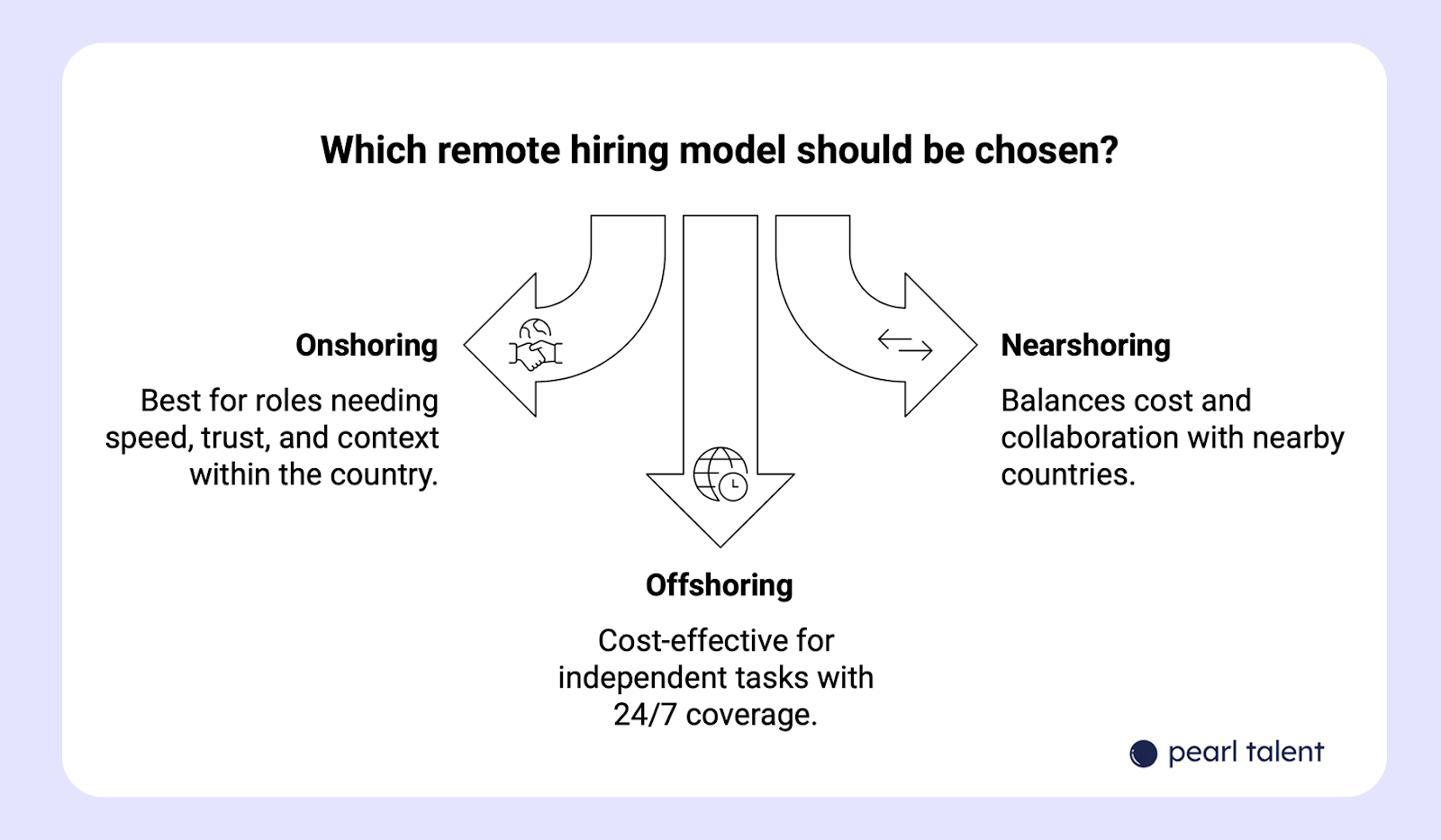
There are three common models for remote hiring. Each has its place:
Onshoring: As we already explained, it means hiring within your country or economic zone. Best for roles that need speed, trust, and context: like ops, support, and executive assistance.
Nearshoring: You are basically hiring in nearby countries with overlapping timezones and similar work norms. The benefit here is balance: you gain access to broader talent pools and sometimes lower costs, while still keeping collaboration smooth. Nearshoring works well for roles that depend on frequent interaction, design, marketing, or sales development, because feedback cycles stay short and onboarding is faster. Legal and payroll processes are more complex than onshoring but usually manageable, especially in regions with established trade agreements.
Offshoring: Is hiring in distant countries, often chosen for cost efficiency or access to specialized skills. Offshoring is effective for work that can be clearly documented and executed independently, such as engineering, back‑office support, or data processing. It also supports 24/7 coverage when teams are spread across multiple timezones. The trade‑off is coordination: communication takes longer, onboarding requires more structure, and compliance can be more involved. Success depends on strong documentation and clear processes.
Here’s the reality: not every role needs to be hired locally. In fact, for many startups, nearshore and offshore models are the smarter move. They give you access to broader talent pools, lower costs, and still keep collaboration smooth, especially when the team works fully in your hours.
Nearshore and offshore hiring are most effective when:
Hiring globally isn’t just about saving money — it’s about building a team that can actually deliver at scale. Nearshore and offshore models support that by expanding your reach, reducing costs, and keeping collaboration aligned.
These models shine in roles where speed, cost, and specialization matter most:
Nearshore and offshore models aren’t about cutting corners… they’re about hiring smarter. They give founders the ability to scale quickly, tap into global expertise, and keep collaboration aligned without paying domestic premiums.
Nearshoring is the sweet spot for roles that need collaboration without the high cost of domestic hiring. Founders lean on nearshore talent when they want people working in the same hours, with similar cultural context, but at a more scalable price point.
Think of customer‑facing and creative roles: SDRs who need to prospect and respond in real time, designers who rely on quick feedback loops, or marketers who collaborate closely on campaigns. These positions benefit from timezone overlap and cultural familiarity, which makes communication smoother and onboarding faster.
For example:
Nearshoring gives startups the ability to scale collaboration without burning cash, making it a go‑to model for growth‑oriented teams.
Offshoring shines when the work can be scoped clearly and executed independently. Founders use offshore talent for specialized or asynchronous roles where cost efficiency and depth of expertise matter more than real‑time collaboration.
Engineering, back‑office support, analytics, and data processing are classic offshore functions. These roles don’t require constant back‑and‑forth, but they do demand precision and reliability. Offshore teams can deliver that — often at a fraction of the cost of local hires.
For example:
Offshoring gives startups reach and efficiency. It’s not about cutting corners — it’s about tapping into specialized talent pools and extending capacity without slowing down.
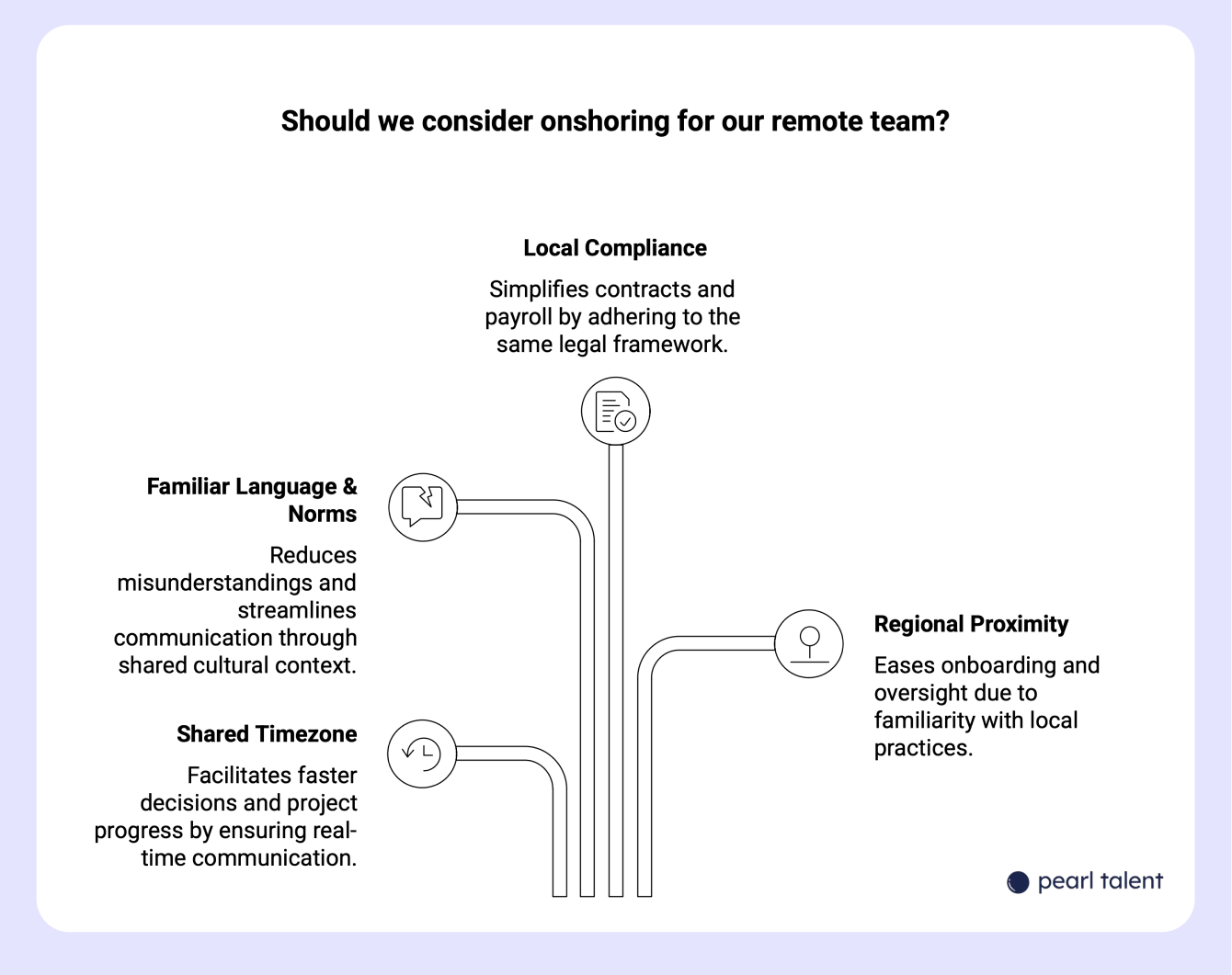
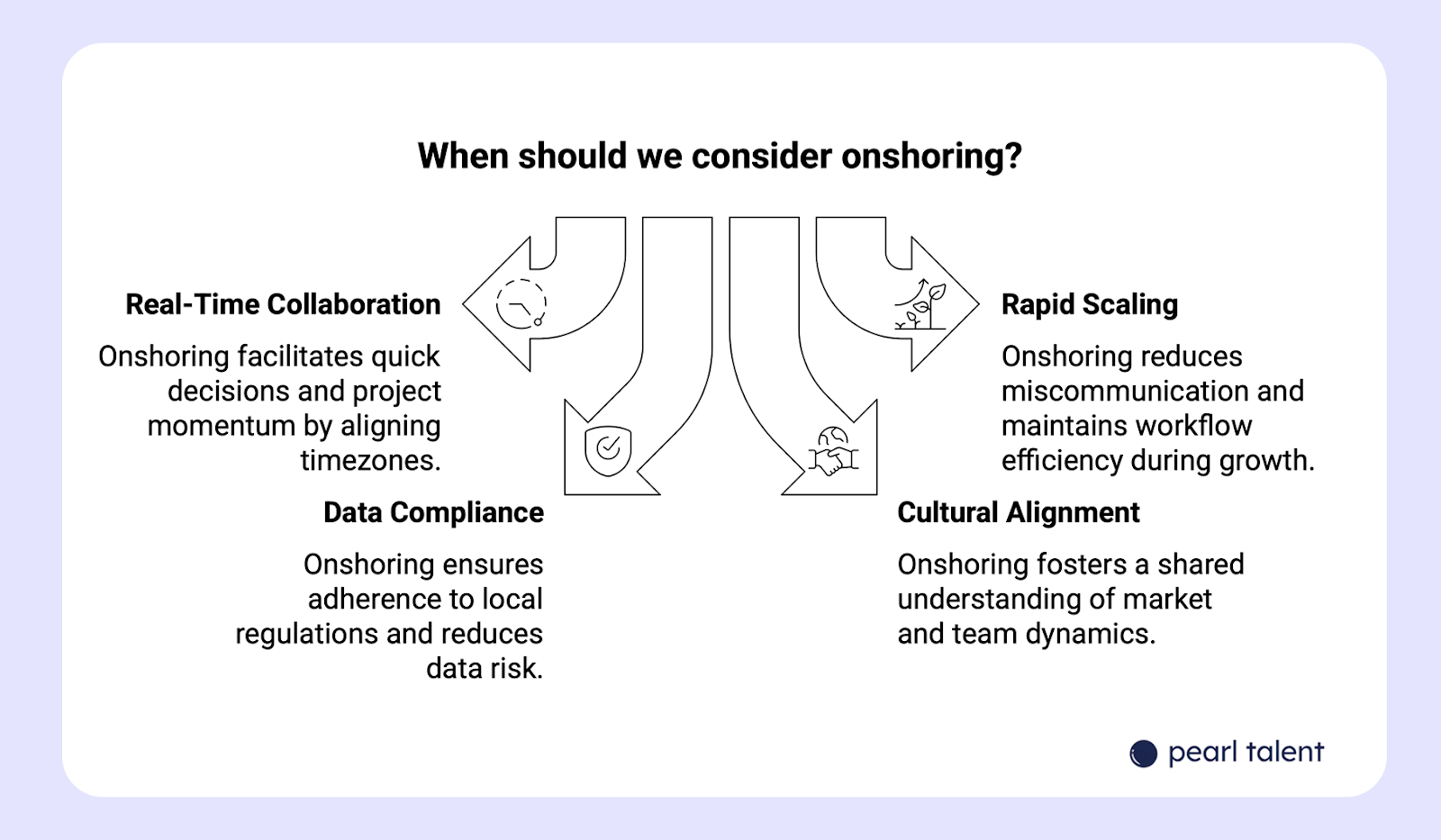
Onshoring does have its advantages: same timezone, shared culture, and simpler compliance. For roles that demand tight coordination, like executive assistance or operations, it can feel like the safest choice. But “safe” doesn’t always mean “best.”
The truth is, onshoring comes with trade‑offs that can hold startups back:
Most startups use a mix. It’s rarely about choosing one model exclusively, founders match the model to the role: onshore for sensitive or high‑trust positions, nearshore for collaborative roles, offshore for specialized or cost‑efficient work.
An onshore executive assistant gives founders immediate support. These roles require quick responses, sensitive task management, and direct alignment with a founder’s calendar. Keeping them onshore ensures speed and confidentiality.
Nearshore SDRs are often used for outbound sales. These roles benefit from timezone overlap and cultural proximity, which makes prospecting and customer conversations smoother. At the same time, they don’t require full in‑house integration, so nearshore hiring balances efficiency with cost.
Offshore developers are commonly chosen for backend builds or engineering projects. Because these tasks can be scoped clearly and executed asynchronously, offshoring becomes a cost‑effective option. It works best when documentation is strong and expectations are defined up front.
Where Pearl Talent Changes the Game
Onshoring used to feel like the “safe” choice: same timezone, same language, same rules. But safe doesn’t always mean best. Nearshore and offshore models now give founders access to broader talent pools, lower costs, and specialized skills — without losing alignment.
Pearl makes these alternatives work better than anyone else.
Instead of forcing founders to compromise between cost and collaboration, Pearl designs hiring models that deliver both — top 1% talent, working in your hours, integrated seamlessly into your team.
Pearl helps startups hire top‑tier remote talent across Latin America, Africa, and the Philippines — regions that give founders access to broader talent pools and cost efficiency without sacrificing collaboration. Nearshore and offshore aren’t “second best” options here; Pearl makes them feel as smooth and reliable as hiring locally.
What Pearl Handles
Onshoring still works for sensitive, high‑trust roles. But by 2026, founders face a different reality: distributed teams, tighter regulations, and customers who expect instant responses. In this environment, access to talent alone isn’t enough. What matters is execution: building teams that match your pace, priorities, and growth goals.
That’s why more startups are moving beyond onshoring. Nearshore and offshore models open the door to broader talent pools, lower costs, and specialized skills, without losing alignment. With Pearl Talent, founders don’t have to choose between cost and collaboration. They get both.
👉 Ready to hire smarter? Visit Pearl Talent to get matched with top‑tier remote talent in days.

.svg)