Catena is now Pearl Talent! Same mission, new name.
AI is already part of everyday work inside most companies. It drafts, summarizes, analyzes, and speeds things up in ways that are easy to take for granted. So the question is no longer whether teams will use AI. The question is how work gets structured around it so teams don’t end up moving faster without knowing why, producing more without improving outcomes, or mistaking activity for progress.
Without a clear structure, AI adds speed but not direction.
An AI-augmented workforce is the solution to that problem. It redesigns roles, workflows, and decision-making so AI supports human judgment instead of creating noise.
Let’s break down what an AI-augmented workforce actually means, how to build one step by step, and what kind of talent makes it work.
In an AI-augmented model, employees use approved AI systems to handle repetitive execution, surface insights, and speed up decision support. The value comes from the redistribution of effort, not headcount reduction.
AI takes on the parts of work that are mechanical, time-consuming, or pattern-heavy. People focus on prioritization, interpretation, creative problem-solving, and relationship-driven decisions.
This distinction matters because many teams conflate augmentation with automation. Automation optimizes existing processes by removing human involvement. Augmentation rethinks the process itself by asking a different question: Which parts of this work benefit from speed and scale, and which parts require judgment and context?
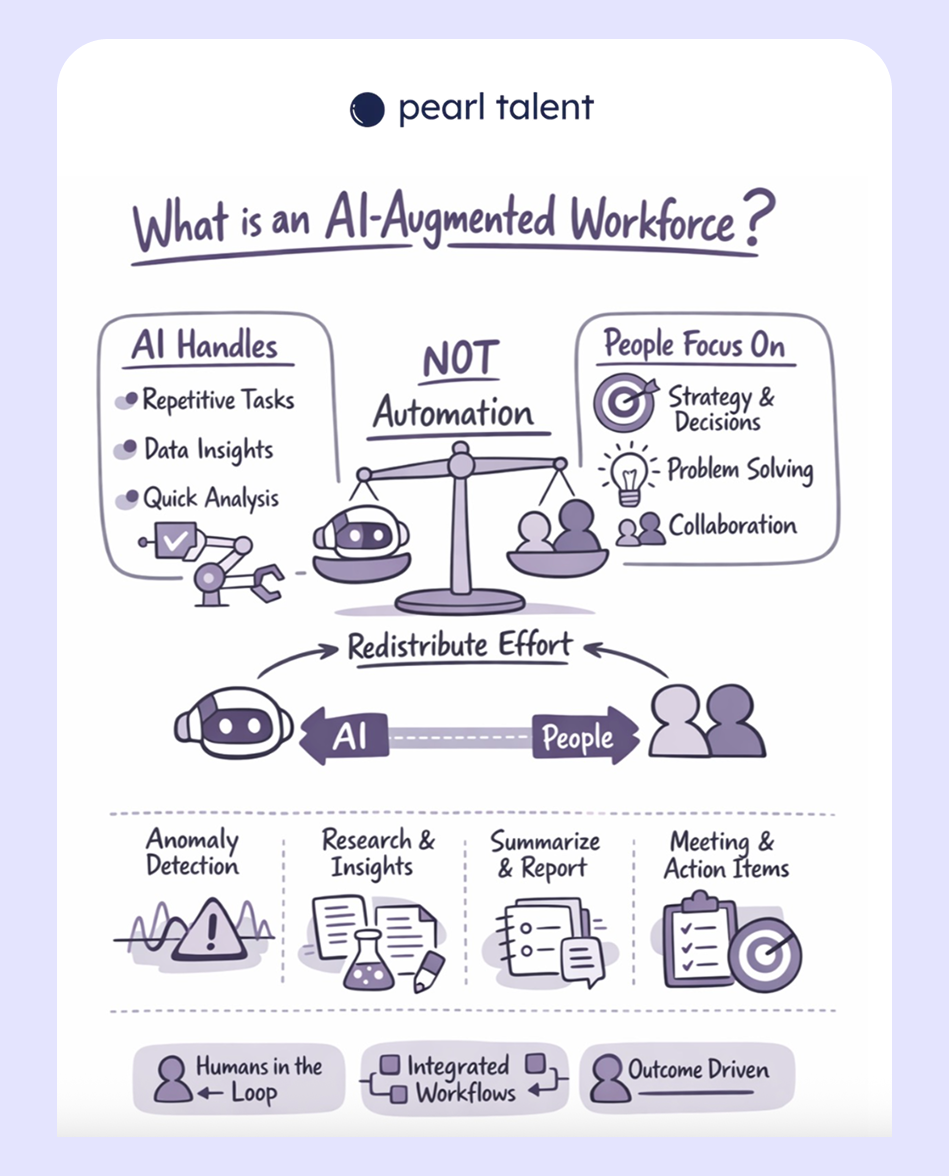
When organizations get this right, AI becomes embedded inside everyday workflows instead of sitting on the side as a separate initiative. Common examples include:
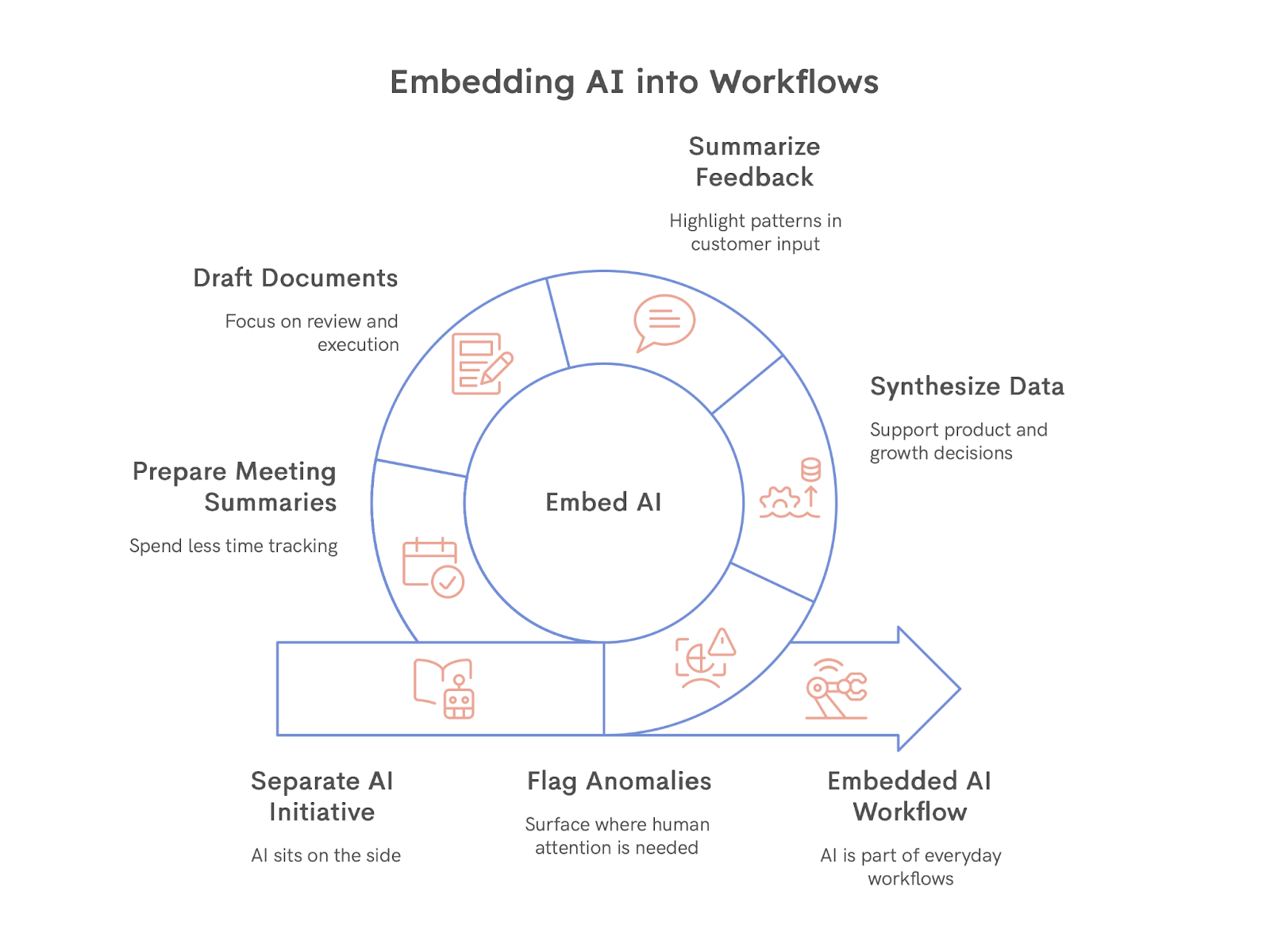
The practical shift is subtle but powerful. Work stops being defined by static job descriptions and starts being defined by outcomes. Roles become more flexible. Teams spend less time producing artifacts and more time making decisions. Output increases not because people work harder, but because less effort is wasted on low-leverage tasks.
An AI-augmented workforce only works when three things are true:
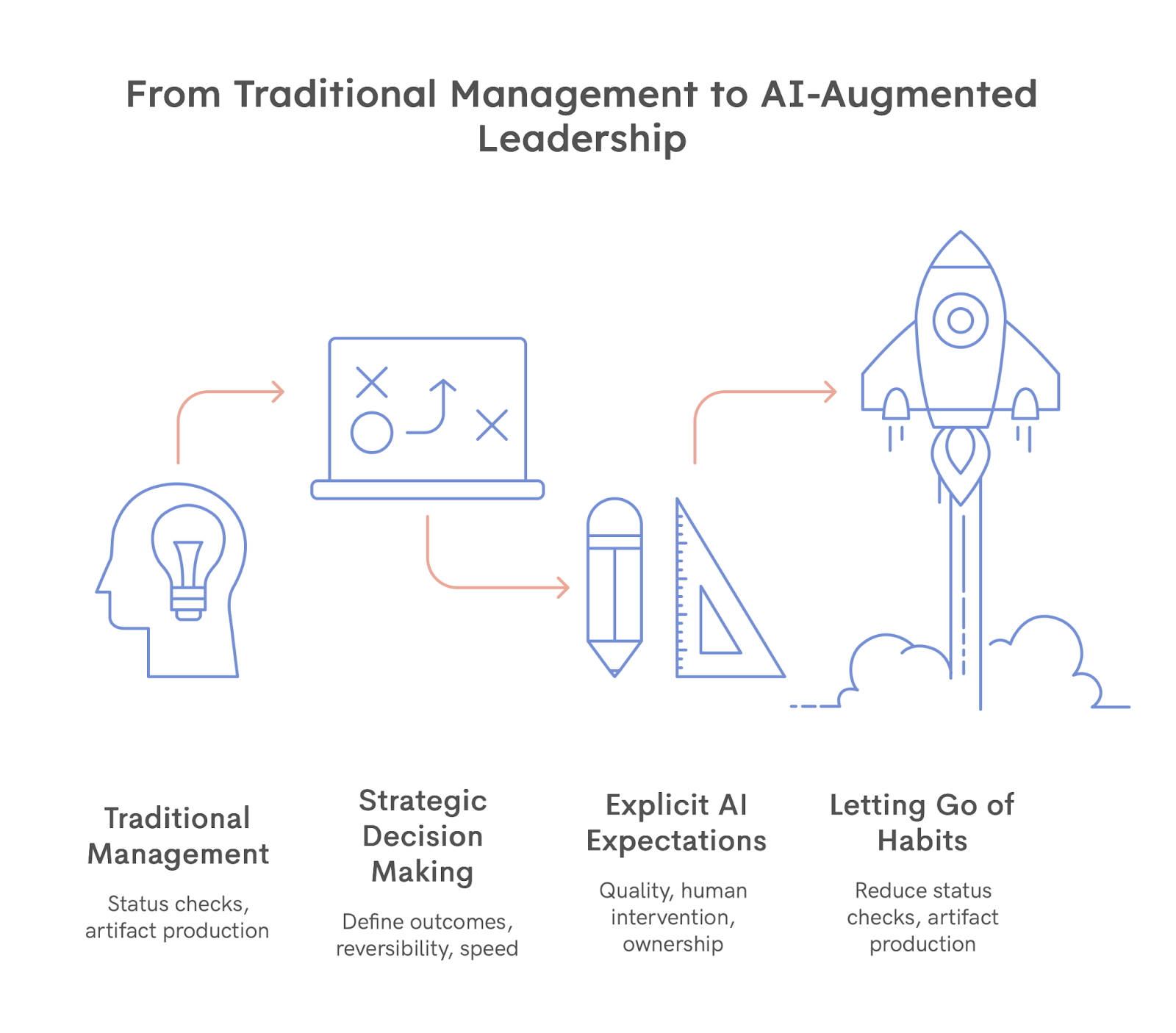
In an AI-augmented workforce, the biggest shifts happen upstream, before any tool is deployed. Leaders have to decide which outcomes actually matter, which decisions are reversible, and where speed is more valuable than precision.
Without those choices, AI just accelerates activity without improving results.
Leading an AI-augmented workforce means being explicit about:
It also requires letting go of outdated management habits. When AI can surface information instantly, leaders don’t need to manage through constant status checks or artifact production. Their role shifts toward setting direction, resolving ambiguity, and making tradeoffs that systems can’t.
Take an example of a product team that starts using AI to assist with planning. The AI pulls historical performance, forecasts workload, and suggests what should be prioritized next quarter.
On paper, this looks like a win because the output appears more data-driven. Product managers feel confident that decisions are now grounded in evidence.
The tension shows up later.
If leaders haven’t clarified what kind of judgment the AI is allowed to influence, the team starts optimizing for what the system can measure easily. Short-term efficiency improves, but longer-term bets get deprioritized.
In teams where leadership treats AI forecasts as inputs, not answers, the dynamic is different. Leaders use AI to pressure-test assumptions, surface tradeoffs, and ask better questions:
Those conversations prevent misalignment.
Building an AI-augmented team doesn’t require new job titles or a full org redesign. It requires deliberate choices about how work is structured, how people are supported, and how judgment flows through the system. The teams that get this right focus less on tools and more on operating habits.
AI augmentation works best when teams stop defining work purely by role boundaries and start defining it by outcomes.
Instead of asking, “What does this role own?” effective teams ask, “What needs to get done from input to outcome, and where does AI help along the way?”
This often reveals that large portions of work are repetitive, extractive, or preparatory. AI can handle first drafts, synthesis, and monitoring, while humans retain ownership of decisions and execution. The key is that AI support is mapped to specific steps in the workflow, not bolted onto a role.
Teams that take this approach avoid the trap of underutilized tools. AI becomes part of how work moves forward rather than something people optionally experiment with. Over time, roles naturally evolve, but accountability stays intact because outcomes (and not activities) anchor ownership.
In an AI-augmented team, raw execution speed matters less than judgment. The most effective hires are not those who “know the tools” best on day one, but those who can reason through incomplete information, review AI outputs critically, and adapt as systems change.
These teams look for people who:
This shifts hiring away from narrow experience checklists. Past job titles matter less than how candidates explain decisions, handle ambiguity, and learn new workflows. As AI capabilities evolve, these traits compound. Teams built around judgment stay resilient even as tools change underneath them.
High-performing AI-augmented teams don’t rely on informal norms. They make expectations explicit. People know when AI is encouraged, when review is required, and when human override is expected.
This doesn’t mean rigid rules. It means shared understanding. For example, AI might be trusted for summarization but always reviewed for customer-facing communication. It might support planning scenarios, but never make final prioritization calls.
These guardrails reduce friction. Teams spend less time debating whether AI “should” be used and more time focusing on quality and outcomes. Trust grows because accountability is clear. When something goes wrong, the issue is traceable to a decision, not a tool.
Giving teams AI access without enablement rarely produces results. Effective teams invest in training that is practical and contextual, not abstract. People learn how AI fits into their workflows, where it helps, and where it doesn’t.
This includes:
Teams that treat learning as continuous adapt faster and avoid both overreliance and underuse. AI becomes something people grow with, not something they are expected to instantly master.
Access to powerful AI tools is easy. What slows teams down is hiring people who can actually work inside AI-augmented workflows. You need people who know how to use AI as part of daily execution, apply judgment to AI-assisted outputs, and adapt as tools and processes evolve.
That’s where Pearl Talent can help.
Pearl Talent helps companies hire full-time, AI-ready operators from top global talent pools. Unlike a traditional staffing agency, we focus on long-term hires who can use AI tools as part of their daily workflow and be accountable for measurable results.
Instead of competing in expensive local markets or settling for short-term contractors, companies use Pearl Talent to build durable teams that scale. You get long-term hires who operate on your time zone, integrate into your workflows, and cost up to 60% less than comparable U.S.-based roles, without sacrificing quality or ownership.
Browse available hires or get hand-picked profiles from Pearl Talent to start building your AI-ready team.

.svg)