Catena is now Pearl Talent! Same mission, new name.
Customer experience problems mostly happen because teams are working with partial information, delayed signals, and too much manual work.
AI changes that. It gives teams context before a customer has to repeat themselves. It surfaces issues while they are still small. It helps people respond with confidence instead of scrambling for answers.
When applied thoughtfully, AI does not make customer interactions feel colder. It reduces friction behind the scenes so the experience on the other side feels simpler and more reliable.
Let's look at ways you can use AI to improve customer experience. We'll also share some challenges that you might face and how to overcome them.
In customer experience, AI refers to systems that help teams understand customers better and act faster during real interactions. It sits inside support tools, CRMs, chat systems, and analytics platforms. The goal is not automation for its own sake. The goal is to make better decisions at the moment a customer needs help.
Instead of relying only on scripts or memory, AI pulls context from past conversations, account history, and behavior patterns. That context helps teams respond with relevance rather than starting from scratch each time.
A simple example is customer support. AI can read an incoming ticket, understand the issue, and suggest the most likely solution to the agent. The customer gets a faster answer. The agent spends less time searching.
Another common use is routing. AI can detect urgency or intent and send a customer to the right team immediately. That avoids long back-and-forth loops and reduces frustration early in the interaction.
At its best, AI in CX works quietly in the background. Customers notice smoother experiences. Teams notice less chaos.
AI improves customer experience by fixing small breakdowns that add up over time. It helps teams respond faster, stay consistent, and understand customers without asking them to repeat themselves. Below are practical ways this shows up in real workflows.
Most “personalization” in customer experience is shallow. It changes a name in an email or references a recent action without understanding the larger context. AI makes personalization useful by helping teams see the full picture before they respond.
With AI, customer data is connected across touchpoints. A support agent can immediately see what the customer has tried, where they got stuck, and how often the issue has come up. That changes the tone of the interaction. The response is more specific. The next step is clearer. The customer does not have to explain everything again.
When personalization works at this level, it reduces effort for both sides. Customers feel understood. Teams spend less time guessing and more time solving the right problem.
As teams scale, brand experience often breaks down in small ways. Tone shifts between agents. Policies get explained differently. One reply feels careful while the next feels rushed. This usually isn’t a training problem. It’s a context problem.
AI helps reduce these gaps by giving teams a shared baseline to work from, without locking them into scripts.
It supports brand consistency by:
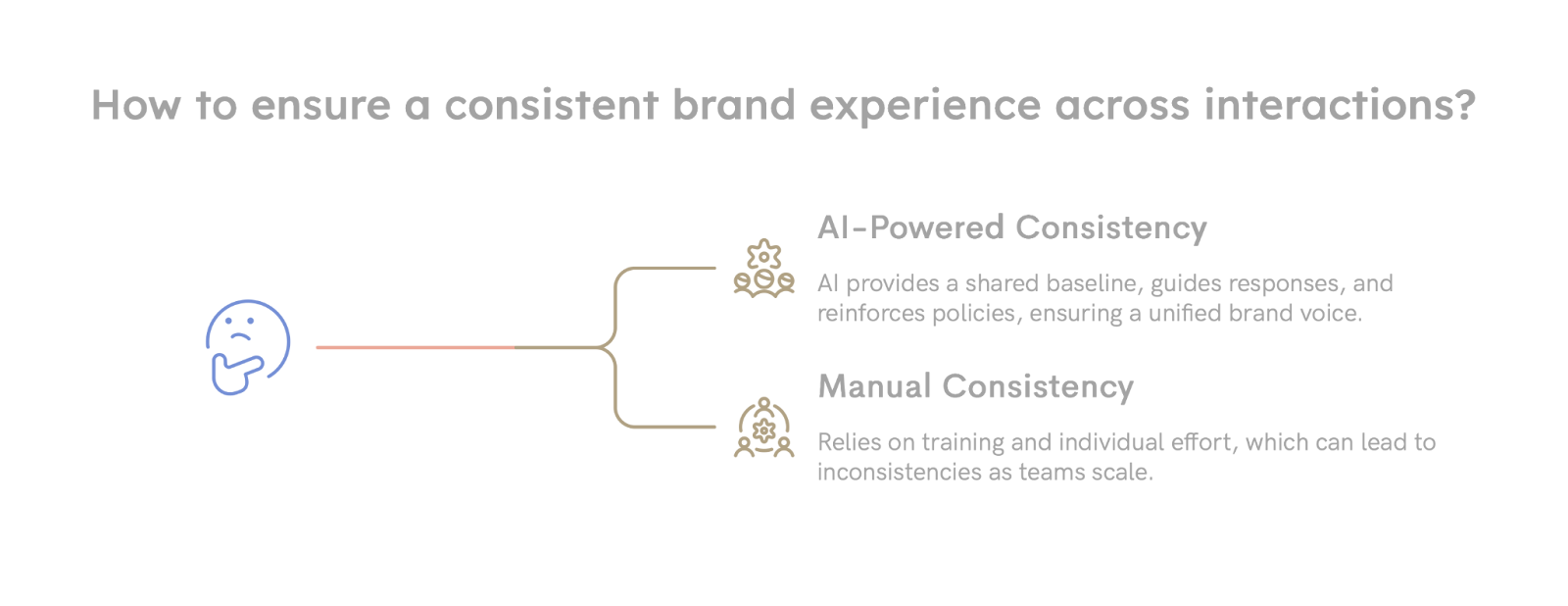
AI also helps catch avoidable mistakes before they reach the customer:
Over time, this creates a steadier customer experience. Customers feel like they’re interacting with one company, not a rotating set of individuals. The brand stays reliable even as volume grows or teams change.
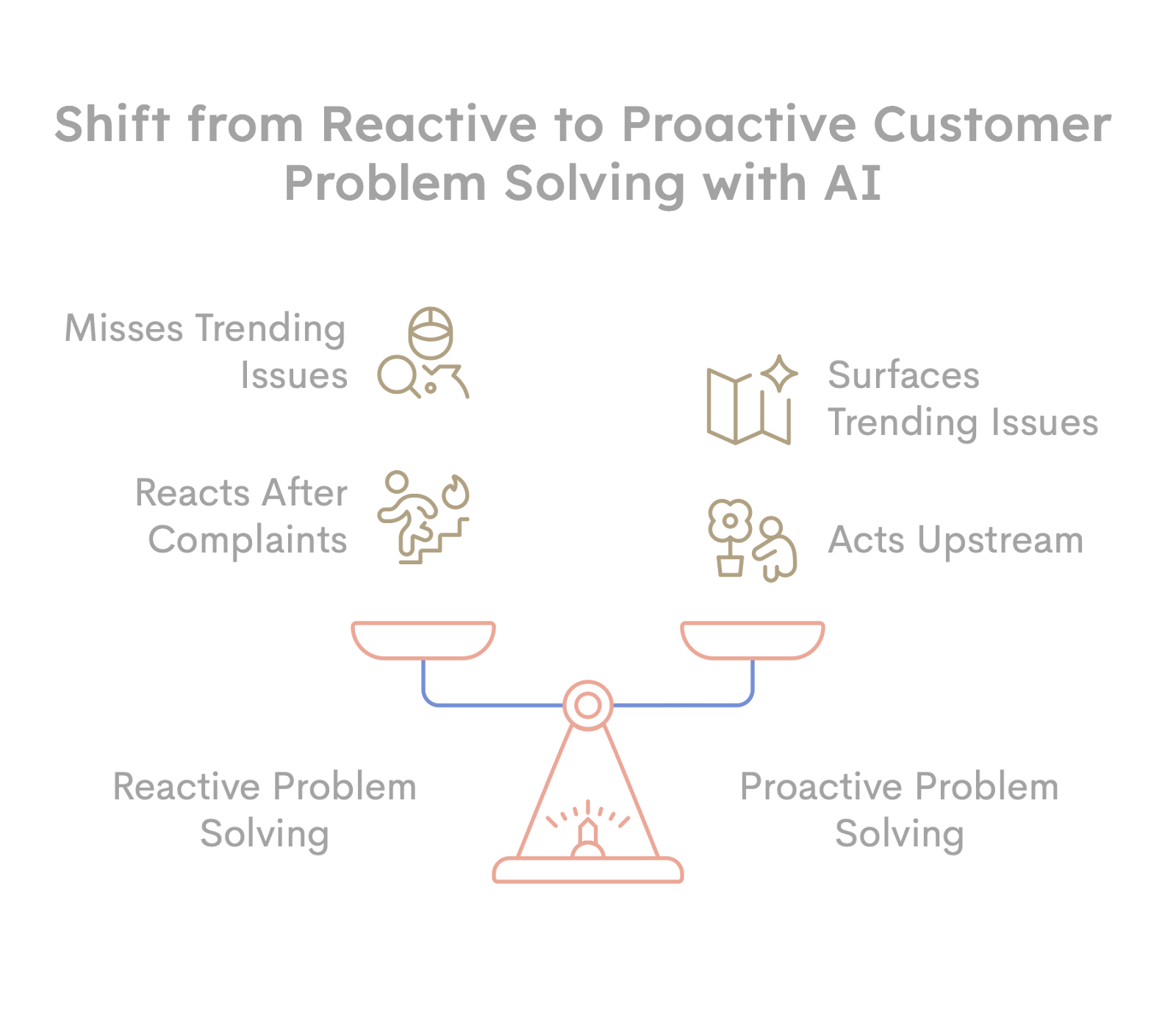
Most customer problems don’t appear suddenly. They repeat quietly. A few similar tickets. Slightly longer resolution times. A pattern that is easy to miss when teams are focused on clearing today’s queue.
AI helps surface these patterns early by analyzing conversations, tickets, and feedback at scale. It looks across volume, wording, sentiment, and outcomes to spot issues that are trending even when no single case looks urgent.
How to detect customer problems before they become big
This kind of analysis can highlight things like:
Once these signals are visible, teams can act upstream. Product fixes can be prioritized. Help content can be updated. Support teams can be briefed before the issue escalates.
The result is fewer repeated problems reaching customers. Instead of reacting after complaints pile up, teams get a chance to fix root causes while the impact is still limited.
Most routing systems rely on forms, dropdowns, or a few keywords. Customers pick the closest option and hope it lands in the right place. When it doesn’t, the conversation stalls before it even starts.
AI changes routing by interpreting what the customer is actually trying to do. It reads the message in full, understands intent, and weighs it against past cases and account context. A billing issue from a long-time customer is treated differently from the same question coming from a new user. A frustrated message is handled differently from a routine request.
This reduces unnecessary handoffs. Agents no longer need to re-triage the case or send it back into the queue. Customers don’t have to restate the problem. The first response is more likely to come from someone who can act.
When routing improves at this level, speed is a side effect. The bigger change is momentum. Issues move forward instead of bouncing around.
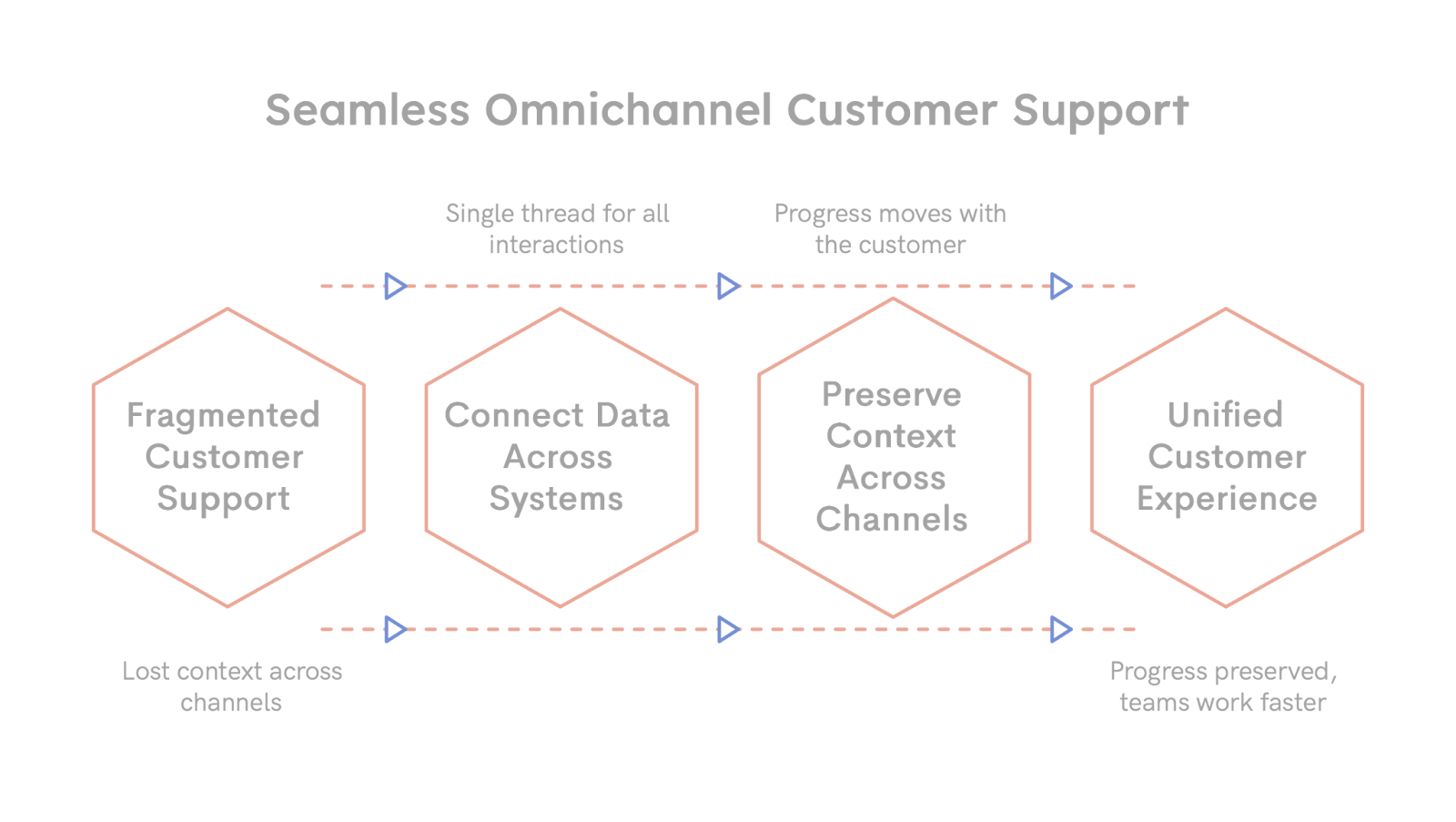
Customers don’t think in channels. They start in one place and move to another based on convenience or urgency. What usually breaks the experience is having to start over every time they switch.
AI enables true omnichannel support by connecting data across systems. Conversations from chat, email, social, in-app, or even in-store interactions are tied together into a single thread. When a customer moves channels, the context moves with them.
This changes the experience in practical ways:
Instead of each channel acting like a separate entry point, AI helps treat them as different doors into the same conversation. Customers stay engaged because progress is preserved. Teams work faster because they’re not reconstructing history.
When AI is added to customer experience teams, the work does not disappear. It redistributes.
The first visible change is reduced friction. Agents spend less time searching for context, rewriting standard replies, or digging through documentation. Information surfaces earlier. Suggestions shorten the mechanical part of the job.
But the bigger changes show up in how teams operate.
AI handles repetitive structure. Humans handle judgment.
Instead of being measured only on speed or ticket volume, strong agents are now expected to:
Consistency improves, but accountability becomes more important.
With AI analyzing conversations at scale, managers gain visibility into trends they would otherwise miss.
They can:
Instead of reacting to isolated tickets, leadership works upstream.
Onboarding no longer centers on memorizing every policy or response template.
It shifts toward:
New hires ramp faster because context is available. The focus moves from recall to reasoning.
AI does not automatically improve CX. Poor implementation creates new problems.
Teams must guard against:
AI works best when roles are clearly defined, and humans retain responsibility.
Over time, mature CX teams treat AI as infrastructure. It reduces repetitive strain, surfaces early signals, and keeps context connected across systems. The human layer becomes more focused on empathy, prioritization, and resolving root causes instead of clearing queues. And overall, teams become more productive.
AI tools are powerful, but when no one owns the workflows, the data hygiene, or the day-to-day execution, they fail. Customer experience suffers not because AI is weak, but because the team around it is stretched or misaligned.
This is where Pearl Talent fits in. We help companies build dedicated CX and operations teams without the cost and friction that usually come with hiring in the U.S. Candidates are screened for communication, problem-solving ability, and real experience.
Instead of hiring reactively or overloading existing teams, companies use Pearl Talent to add sharp operators who know how to work with modern CX stacks. The result is an AI that actually improves customer experience rather than becoming another system to babysit.
Browse available hires and see pre-vetted CX and operations talent ready to join your team.

.svg)