Catena is now Pearl Talent! Same mission, new name.
If you’ve ever looked at a company’s team and thought, how do they keep hiring people like this, it’s usually not luck or a heavy pay package. It’s also rarely the hiring manager alone. There’s almost always a recruiter behind the scenes shaping who shows up, who gets through, and who gets hired for the right role.
Recruiters don’t get much credit when things go right. But they quietly influence the quality of a team over months and years.
This article breaks down the specific qualities that affect how recruiters work day to day. You’ll see how these traits influence sourcing, evaluation, communication, and follow-through, and why they make such a big difference to who gets hired and who doesn’t.
A recruiter helps companies find, evaluate, and hire the right people for specific roles. Their work starts by understanding what the team actually needs, not just the job title, but the skills, expectations, and outcomes tied to the role.
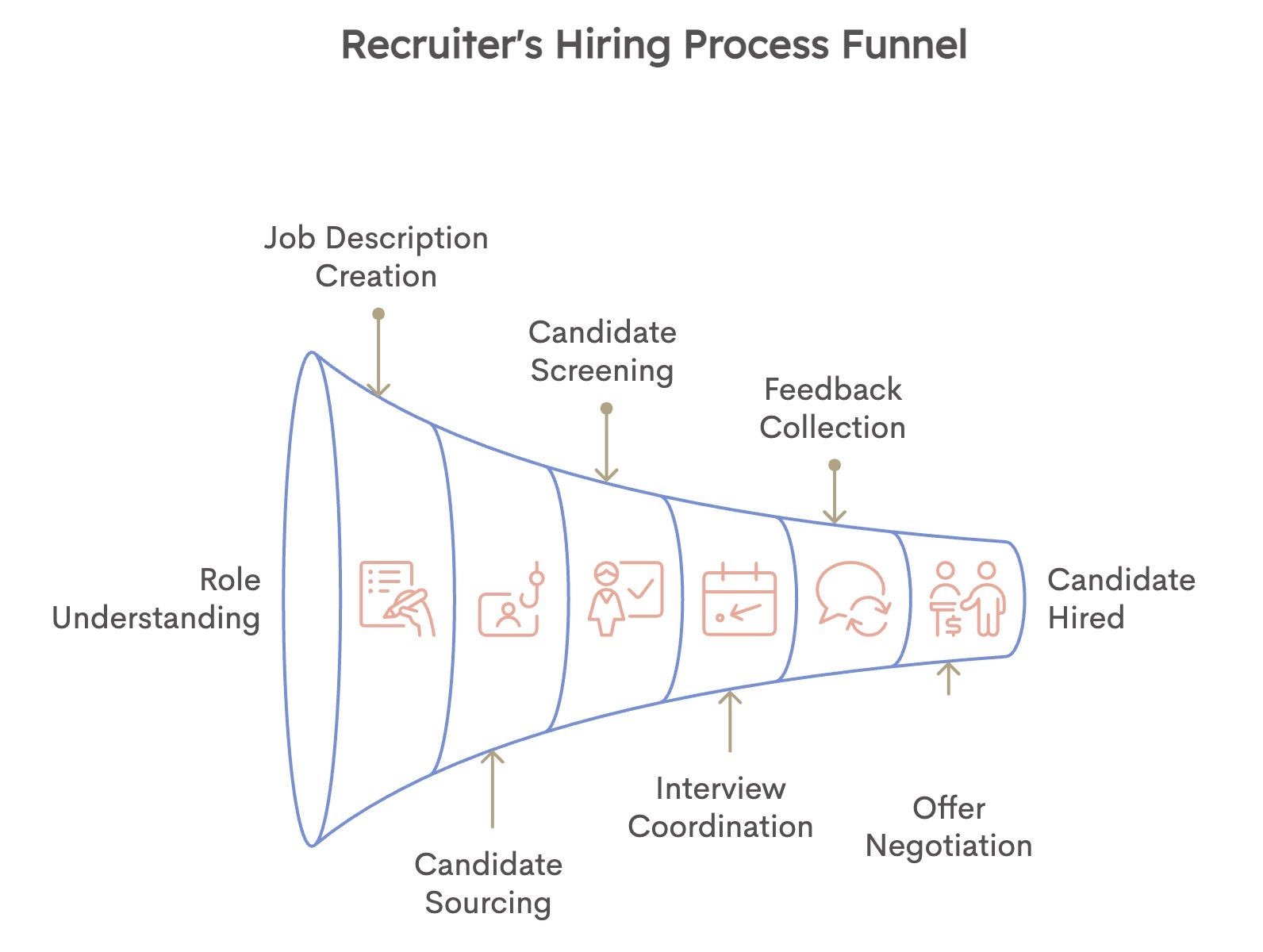
Here are the typical steps in a recruiter’s process:
Throughout this process, they act as a point of communication between hiring managers and candidates, making sure both sides have clarity on expectations and timelines.
An ideal recruiter brings a specific set of qualities that consistently lead to better hiring outcomes. These traits help them understand the role deeply, evaluate candidates more accurately, and connect the right talent to the right team.
Strong recruiters know that good hiring starts before the interview stage. They understand where the right candidates are likely to be working, which titles or backgrounds actually map to the role, and how different markets behave. Instead of relying only on job boards, they actively search, reach out, and build pipelines suited to the role.
This quality shows up in how focused their outreach is. Messages feel relevant, not templated. Shortlists improve faster, and less time is spent filtering obvious mismatches. Over time, strong sourcing instincts reduce time-to-hire and raise the overall quality of candidates entering the process.
These qualities show up in how a recruiter approaches the problem, not just the process. Instead of treating a role as a set of keywords to match, they try to understand why the role exists in the first place. They ask what’s breaking today, what success would look like after the first few months, and what kind of person has historically struggled in similar roles. This curiosity helps them separate what matters from what is simply “nice to have.”
Accountability is what keeps that curiosity from staying theoretical.
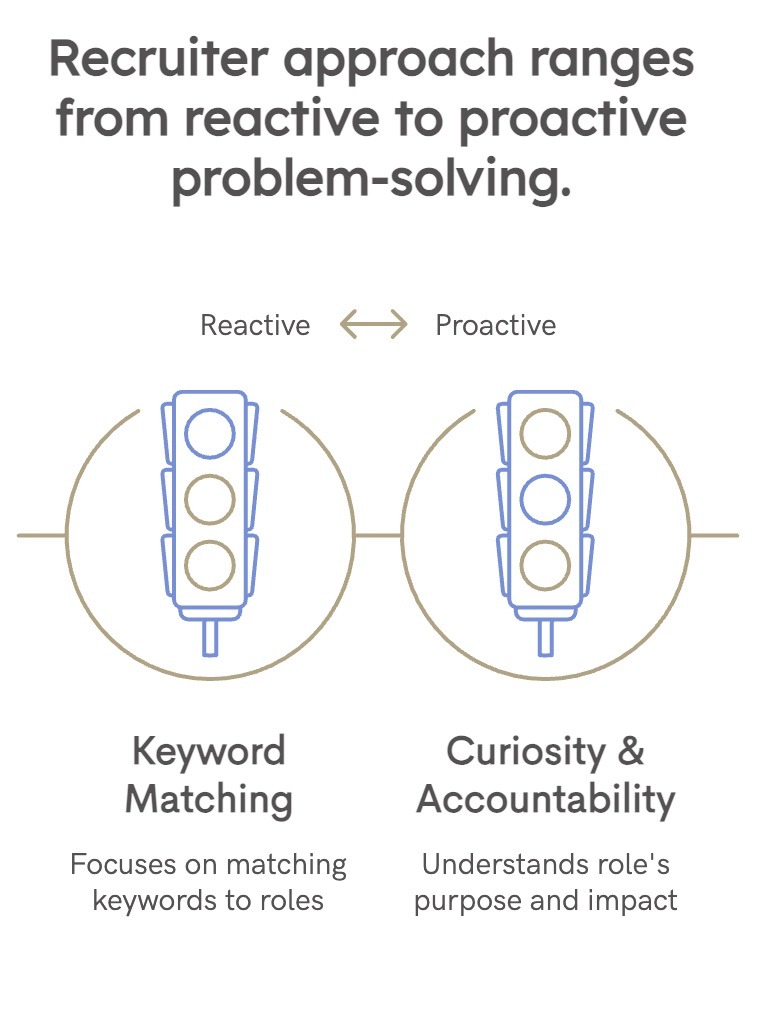
A recruiter with this trait feels responsible for the downstream impact of their decisions. If a candidate looks good on paper but feels misaligned in conversation, they slow things down. If a hiring manager’s expectations seem unrealistic for the market, they raise them early instead of pushing the role live and hoping for the best.
Over time, this quality builds trust on both sides of the market. Candidates feel heard rather than processed, and hiring managers rely on the recruiter’s judgment instead of using them as a scheduling layer. That trust is what allows a recruiter to influence decisions, challenge assumptions, and ultimately hire better talent.
A good recruiter develops judgment that goes beyond resumes and scripted interviews. This quality helps them notice patterns early and avoid being overly influenced by polish or pedigree.
It usually shows up as:
This kind of judgment improves with repetition and feedback, but it also requires restraint. Recruiters with this quality don’t rush to conclusions or oversell candidates. They present strengths and risks clearly, helping teams make informed decisions rather than emotional ones.
Good recruiters communicate differently with hiring managers and candidates, but the goal is the same: to remove any confusion.
With hiring managers, this means setting expectations early and keeping them grounded in reality. They explain what the market looks like, flag risks before they become problems, and share feedback in plain language. There is no overselling and no hiding behind vague updates.
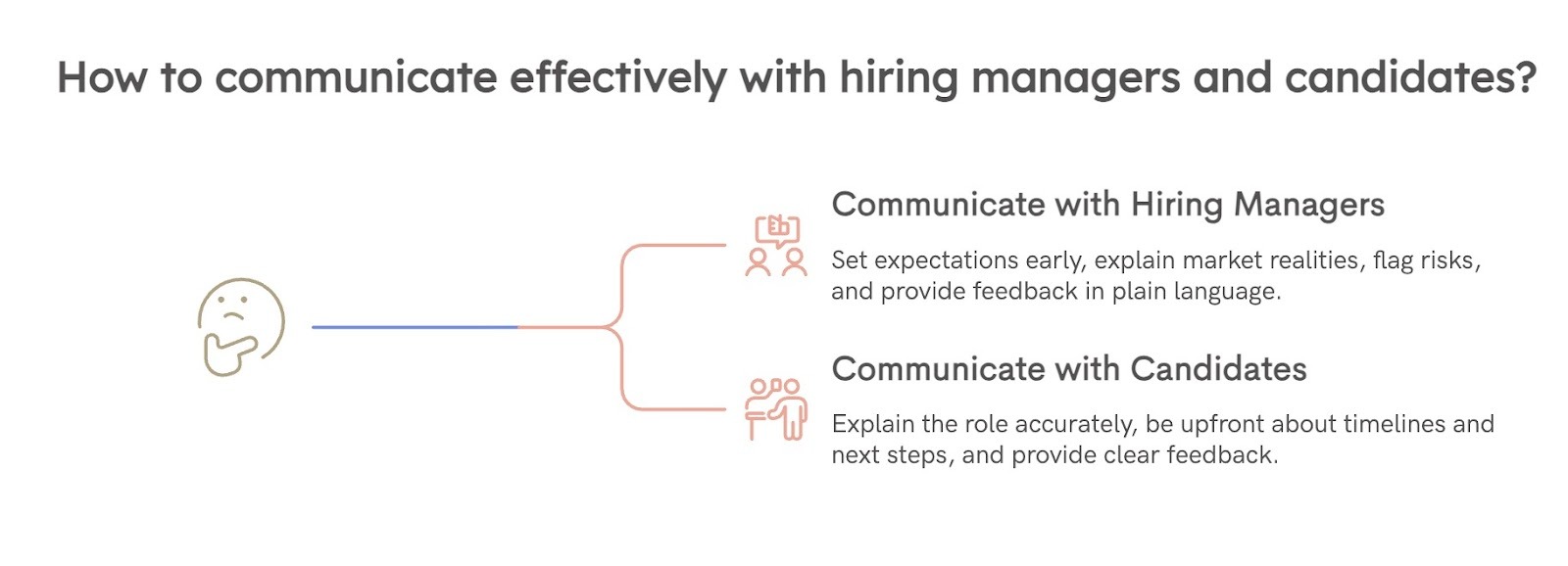
With candidates, clear communication builds trust. Recruiters explain the role as it actually is, not as a pitch. They are upfront about timelines, next steps, and where a candidate stands. Even when the answer is ‘no,’ candidates know where they stand and why. This kind of communication keeps relationships intact and makes people willing to engage again in the future.
Recruiting starts to fall apart when details slip through the cracks or decisions sit unresolved. Strong recruiters bring structure to a process that naturally has many moving parts. They take responsibility for what happens at every stage, from the first message a candidate receives to how the offer is handled and what happens after the hire joins. This discipline keeps momentum high and avoids unnecessary confusion for both candidates and hiring teams.
In practice, operational discipline looks like this:
When recruiters operate this way, fewer candidates drop out mid-process, and hiring managers spend less time chasing updates. The process feels predictable and controlled, which makes better decisions easier to reach.
Good recruiting is repetitive, slow, and full of rejection. Most outreach goes unanswered. Good candidates often say no. Roles fall apart halfway through. A strong recruiter doesn’t get discouraged by this. They keep going without lowering the bar.
Persistence shows up in sourcing first. When initial searches don’t deliver, they try different angles. They widen or narrow criteria thoughtfully instead of blasting more messages. They follow up when it makes sense and move on when it doesn’t, without taking silence personally.
It also shows up later in the process. Candidates drop out. Interviewers delay feedback. Offers take longer than expected. A persistent recruiter keeps the process alive. They nudge decisions forward, re-engage candidates who go quiet, and rebuild pipelines when searches reset.
This quality matters because hiring is rarely linear. Recruiters who lack persistence either rush to fill gaps with weaker candidates or stall when momentum drops. Persistent recruiters stay steady. Over time, that steadiness leads to fuller pipelines, fewer abandoned searches, and hires that don’t feel forced just to close a role.
Strong recruiters ask questions that help them understand how someone actually works. They don’t rush through a list or steer the conversation toward a preset outcome. They give candidates space to explain their experience in their own words and pay attention to how those explanations come together.
This quality shows up in small but important ways:
Listening also shapes how recruiters work with hiring managers. They pick up on what’s being said directly and what’s implied. Over time, they learn where expectations are flexible and where they aren’t. This helps them filter candidates more accurately and avoid misalignment early.
Recruiters who ask well and listen closely make fewer assumptions. Their shortlists tend to be tighter, their feedback clearer, and their hiring outcomes more predictable.
Before you build a strong team, you usually have to hire a strong recruiter. That’s the first bottleneck. If that step drags on, everything else slows down. Roles stay open, plans get delayed, and hiring turns into a constant backlog.
The problem is that finding good recruiters often feels as hard as hiring for the roles they’re meant to fill. Senior recruiters are expensive. Junior ones need a lot of ramp time. Freelancers can be hit or miss. Meanwhile, the work keeps piling up. You lose valuable time.
This is where Pearl Talent can help.
Pearl Talent connects scaling US and EU companies with experienced global recruiters who are used to running hiring processes end to end. Instead of functioning as a resume pipeline, they take ownership of the entire search and are accountable for outcomes.
Here's what you get:
Because we operate as a global talent acquisition partner, companies are able to access experienced recruiting capability without carrying the cost structure of a full US-based hire.
Want to see what working with experienced recruiters looks like in practice? Browse available recruiter profiles and evaluate who aligns best with your requirements.

.svg)