Catena is now Pearl Talent! Same mission, new name.
Hiring a virtual assistant is often less about what they do and more about what changes once they are in place. Their tasks may look simple, but what gets overlooked is the second-order effects of having a virtual assistant. It can be smoother follow-through, fewer interruptions, and work that moves without constant attention.
Because those benefits are not always immediate or visible, they are easy to underestimate. This article looks at the real advantages of hiring a virtual assistant and how you can hire the best virtual assistant for your business.
These benefits tend to show up after the first few weeks, once they know how you delegate tasks and have set up their own workflows for coordinating things with you.
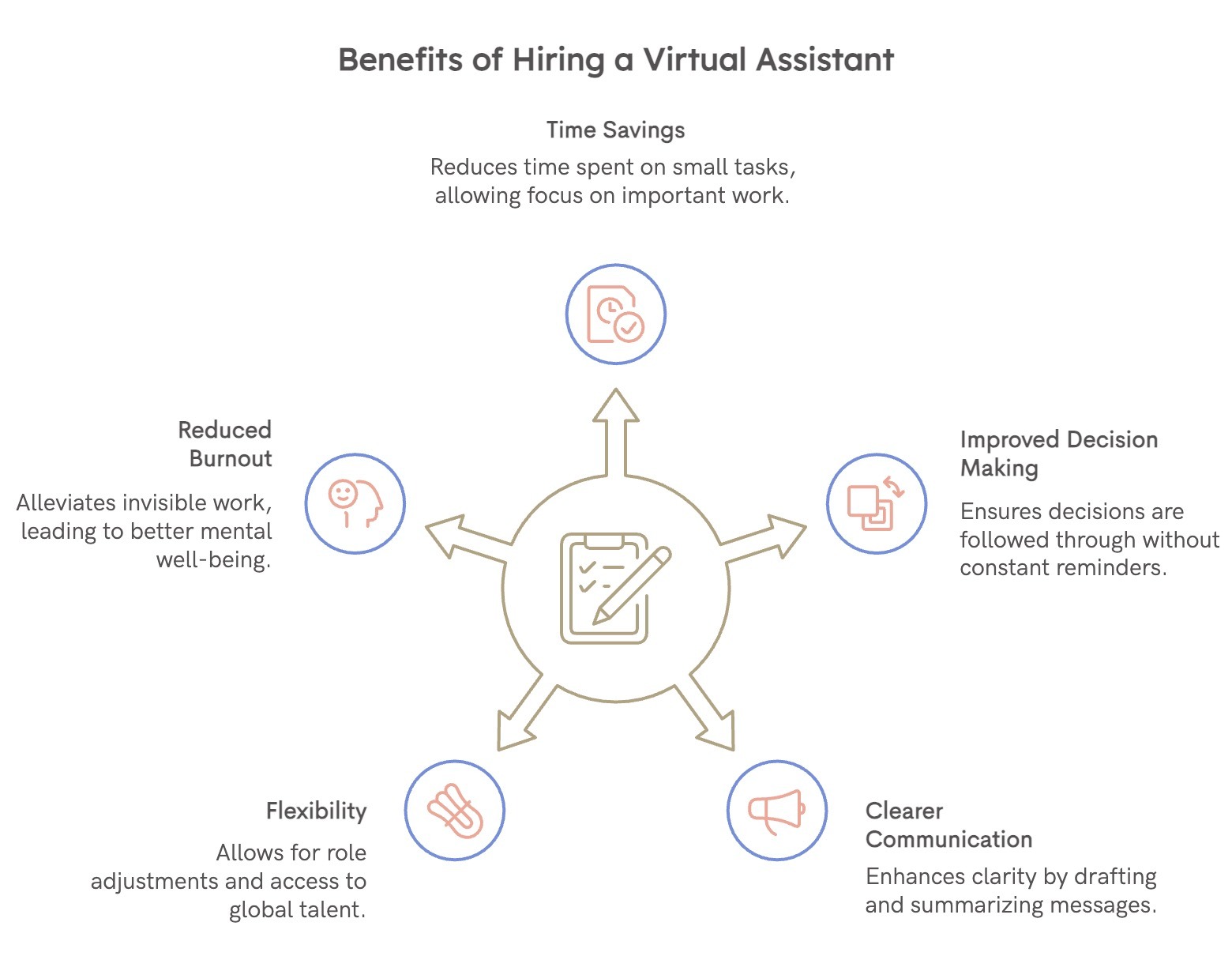
This is usually the first benefit people notice, and it shows up in unglamorous ways.
Instead of spending your mornings replying to scheduling emails, chasing documents, or nudging people for updates, that work quietly disappears from your plate. For example, meetings get set up without three rounds of back-and-forth, files are ready before you ask, and routine admin no longer interrupts deep work.
The shift is subtle but important. You are not just saving time. You are protecting attention. When fewer small tasks pull you out of what you are doing, it becomes easier to stay focused on work that actually needs your thinking.
Many teams do not have a decision problem. They have a follow-through problem.
A virtual assistant helps bridge that gap by tracking what happens after a decision is made. For example, after a client call where you agree to send a revised proposal by Thursday, they might:
You stop being the person who remembers everything. Over time, this creates momentum. Work moves because someone is paying attention to what needs to happen next, not because you are constantly reminding people.
Many people assume better communication means writing more or being more available. In practice, it often means someone else is shaping communication before it reaches you.
A virtual assistant can help by:
This does not make communication louder. It makes it clearer. You spend less time correcting misunderstandings or re-explaining decisions because someone is paying attention to how information is framed and shared.
Virtual assistants are often easier to start with than traditional hires because the role can be shaped over time.
You might begin with a narrow scope, such as inbox support or scheduling, and gradually expand as trust builds. If priorities change, the role can change with them. This is especially useful if your workload fluctuates or if you are still figuring out where support would help most.
Because the role is remote, you are also not limited to local talent. That often makes it easier to find someone whose working style fits you, not just someone available nearby. The flexibility reduces pressure to get everything perfect on day one.
Invisible work is not about tasks. It is the mental weight of holding everything together.
Knowing which client prefers email over Slack. Remember that the vendor contract renews next Tuesday. Keeping track of who still has not responded to last week's request. None of that shows up on a to-do list, but it takes up real space in your head and accumulates quietly across a full week.
This is what makes workloads feel heavier than they look on paper. You can finish every task on your list and still feel drained because the ambient effort of tracking, remembering, and anticipating never actually stops.
A virtual assistant absorbs that layer.
They hold the client preferences, the recurring deadlines, the unfinished threads, and the small contextual details that you would otherwise carry alone. Once someone else is tracking that stuff day to day, the relief is less about getting more done and more about how sustainable your work actually feels week to week.
Anything repeatable, does not require your strategic input, or follows a process you can explain can be delegated to a virtual assistant. But it helps to think about it in layers rather than as a single list, because most people start with one layer and expand from there.
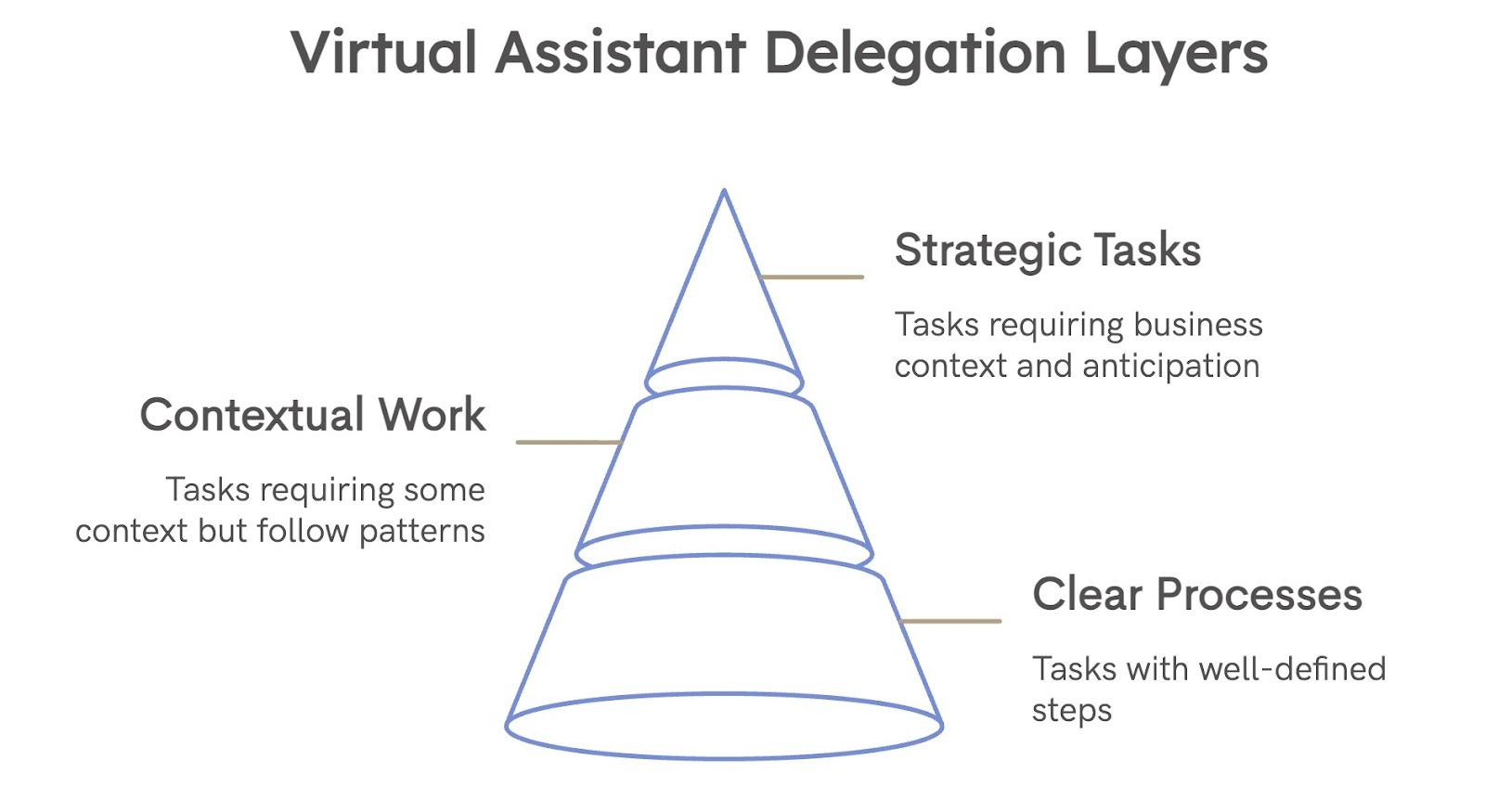
The first layer is the work that already has a clear process, such as:
The second layer is work that requires some context but still follows a pattern.
Things like updating your CRM after sales calls, coordinating between team members on recurring projects, drafting status reports, managing vendor communications, or handling customer inquiries that follow a known set of responses. This is where a VA starts to contribute to your workflows.
The third layer is the work you probably have not thought to delegate yet. It can be researching potential partners, pulling together competitive analysis, organizing internal documentation, prepping materials before meetings, or maintaining SOPs as processes evolve. This layer usually opens up once a VA has enough context about your business to start anticipating what would be useful rather than waiting to be told.
Most of the friction in working with a virtual assistant comes from the first few weeks. Getting a few things right early on makes the difference between a VA who needs constant direction and one who runs ahead of you.
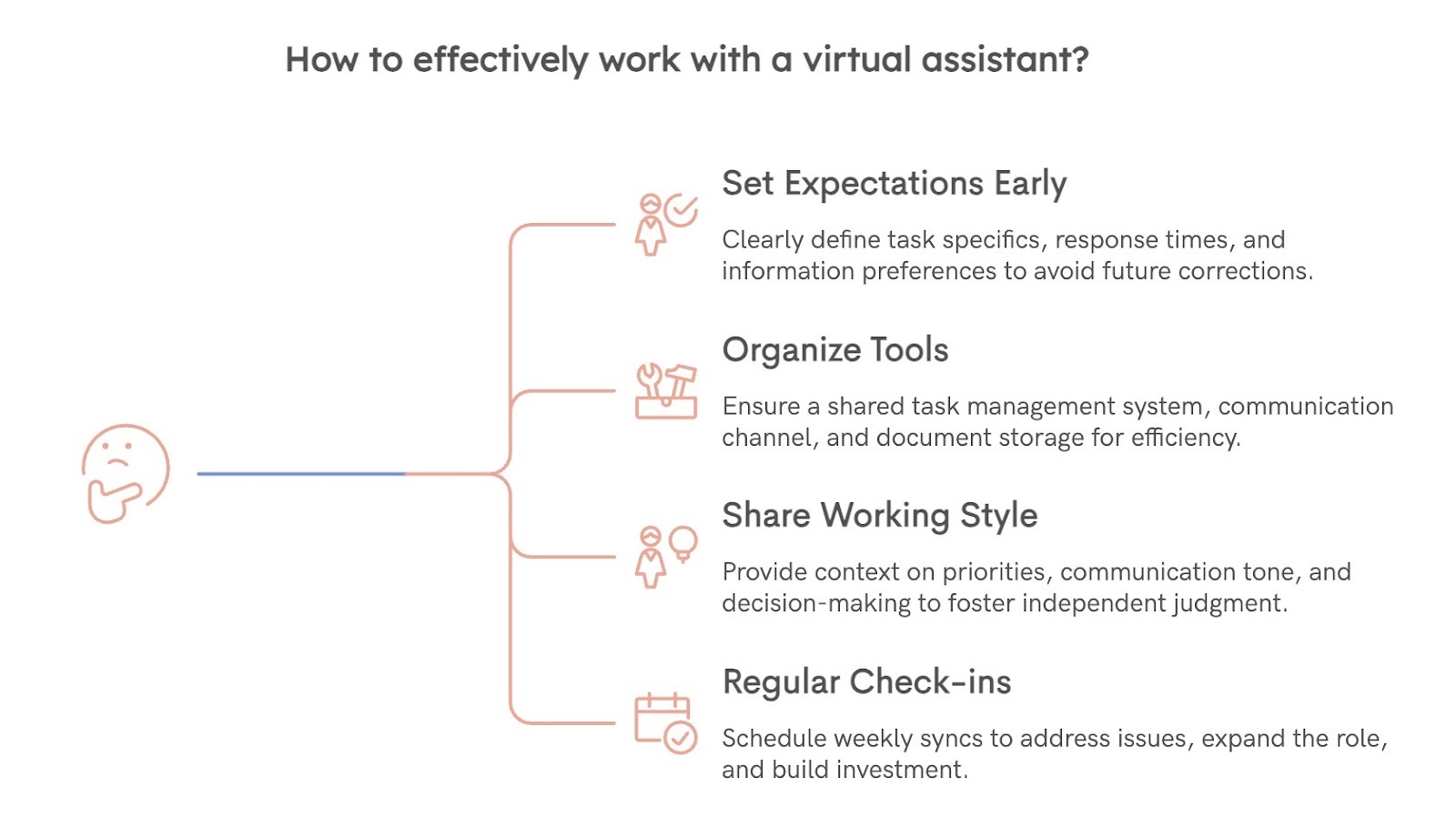
Walk through specifics like when you expect updates, how quickly you want responses, what "done" looks like on a given task, and how you prefer to receive information. None of this is obvious to someone new, even if it feels that way to you. Spending thirty minutes upfront on your preferences saves weeks of small corrections later. The more specific you are, the faster your VA stops asking and starts anticipating.
A VA can only be as organized as the systems you give them access to. You do not need a complicated setup, but before day one, make sure you have:
If your tasks are scattered across Slack threads, inboxes, and random docs, even a great VA will spend their first few weeks just trying to figure out where things live instead of doing the work.
This is the part most people skip. Telling your VA to manage your inbox is not enough if you have not explained which emails are high priority, which ones can wait, and which ones you want to see untouched. The same applies to communication tone, level of detail in updates, and when to loop you in versus handle something independently. The goal is not to script every move but to give them enough context about your working style that their judgment starts to feel like an extension of yours.
A short weekly sync, especially in the first month or two. That is all it takes. It gives both of you a space to flag what is working, what is not, and where the role could expand. Without it, small issues build up quietly until someone is frustrated. It also signals to your VA that you are invested in making the relationship work, which tends to bring out more initiative on their end.
Hiring processes break down at the sourcing stage. You screen dozens of resumes, run decent interviews, and still end up choosing from a pool where many candidates look similar on paper.
Pearl Talent solves that problem by starting with quality, not volume.
Every candidate goes through communication evaluations, judgment-based assessments, and remote-readiness checks before they ever reach you. Every role is headhunted based on your needs, and not matched from a generic bench.
Here's what Pearl Talent offers:
Pearl Talent stays involved after the hire with structured check-ins at 30, 60, and 90 days, plus ongoing coaching and upskilling. Your VA keeps building context, taking on more responsibility, and getting sharper at anticipating what you need. The result is support that compounds over time instead of plateauing after onboarding.
Browse virtual assistants available for hire with Pearl Talent.

.svg)