Catena is now Pearl Talent! Same mission, new name.
If you're running a growing company and trying to figure out what you'll actually spend on an executive assistant, the salary number you see on a job board is only the starting point. The gap between the posted salary and the true cost of an EA hire is wider than most founders expect, and understanding that gap is what separates a smart hiring decision from one that quietly drains your budget.
The average base salary for an executive assistant in the US sits somewhere between $60,000 and $75,000, depending on which source you're looking at.
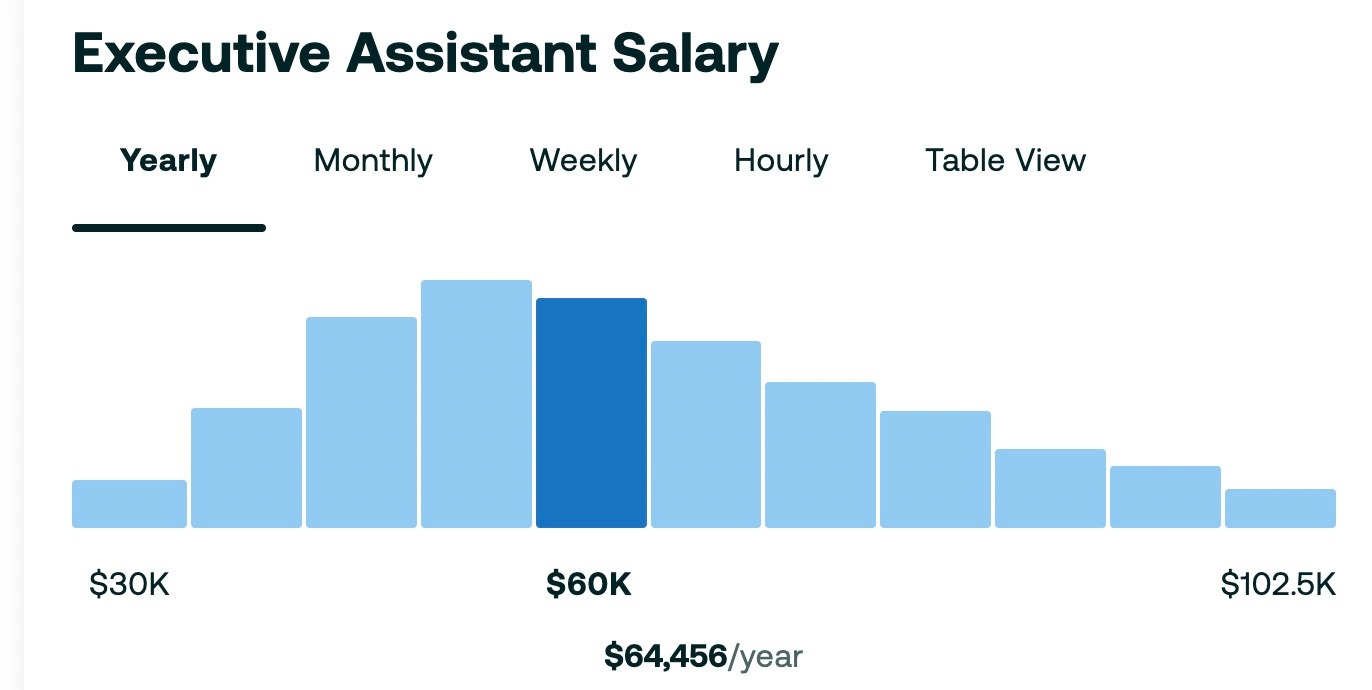
ZipRecruiter puts the national average at around $64,500.
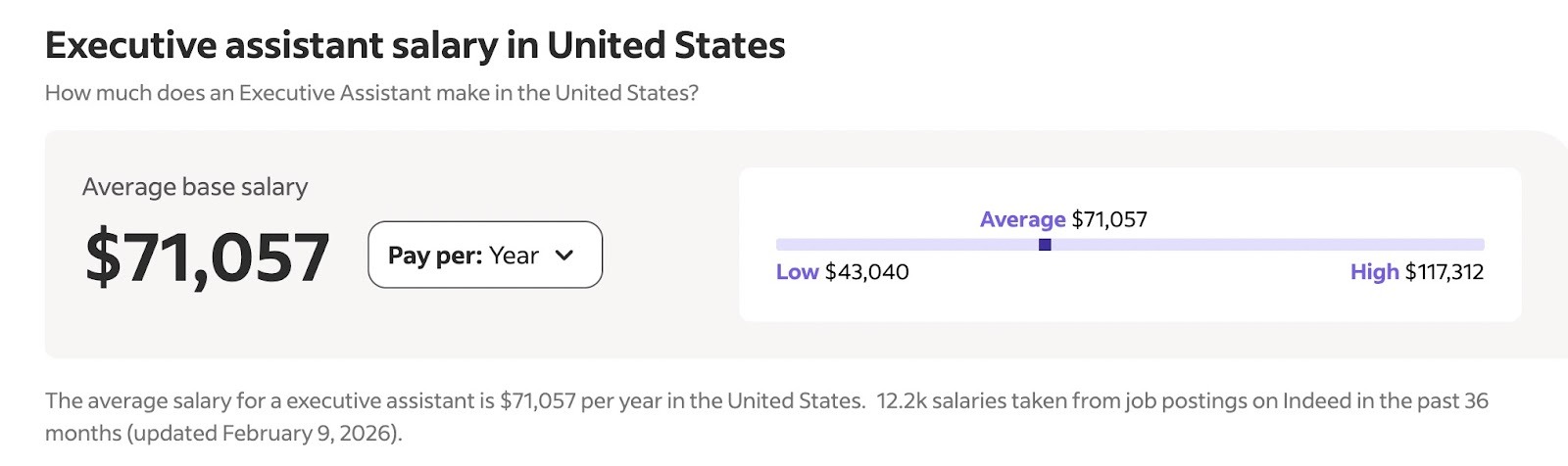
Indeed reports closer to $71,000
But base salary is just one line in a much bigger spreadsheet. Once you layer on employer costs, the real number moves significantly.
Add in retirement contributions, PTO, equipment, and software licenses, and a conservative rule of thumb is that total employer costs run 25 to 40% above base salary.
So that $70,000 EA? You're realistically looking at $90,000 to $100,000 in fully loaded cost by the time all the line items are accounted for.
Beyond the fully loaded compensation, there's a set of costs that most companies don't account for upfront but end up paying anyway.
If you're working with a domestic recruiting agency, expect to pay 15 to 25% of the first-year salary as a placement fee. For a $75,000 hire, that's $11,000 to $19,000 before the person starts.
If you're sourcing and interviewing internally, you're spending founder or operator time on resume screening, phone screens, interviews, reference checks, and offer negotiations.
For a team of 15 to 40 people where every senior person is wearing multiple hats, that time cost is very real, even if it doesn't show up on a balance sheet.
Even a strong EA needs one to three months to learn your systems, preferences, communication style, and team dynamics. During that window, they're productive at maybe 50 to 70% of their eventual capacity, which means you're paying full cost for partial output while also spending your own time training.
If the hire doesn't work out, and EA turnover at startups tends to be higher than people expect because the role is often poorly scoped or under-supported, you're back to square one. You've spent the recruiting fees, absorbed the ramp-up period, and now you're doing it all again. The generally accepted estimate is that replacing an employee costs 50 to 200% of their annual salary when you add it all up.
For companies that have already decided to build globally, or are seriously considering it, hiring an executive assistant from the Philippines, Latin America, or South Africa changes the cost equation substantially without necessarily changing the quality equation.
The cost difference comes down to cost-of-living arbitrage, not a gap in talent quality.
A highly experienced EA in the Philippines or Colombia who previously worked at a prestigious local company or multinational might earn $20,000 to $25,000 locally.
Through a talent partner like Pearl Talent, companies typically pay around $3,000 per month for a fully managed placement. That's $36,000 per year. It includes sourcing, vetting, payroll, compliance, pre-onboarding training, and ongoing performance management. Compare that to the $90,000 to $100,000 fully loaded cost of a US-based EA, and you're looking at a 60 to 65% reduction in cost.
The talent isn't cheaper because it's lesser. It's more affordable because the cost of living in Manila or Bogotá is fundamentally different from San Francisco or Austin.
What matters more than the price difference, though, is whether the person can actually do the job at the level you need.
Many agencies hire in bulk and maintain a bench of pre-vetted candidates. When a client signs, they match from that existing pool.
Pearl Talent's approach to hiring executive assistants is different from how most outsourcing or staffing companies operate. Pearl Talent does not work from a bench. We headhunt for every individual role. We source from prestigious local companies and top universities. Every candidate goes through rigorous checks to make sure they're a fit for your needs.
Most founders focus on what an executive assistant costs. The bigger number is what you lose by not having one, or by hiring the wrong one
If you're a founder or COO spending 10 to 15 hours a week on things like calendar management, email triage, travel coordination, and vendor follow-ups, that's the time you're not putting toward fundraising, closing deals, or building products. Administrative tasks reduce the time and energy available for those responsibilities.
The issue is not that admin work is unimportant. But it does not require the founder’s direct involvement. The cost of not hiring an executive assistant is not only time. It is reduced clarity, slower execution, and missed opportunities to operate at a higher level.
A great EA doesn't just free up your time. They also:
The companies that get the most out of this hire treat it as a force multiplier, not an administrative expense. They define the scope clearly, budget for quality, and choose partners who are accountable for outcomes beyond just the initial placement.
Not all talent partners work the same way, and the questions you ask before signing will tell you a lot more than the pricing page on their website. Here are the things worth digging into before you commit:
The right partner should be able to answer all of these clearly and specifically. Vague responses or redirects back to pricing are usually a sign that the process behind the price isn't as strong as the marketing suggests.
The difference between an EA who transforms how you work and one who quietly drains your time usually comes down to how they were sourced, vetted, and supported after the hire. Most companies get one or two of those right. Very few get all three, especially when hiring across borders.
That's the problem Pearl Talent was built to solve.
Over 200 companies backed by Y Combinator, Sequoia, a16z, and Founders Fund have trusted Pearl to build their teams. Browse available hires and start building your global team.

.svg)