Catena is now Pearl Talent! Same mission, new name.
A study by Gartner predicts that, by 2028, 1 in 4 candidate profiles will be fake. From lying about their credentials in resumes to impersonating someone else, candidate fraud during remote hiring processes is on the rise. Plus, AI has only made deception easier.
A candidate lying on their resume might seem like a minor thing, but when you unknowingly hire ineligible or fraudulent candidates, you put your entire organisation at risk.
So, how do you make sure not to fall victim to remote staffing fraud? By knowing the types of fraud prevalent in the job market, and having strict verification protocols in place. We cover everything you need to know in this remote staffing, security and fraud prevention guide.
Knowing what types of candidate fraud you’re up against can make it easier to learn how to spot the signs. Here are the most common types of remote staffing fraud by candidates.
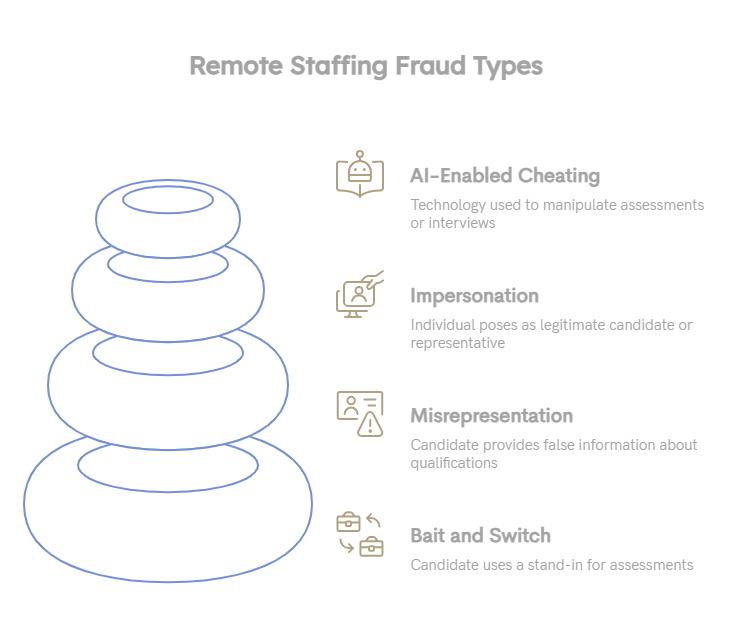
Bait and switch is when a highly skilled candidate appears for the interview(s) and assessments, only to be replaced by an unskilled employee after they’ve been hired and onboarded. It’s a tactic that candidates use to get jobs they aren’t qualified for.
Consequences: The employee delivers low-quality work, bringing down the productivity levels of your organization, which can damage your reputation. Their poor quality work may also contain several errors, requiring cross-checking by others, wasting precious time and resources.
This involves candidates lying on their resumes, typically about their education, past work experiences, skills, or references, to inflate their credentials.
Consequences: This carries a lower risk than others, but if the candidate doesn’t have the necessary skills, it can lower productivity. The unskilled candidates may even outsource their work to unauthorized outsiders through remote desktop access, making confidential company data vulnerable to leaks
Fraudsters often steal other, more qualified people’s identities and use deepfake videos and AI manipulation to pose as them during interviews. Since they use the real LinkedIn profiles, resumes, and portfolios of the people they’re impersonating, everything seems legitimate during the hiring process.
Consequences: When these impersonators get hired, they gain access to sensitive company information, often by installing malware or hacking into internal systems. They can leak or sell the data, causing massive reputational and financial losses for your organization.
This is where candidates use AI to answer questions or complete skill-based assessments for them in a bid to appear smarter.
Consequences: The employee delivers shoddy work, which affects your organizational goals. Whether you decide to invest in their training or hire a different person, you end up wasting time, energy, and financial resources.
Statistics show that hiring a single bad candidate can cost you as much as $15,000. In addition to financial losses, you also waste time and resources and run the risk of putting sensitive company data in the wrong hands.
Following these remote staffing security and fraud prevention tips will help make your hiring process more secure.
Startups and small businesses often skip this step, thinking a post-employment check will be enough. But if you don’t screen out the bad candidates before they enter your organization, you’re losing money and resources.
Your candidate background check should involve verifying:
When you onboard Pearl Talent as a talent acquisition partner, you get access to pre-vetted candidate profiles, which could save you hours on verification.
Checking your candidate’s ID cards against their government databases is one of the best ways to make sure they match. For a more layered security process, you can ask your candidates to take a live photo or video of themselves and use biometric verification tools to match their photos to their government-issued IDs. These tools capture the candidate’s facial markers to make sure they haven’t used deepfake photos.
Analyzing candidates’ documents for forgery and tampering through digital tools is also a good addition to the verification process. But these AI tools aren’t always accurate, so take their results with a grain of salt.
Scoping out your candidates’ online presence can give you greater insight into whether they really are who they say they are. For starters, you can verify their credentials through professional platforms like LinkedIn and see if there are any discrepancies.
Additionally, digital footprints also help you identify applicant red flags early on. For instance, if a candidate has only recently created work-related profiles or uses the same photo (or stock photos) everywhere, they may be impersonating someone else.
When the interview and assessment process is asynchronous, it becomes easier for candidates to AI-generate answers or have someone else do the tests in their place. This won't give you a real measure of their skills. The solution is to do everything in real time to minimize the chances of an applicant cheating.
While AI advancement has made it virtually impossible to spot deepfakes at a glance, some signs can indicate something is wrong. If you notice any of the following red flags, your candidate may be using deepfake tech.
To prevent deepfakes, you can have multiple verification checkpoints throughout the process (such as asking the applicant to make sudden, unplanned actions like turning sideways or holding up an object). Making the candidates log in with multiple video angles also helps.
Instead of just cross-checking a candidate’s past work experiences, go one step beyond and ask them specific questions about their processes and thoughts. For example, you can ask them about a time they spearheaded a project with questions like “how did you solve X problem?” or “what made you think of this solution?”
If you suspect the candidate may be using AI or someone else to answer, you can mix in a few personal questions to throw them off. “What is your favorite coffee spot?” Make sure to bring up their answers to these questions at a later time (maybe during the next interview) to make sure you were talking to the same person.
When you partner with agencies like Pearl Talent, you get access to pre-vetted candidates who have been thoroughly assessed. Not only do we conduct rigorous background checks, but we also assess them on their skills and values and train them ourselves.
And if a Pearl Talent hire doesn’t work out for some reason? We replace them at no additional cost to you. This practically brings down your risks of a bad hire to zero.
At Pearl Talent, we like to keep our talent pool tight. Each of our candidates is handpicked by us and goes through a comprehensive screening and AI-training process before they become available for you to hire. This means that when you hire someone through us, you can be sure that each line on their resume has been verified and each skill tested.
Here are the benefits of partnering with us:
Protect your company from bad hires by working with an agency like Pearl Talent with a 90%+ employee retention rate. Get hand-picked candidate profiles.

.svg)