Catena is now Pearl Talent! Same mission, new name.
An account manager is the person responsible for owning the relationship between your company and your clients after the sale is made. Their job starts once a customer is already on board.
That means an account manager is the main point of contact for a set of clients. They handle the day-to-day communication, flag issues before they become problems, and look for opportunities to expand the account over time. If a client has a question, a concern, or a request, the account manager is usually the first person they reach out to.
This guide breaks down what account managers actually do across different industries, how to tell when your business needs one, and what to screen for when you're ready to hire.
The scope of the role shifts depending on the type of business.
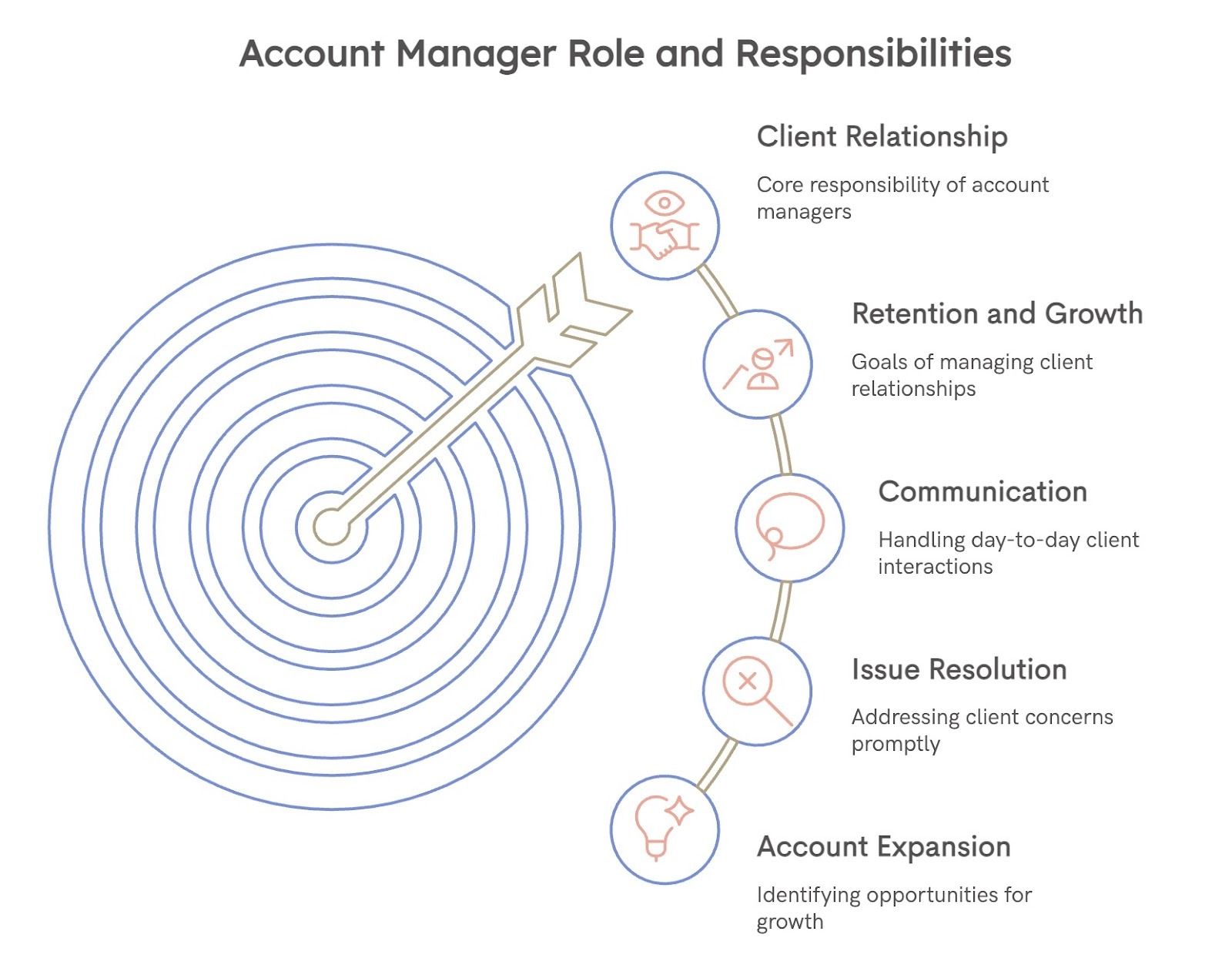
What stays consistent across all of these is the core function: the account manager owns the client relationship post-sale and is responsible for retention and growth within that account. They make sure nothing falls through the cracks and that the client's experience actually matches what was promised during the sales process.
It's worth noting that account managers are different from account executives, even though the titles sound similar. Account executives are typically focused on acquiring new clients. Account managers are focused on keeping and growing existing ones.
Not every company needs a dedicated account manager, and hiring one too early can create its own problems, like adding a layer between you and your clients before the relationship model is even figured out.
The clearest signal that you need one is when client relationships are generating real revenue risk. That means things like:
These aren't just operational annoyances. Each one of them is money walking out the door because nobody's job is to catch it.
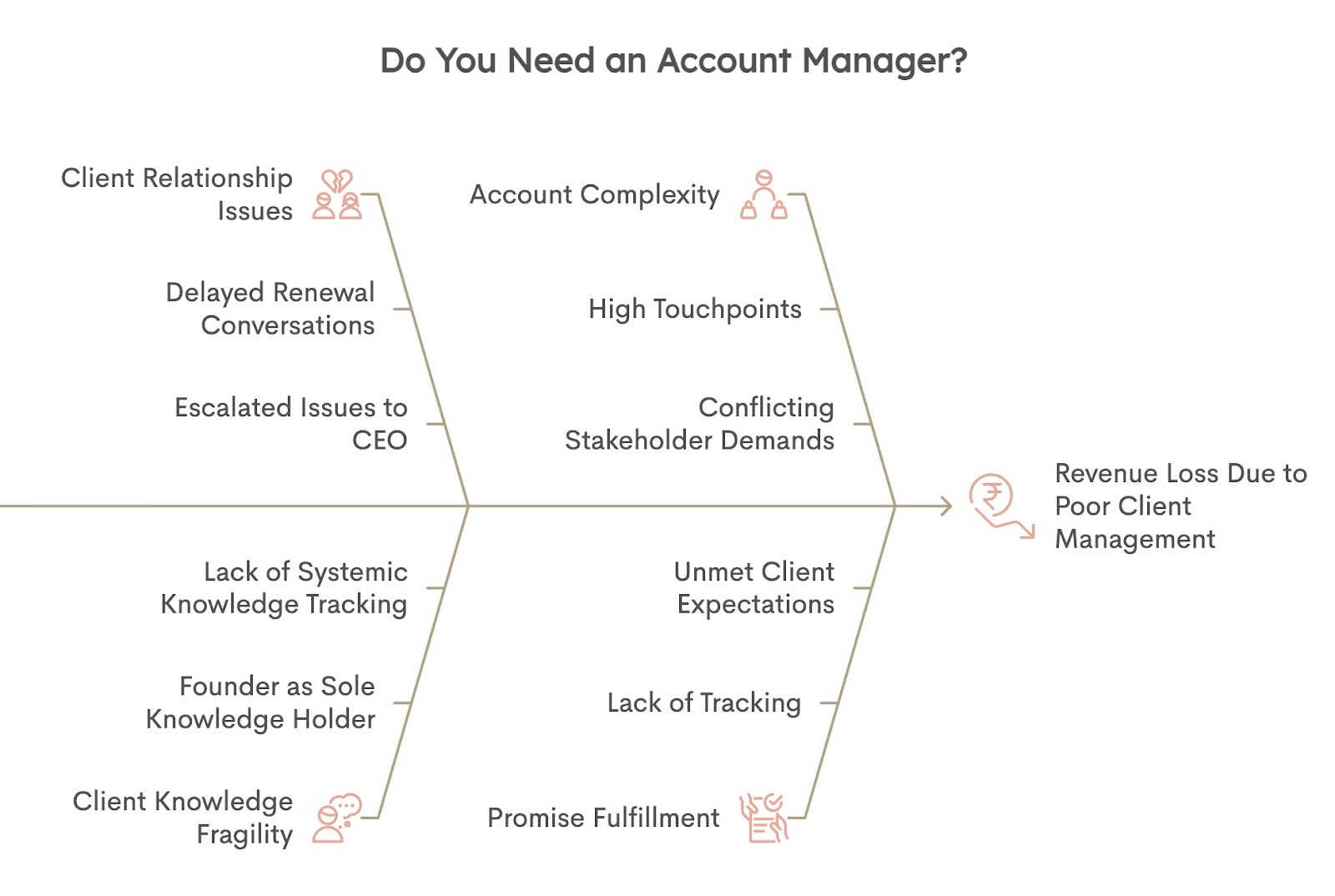
Think about where your client's knowledge actually lives. If your founder is the only person who knows that Client A is frustrated with response times, or that Client B mentioned a budget for a second hire next quarter, that's fragile. One busy week and those details disappear. An account manager turns that into a system instead of letting it depend on someone's memory.
It's also worth looking at how complex your accounts are. A few questions to gut-check this:
If nobody owns those answers, things will eventually slip. Maybe not this month, but soon.
When hiring for the role of account manager, you have to look at a blend of relationship instincts and operational discipline. Here's what actually separates the ones who perform from the ones who just stay busy.
A good account manager doesn't communicate the same way with every stakeholder. They know when a client needs a detailed walkthrough and when they just need a three-line email confirming something's handled. They can translate technical issues into business language for a CEO, then turn around and give the engineering team precise context on what the client actually needs fixed.
The thing to test for in interviews is whether they can shift how they communicate depending on who they're talking to. Ask them to explain a complex situation they had to communicate to two very different audiences. If they can only operate in one register, that's going to become a problem once they're managing accounts with multiple decision-makers.
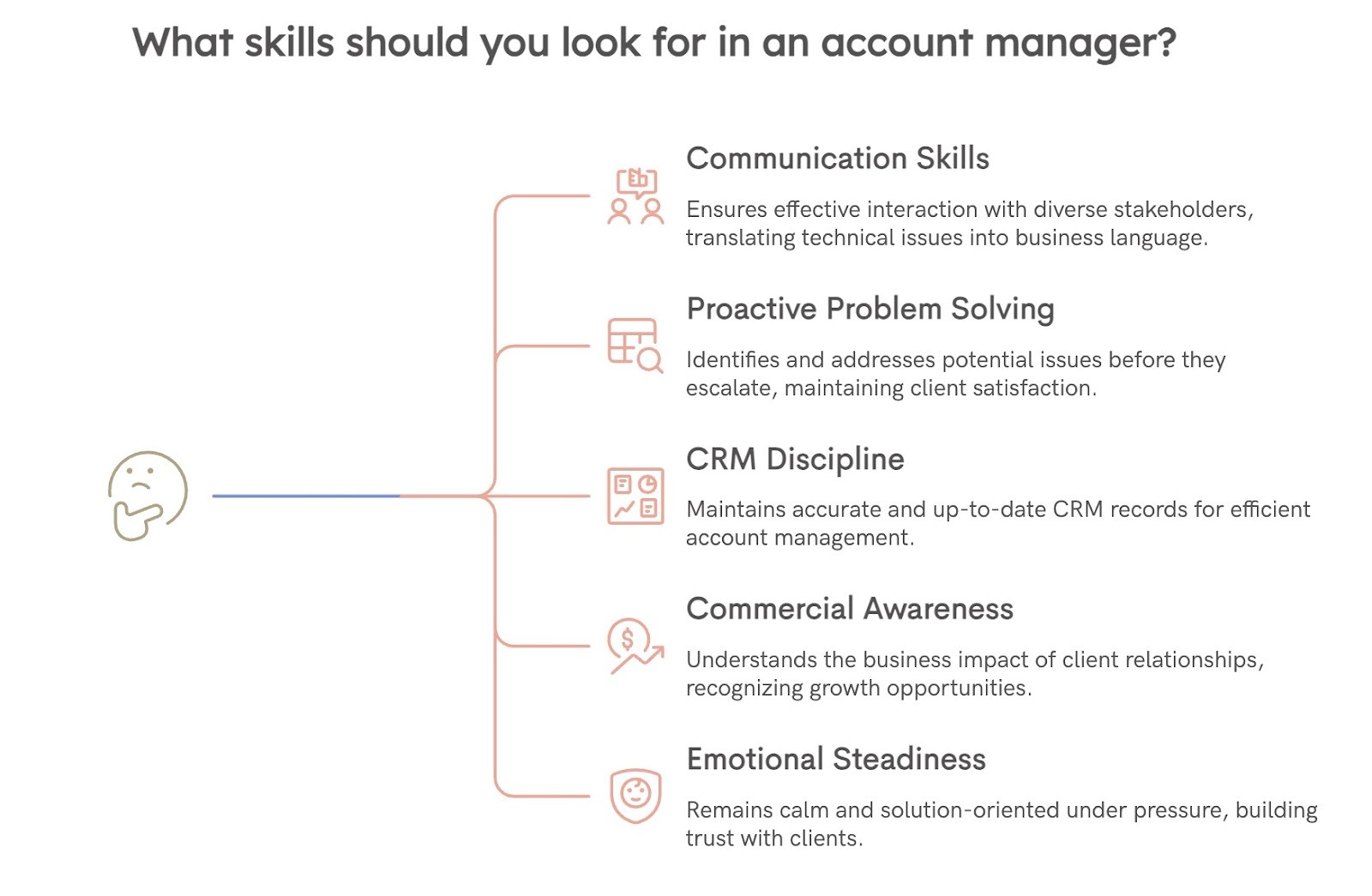
This is the difference between an account manager who manages and one who just maintains. The maintenance version waits for clients to raise issues, responds politely, and moves on. A strong account manager works ahead of the client, catching friction before it becomes a conversation and surfacing opportunities the client hasn't thought about yet.
What that looks like:
You want someone who treats silence from a client as something to investigate, not something to enjoy.
You want someone who actually lives inside your CRM and keeps it accurate, not someone who updates it once a week before a team meeting. A strong account manager logs calls, tracks contract dates, records client feedback, and keeps every deal stage current without being reminded. Ask candidates to walk you through how they used their last CRM day-to-day:
If their answer is vague or they treated the CRM as an afterthought, you'll end up with blind spots across your accounts within a few months.
Account managers who only focus on keeping clients happy without understanding the business side of the relationship will cap out quickly. The best ones understand how their accounts connect to revenue targets, and they think about growth as part of their job rather than something that belongs to sales.
That doesn't mean they should be pushy upsellers. It means they should be able to:
If someone has never thought about how their work connects to the company's bottom line, they'll need heavy coaching to get there.
Clients get frustrated. Deals get complicated. Internal teams miss deadlines. The account manager sits at the center of all of that, and if they spiral when things get tense, the client feels it immediately.
The best account managers stay clear-headed when a client is upset. They acknowledge the problem without getting defensive and then actually move toward a solution instead of getting stuck in apology mode. They treat a difficult client conversation as a chance to build more trust rather than something to survive. That's a temperament thing as much as a skill, and it's worth screening for during the hiring process.
Finding a strong account manager takes time. You need someone who can handle client relationships with real ownership, keep your CRM clean, and spot revenue opportunities without being told to look for them. Sourcing and interviewing for all of that while you're already stretched thin managing clients yourself is how the hire keeps getting pushed to next quarter.
Pearl Talent handles the entire process for you. We source account managers from the top 1% of global talent across the Philippines, Latin America, and South Africa. Many of these candidates are already pre-vetted and available, so you'll be able to hire in days, not weeks.
Here's what you get:
Browse available hires, and get an account manager who's ready to support your business.

.svg)