Catena is now Pearl Talent! Same mission, new name.
If you’re looking to scale your development needs quickly with a diverse group of talented developers while saving on overhead costs, it makes sense to go fully remote. But remote developer management comes with its own set of challenges.
As one Redditor put it, “Managing everything has been a mess. We’re constantly context-switching between code, client calls, bug fixes, and new feature requests. Half the time, someone’s waiting on a response, another person’s fixing something they weren’t supposed to touch, and I’m sitting there trying to figure out how we’re already behind schedule when it’s only Tuesday.”
So, unless you find the right developers to work with and have smooth management systems in place, productivity is going to suffer. In this guide, we’ll cover the basics of building and managing remote dev teams.
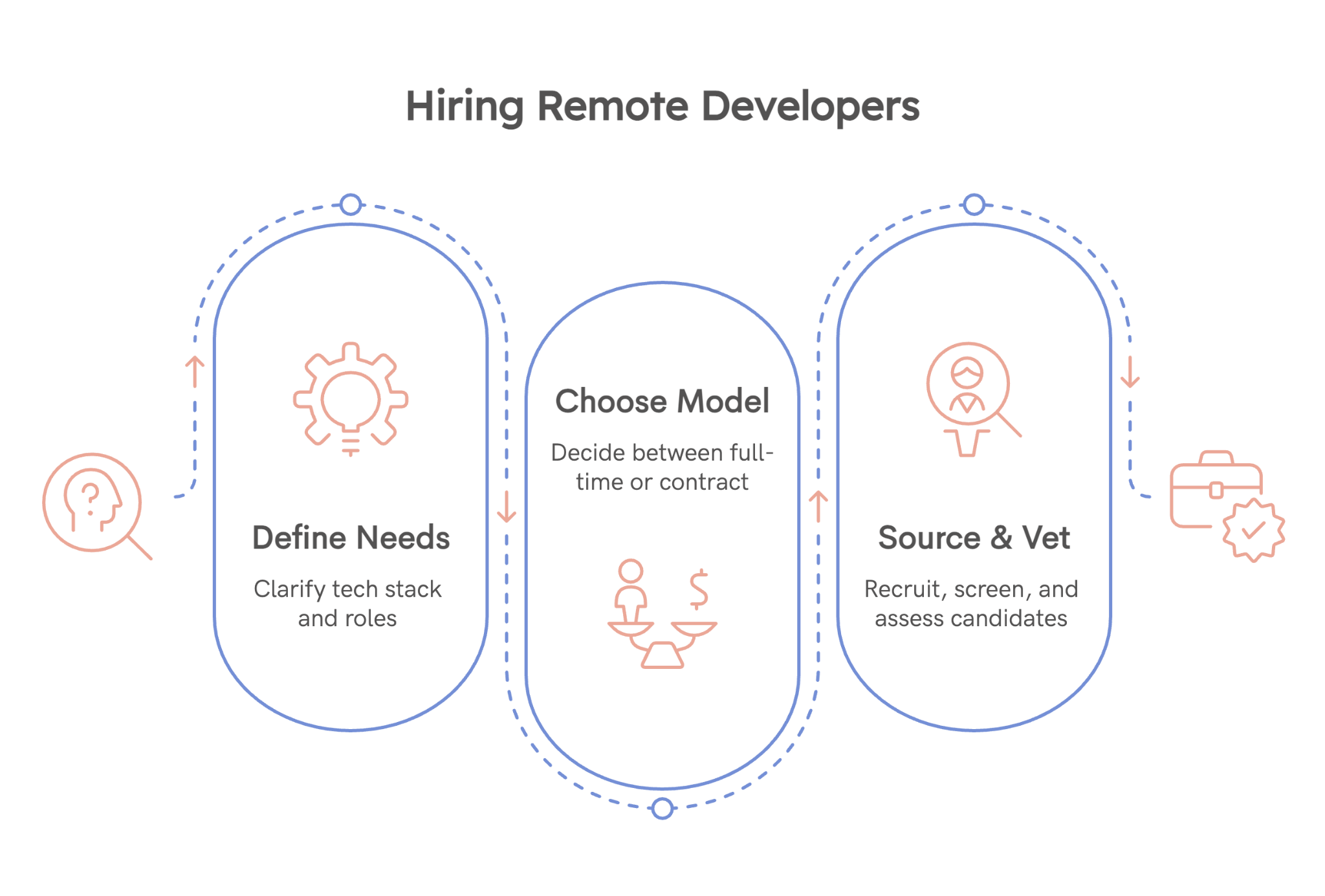
First, define your business needs and the tech stack your company works with. For instance, do you want to build a mobile app or a website? For the first, you’ll need a mobile app developer, while the second calls for a web developer. So, knowing what you want will help you decide what kind of developer(s) to hire.
You should also clarify the roles you need to fill and the skill sets you want your developers to have. For example, QA automation engineers are completely different from coders, front-end developers aren’t the same as back-end developers, and Ruby on Rails is a completely different programming skill set from .NET.
If you're in the IT or SaaS space, you'll likely need a permanent team of developers, which means you'll have to hire full-time employees. But if you're an HVAC business that just needs a website as a one-off project, you’d be better off hiring a contract worker.
Once you decide on full-time or contract employees, you can actively start recruiting. This involves:
Alternatively, you can partner with a developer staffing agency like Pearl Talent to manage the end-to-end remote dev hiring process for you. We have an elite pool of pre-vetted candidates, so you can go from first call to onboarding within days. This is especially beneficial for start-ups and small businesses that don't have the time or resources to dedicate to building an entire team. Browse hand-picked developer profiles now.
You’ve successfully built your remote developers team. Now, the focus should be on getting them up to speed quickly on the project roadmap, your company culture, and your workflow. This reduces the time it takes for them to actively start contributing.
To achieve this, you must have a strong onboarding process in place, particularly because onboarding developers isn’t the same as onboarding, say, an SEO person. Think about it. Your developers need to understand:
Additionally, they also need access to development environments and server-side tools, while also learning how things in your company work. So, your onboarding process should focus on providing your developers with all the knowledge, tools, and access they need.
At Pearl Talent, we take care of the entire onboarding process for your new developers. This saves you time and gives you a new team that’s ready to contribute from day 1 without any loss of productivity. Get hand-picked developer profiles now.
You don’t want your developers getting in each other’s way like the team lead from the Reddit example we cited above. This either leads to a duplication of tasks or causes them to fall through the cracks entirely.
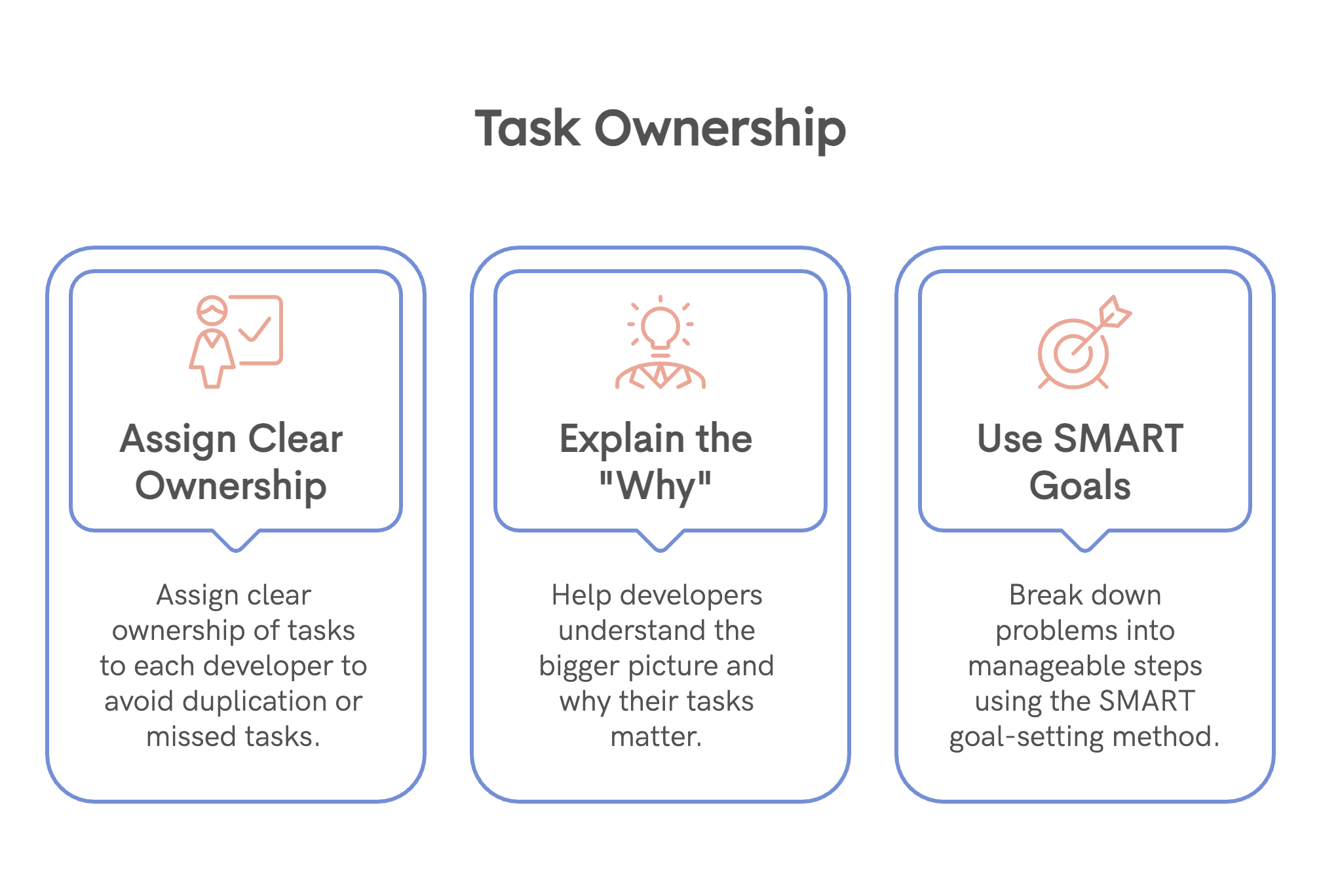
The solution is to assign clear ownership of tasks to each of your devs. For instance, developer 1 could focus on adding new features to your software, developer 2 can work on testing, while developer 3 could focus on fixing bugs. This gives each team member clarity on their responsibilities, which reduces ambiguity and enhances productivity.
Pro tip: Instead of just assigning tasks, help your developers see the bigger picture by explaining “why” the tasks matter. Not only does this help them make smarter decisions aligned with the end goal without your say-so, but it also improves their accountability as it subtly shifts them from “order-taker” to “part of the team.”
When assigning tasks, use the SMART goal-setting method. It breaks down each problem you’re solving into manageable steps, making success that much easier. You can use Pearl Talent’s free SMART goal generator for this.
Effective communication that aligns the entire team on shared goals, vision, and processes is crucial for a remote dev team. Keep your developers in the loop about shifted priorities and business decisions that impact their work. This saves you from having to micromanage, as the team already knows what the next task item would be. This way, important decisions also don’t get delayed.
Good communication also involves providing feedback and encouraging your developers to come forward with any concerns. When you work on problems together and value their opinions, it builds trust, increasing your team retention.
The best way to keep communication channels open, get any doubts clarified, and have your developers share progress updates is through regular team meetings. You can have video conferencing calls either once or twice a week, or even daily. Regular calls also prevent isolation and disengagement.
Instead of relying on verbal communication (which can lead to misinterpretation or confusion in dev teams), use screen recordings or videos to share information. Team meetings are also a great place to show the real-world impact of your developers’ progress to increase motivation.
When your developers are in the flow, it can be hard for them to document all the processes, changes, instructions, shortcuts, tips, and decisions. But development is complex, and relying on memory alone won’t help.
Everything needs to be written down to ensure continuity in knowledge for the other team members, reduce inefficiencies, prevent assumptions, and reduce a lot of back-and-forth. Moreover, written documentation will serve as a future reference.
Use a project management tool or Source Code Management software to make sure everything is documented in a single place. You should also build up your own centralized systems for code reviews. This prevents fragmentation of knowledge, keeping the development process smooth.
Pair programming is when two developers work simultaneously on a single task. This encourages knowledge-sharing, increases accountability, and improves the quality of the end product by identifying and recognizing bugs early. In short, each developer brings a pair of fresh eyes (and different perspectives) to the task, reducing the need for micromanagement.
Pearl Talent is a remote talent acquisition partner that specializes in helping start-ups and enterprises like yours build and manage a team of remote developers. We have a talent pool of pre-vetted and AI-trained developers, skilled across a wide range of software development languages and technologies, ready to start contributing their technical talent from day 1.
Our global talent candidates are hand-picked and make up the top 1% of developers in the Philippines, South Africa, and Latin America. Once you talk to our advisor about your needs, you’ll receive candidate profiles within hours, and can interview them within a day.
When you partner with Pearl Talent:
Hire the top 1% of remote developers at 60% less payroll with Pearl Talent. Get hand-picked developer profiles now.

.svg)