Catena is now Pearl Talent! Same mission, new name.
Thrivas is a U.S.-based staffing and recruiting agency founded in 2000, with headquarters in Fort Lauderdale, Florida. With more than two decades of history, it has a strong presence in other major states as well, such as California, Texas, New York, and New Jersey.
This review looks at Thrivas from an employer’s perspective. We break down the services it offers, the roles and industries it supports, and where its model tends to work well. We also outline situations where other staffing approaches may be a better fit.
Thrivas supports three primary hiring models that cover most standard staffing scenarios. These options give employers flexibility in how they manage risk, speed, and long-term headcount, depending on the role and business context.
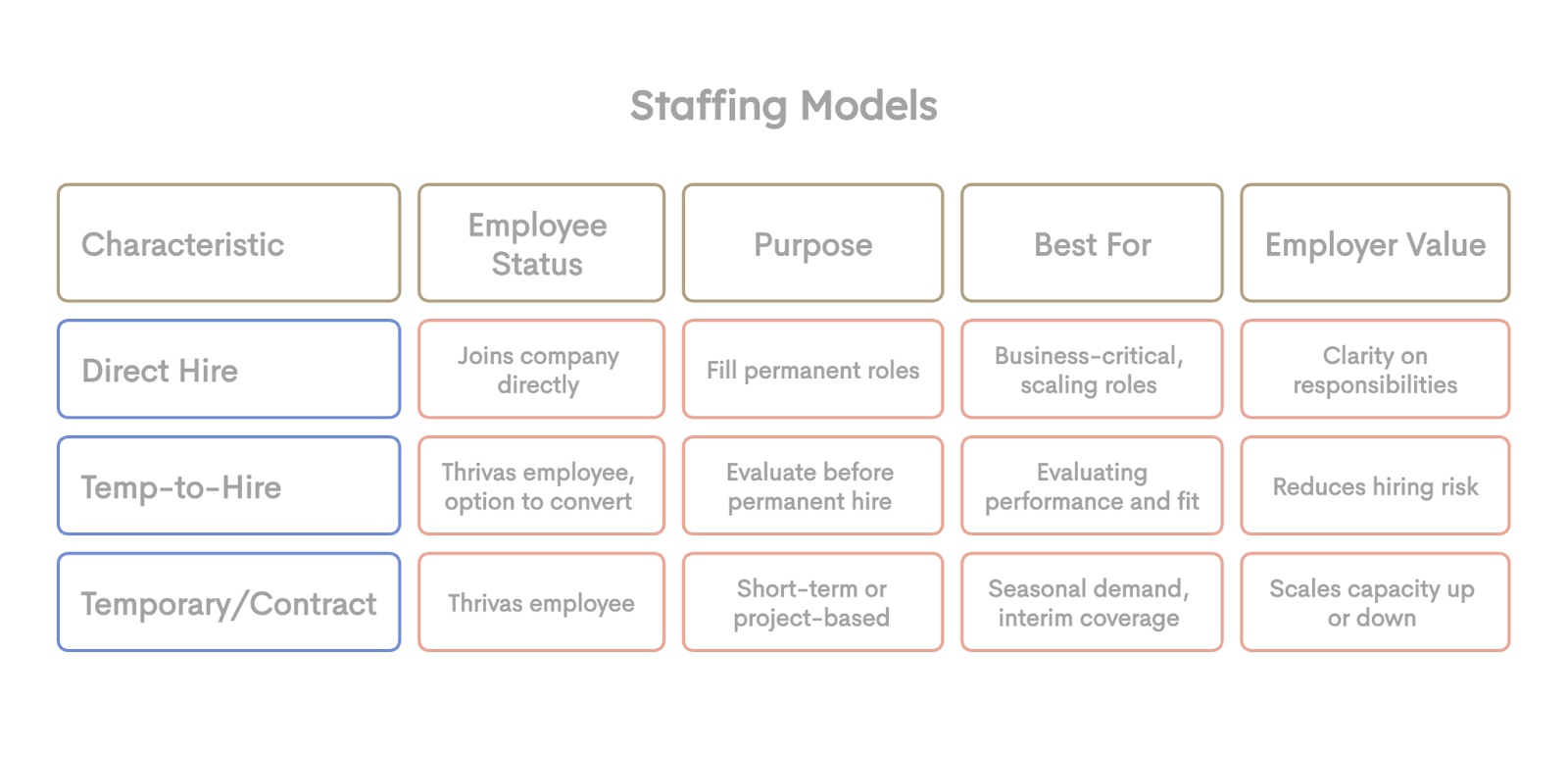
3 kinds of staffing models offered by Thrivas
This model is designed for employers looking to fill permanent roles. Thrivas handles candidate sourcing, screening, and presentation, while the employee joins the company directly upon hire. This approach is most relevant when the role is business-critical, tied to internal ownership, or expected to scale over time. Employers who already have clarity on responsibilities and success metrics tend to get the most value from direct hire placements.
In this arrangement, Thrivas places a worker as their employee for an initial period, with the option for the employer to convert the individual to a permanent hire later. This model can reduce hiring risk for employers who want to evaluate performance, culture fit, and reliability before committing to a full-time offer.
Thrivas also provides short-term or project-based staffing, where workers remain on Thrivas’ payroll for the duration of the assignment. This model is typically used for seasonal demand, interim coverage, special projects, or workload spikes that do not justify permanent headcount. It also allows employers to scale capacity up or down without changing internal staffing structures.
Thrivas focuses primarily on office-based and professional roles rather than heavy industrial or hourly labor. Their strongest emphasis appears to be in the following areas:
For employers in regulated or process-heavy environments such as law firms, financial institutions, or real estate offices, this specialization can be useful. Thrivas is familiar with the compliance requirements, documentation standards, and professionalism expected in these roles.
That said, the firm’s role coverage is broad rather than deeply niche. Companies seeking highly specialized technical talent or senior executive search services may find the offering more generalist than boutique.
One area where Thrivas differentiates itself is the range of ancillary services bundled into its staffing offerings. These include:
For employers, this can simplify administrative overhead, particularly when hiring at volume or under strict compliance requirements. Instead of coordinating with multiple vendors, companies can rely on Thrivas to manage much of the pre-employment and employment administration.
Thrivas is best suited for employers who need to fill roles quickly without overhauling their existing hiring process. Companies hiring for office-based or professional positions are likely to find the agency’s approach familiar and efficient.
Thrivas will appeal to companies that prefer onshoring (keeping hiring and employment within the U.S.) rather than managing cross-border payroll, compliance, or time-zone differences.
Another area where Thrivas fits well is administrative support. For teams that want help beyond sourcing (such as payroll handling, background checks, compliance steps, and pre-employment screening), the agency can function as an extension of an internal HR or recruiting team rather than just a resume provider.
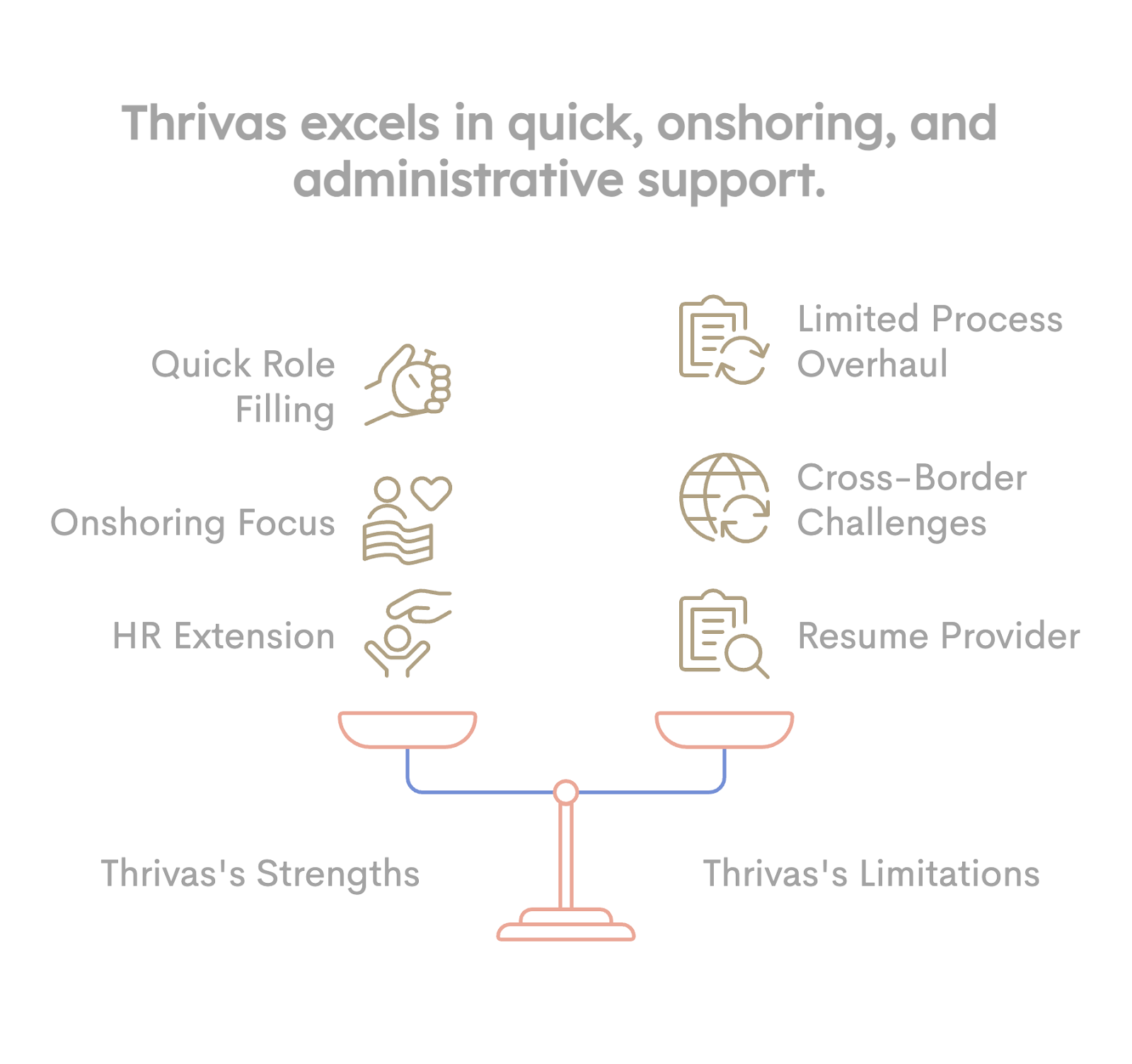
While Thrivas offers convenience and breadth, its model may not fit every hiring strategy. The firm places less emphasis on global or cost-optimized talent sourcing, which means employers looking to significantly reduce labor costs through international hiring may need to look elsewhere.
Thrivas also operates primarily as a traditional staffing agency. For highly specialized roles, senior leadership positions, or searches that require deep niche expertise, the value proposition may feel more generalized than boutique. Although the company promotes nationwide reach, its strongest presence is regional, which can matter for employers hiring across multiple geographies at scale.
For employers weighing whether to outsource staffing rather than build in-house recruiting capacity, agencies like Thrivas offer a familiar, low-friction way to fill roles without changing existing hiring structures. But it helps to look at your requirements before choosing a staffing agency that meets your needs.
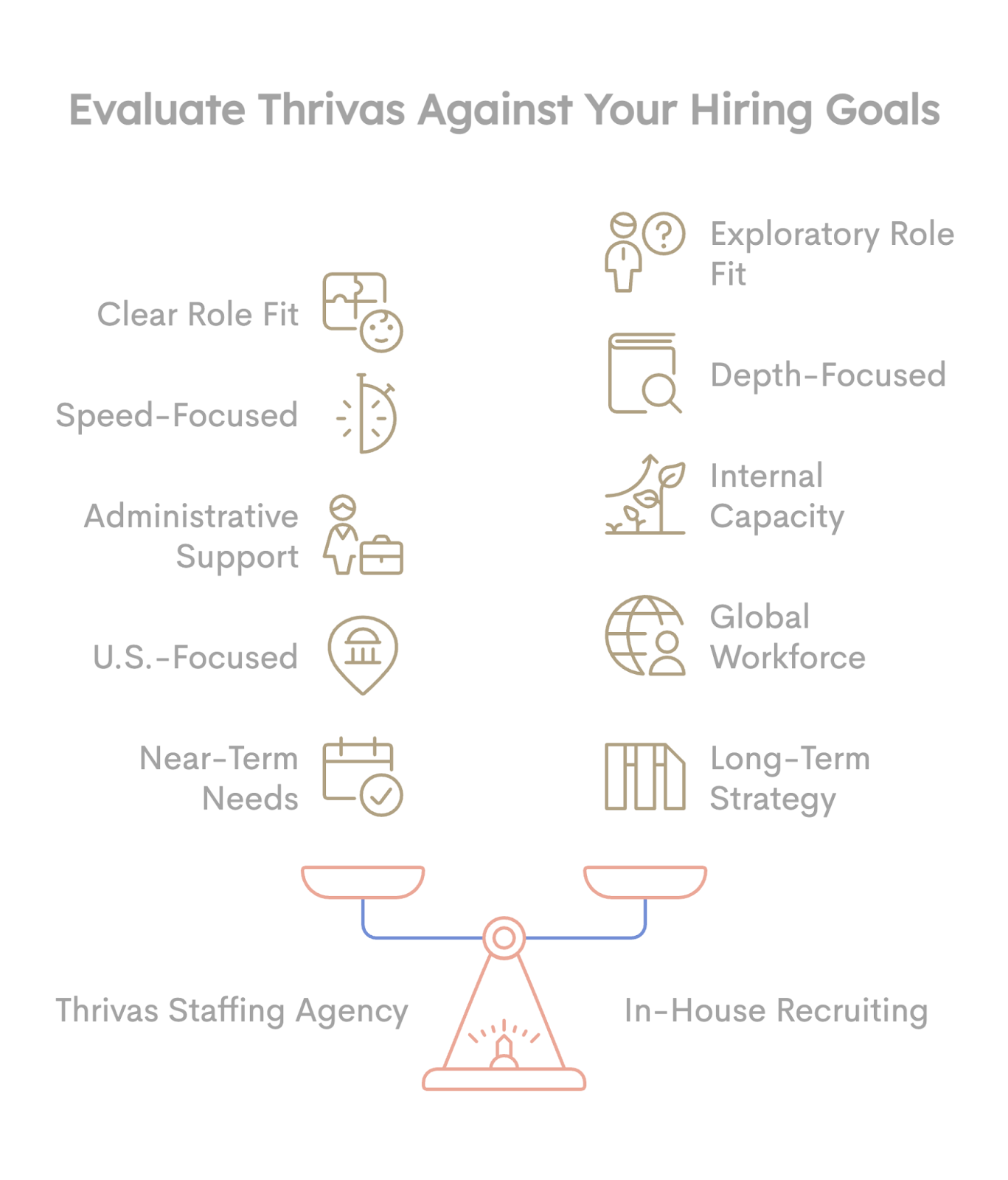
Start by clarifying the nature of the roles you’re hiring for. Agencies like Thrivas tend to work best when positions are clearly defined, operational in nature, and tied to established workflows. When roles are more exploratory, highly specialized, or central to long-term strategy, employers may want to layer in additional evaluation methods or consider complementary hiring approaches.
Another key trade-off to consider is speed. Traditional staffing models are built to reduce time-to-fill, which is valuable when coverage gaps or workload pressure are the main concern. You should decide upfront whether quick placement or extended assessment matters more for a given role, since tighter timelines often limit how deeply candidates can be evaluated before starting.
Hiring decisions should also account for internal capacity. When HR teams are lean or stretched, offloading payroll, screening, and compliance tasks can free up significant time and attention. In these cases, a staffing partner can function as operational support rather than just a sourcing channel. Teams with robust internal systems may see this as helpful but less essential.
Workforce geography plays an increasing role in hiring strategy. If your organization prefers to hire domestically and maintain familiar employment structures, a U.S.-focused staffing model may align well. If, however, your long-term plan includes distributed teams or cost-efficient global hiring, you may need to expand beyond traditional agency frameworks.
Thrivas works well for addressing near-term hiring needs and maintaining operational continuity. Employers should consider whether their goal is short-term capacity, steady backfilling, or a broader rethink of how work gets done. For organizations focused on long-term scalability or structural cost reduction, Thrivas may function best as part of a broader talent strategy rather than a standalone solution.
If you’re hiring for longer-term roles or are open to remote talent, it's worth looking at staffing solutions like Pearl Talent.
Pearl Talent focuses on helping companies hire full-time, long-term remote talent from top global markets, including the Philippines, Latin America, and South Africa. Rather than relying on open job boards, Pearl Talent sources candidates through exclusive networks tied to prestigious local companies, universities, and referral ecosystems.
The result is access to experienced operators who are accustomed to working with U.S. companies, aligned to your time zone, and prepared for long-term roles. You can:
Browse available hires or request curated candidate profiles to see what your next hire could look like.

.svg)