Catena is now Pearl Talent! Same mission, new name.
The Philippines has been a go-to source for assistants since the early 2000s, when the BPO industry took off. That boom built a large workforce experienced with remote collaboration tools and comfortable communicating in English.
Their education system produces skilled professionals, and there's a deep cultural familiarity with American business norms that make them perfect for the role of executive assistants for US companies. Let's see how you can hire them, and how much you can expect to pay.
The quality of your executive assistant depends less on where you post and more on how clearly you define the role, how rigorously you vet for judgment, and how well you structure the relationship from day one. These four steps help you avoid the most common missteps founders make when hiring remotely for the first time.
A vague listing like "looking for an EA to help with day-to-day tasks" will get you hundreds of applicants who can do basic data entry, and almost none who can actually think ahead, manage up, or make judgment calls on your behalf.
Be specific about what a typical week looks like.
If they'll be managing your calendar across three time zones, triaging investor emails, prepping board decks, and coordinating with your ops team, say that. If you need someone comfortable working US Eastern hours, put it in the description. If you care about experience with specific tools like Notion, Slack, HubSpot, or AI productivity tools, list them. The more concrete the JD, the faster you'll filter out candidates who aren't a fit.
Also include the compensation range. Filipino professionals who are serious about remote careers with US companies have learned to skip listings that don't mention pay.
Once you have a solid JD, you need to actually get it to the right people, and where you post it determines the quality of what comes back.
Your own network and LinkedIn are underrated starting points.
If you know other founders who've hired Filipino EAs, ask for referrals. Post the role on LinkedIn with the right tags, and there's a decent chance it'll reach Filipino professionals who are already working with US companies and looking for their next role. Referrals tend to produce better hires because there's some built-in social proof on both sides.
Freelance marketplaces like Upwork work for shorter-term or part-time needs, but they're less ideal if you want a full-time EA who's fully embedded in your business. The platform takes a cut, rates tend to be project-based, and the relationship often stays transactional.
Talent acquisition partners like Pearl Talent handle the sourcing, vetting, and placement for you.
This is the path that makes sense if you don't have weeks to run a hiring process yourself, or if you've tried the DIY route before and ended up with a mismatch. Pearl Talent headhunts for every role from top local companies and universities rather than matching from a pre-trained bench. The team also handles everything through onboarding and ongoing performance support.
This is the part that trips up a lot of first-time international hirers, and it's worth getting right before you make an offer. You have a few options:
Don't over-index on years of experience. A Filipino EA with two years supporting a fast-moving US startup founder might be sharper and more resourceful than someone with eight years at a large corporation where the role was more procedural.
There are 5 aspects to look at when you want to distinguish a competent Filipino EA from one who will actually make your life measurably better.
The Philippines ranks high in English proficiency, but there's a wide range within any talent pool. What you're really evaluating is whether someone can parse ambiguous instructions, write a professional email that sounds like it came from you, and flag potential problems before they escalate.
In the interview, give them a realistic scenario: a scheduling conflict between two important meetings, or a request from an investor that needs a thoughtful response. How they reason through it tells you more than any resume line.
The biggest gap between a $5/hour assistant and a $20-30/hour assistant isn't typing speed or calendar management. It's whether they can anticipate what you need, make reasonable decisions without asking, and take full ownership of their work.
When you're interviewing, ask them to describe the biggest impact they had in their last role, what the situation looked like before, what they specifically did, and what changed as a result. If someone can't articulate a clear before-and-after story, that's a signal.
The best Filipino EAs in 2025 aren't just fluent in Google Workspace and Slack. They're using ChatGPT, Claude, or Notion AI to draft communications, organize information, and automate repetitive tasks. This is increasingly the dividing line between an EA who manages your inbox and one who genuinely multiplies your capacity.
Most Filipino EAs are accustomed to working US hours, given the country's long history in the BPO industry. But it's worth being specific about what you need. Some founders want real-time overlap during their entire workday, while others prefer an async model where the EA handles tasks overnight and has a few hours of overlap for communication. Either model works, but the expectations should be clear from the start.
Filipino professionals tend to value long-term relationships, loyalty to their employers, and a sense of being part of a team. That cultural orientation is a real asset if you invest in building the relationship, giving context on why work matters, and creating a path for the EA to grow into more responsibility over time. But it also means that Filipino EAs may be less likely to push back openly on unreasonable requests, so you'll need to create space for honest communication.
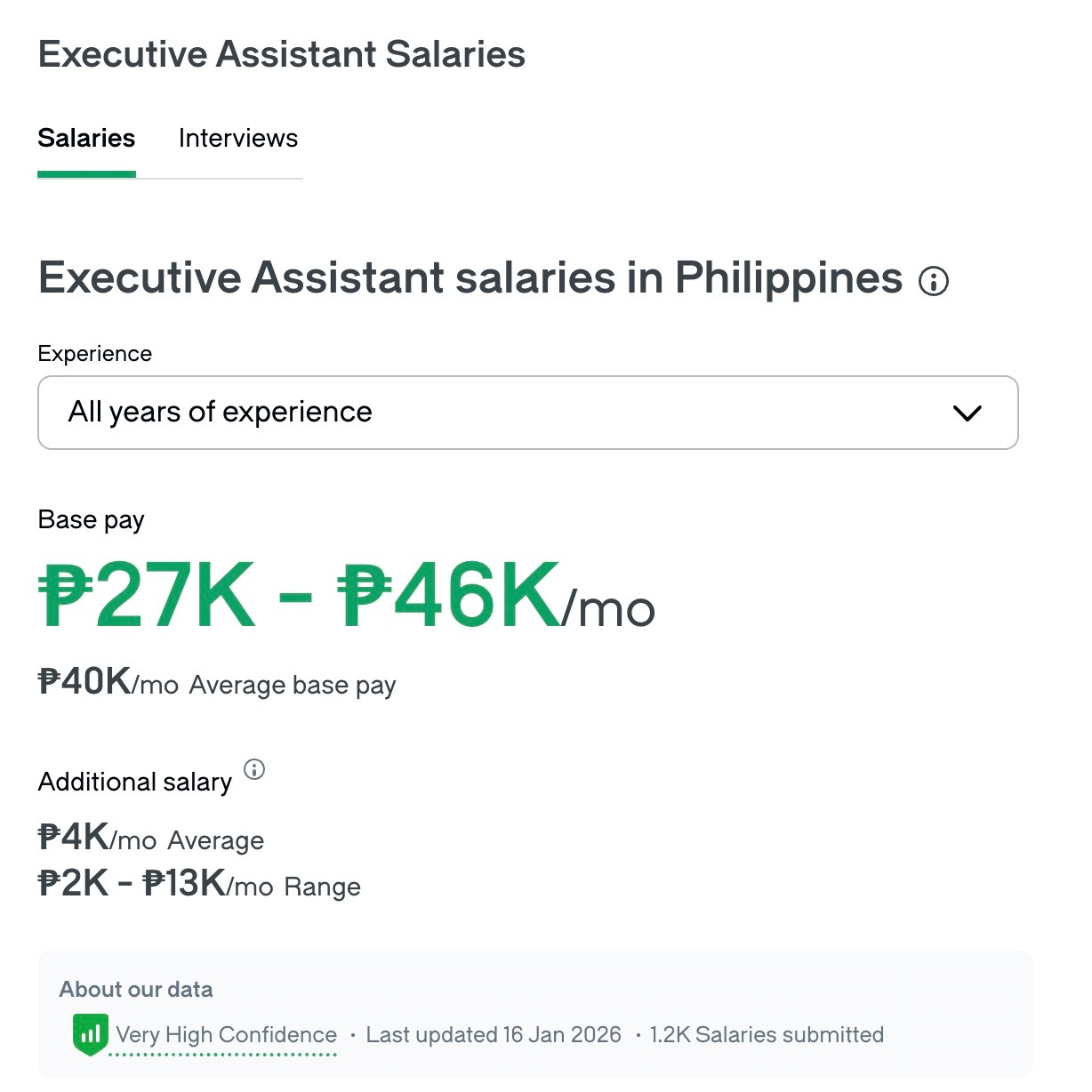
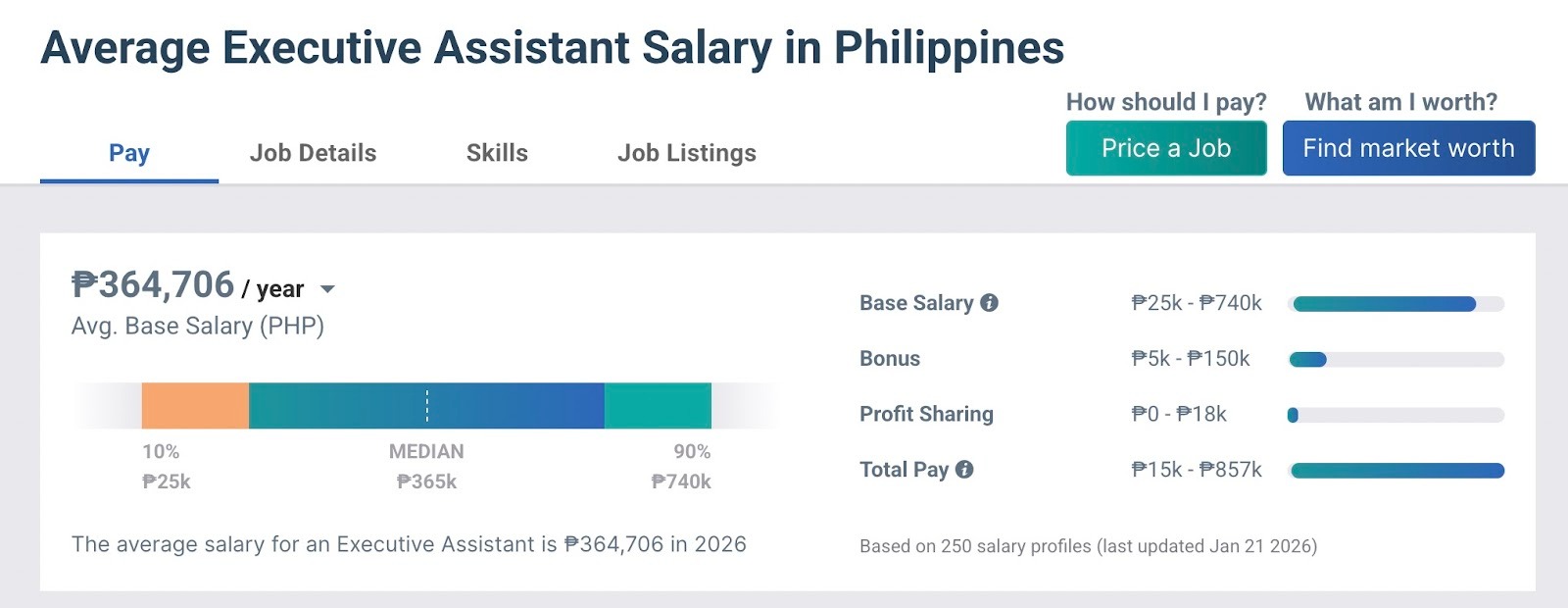
Local Philippine EA salaries range from about $470 to $810 per month, with an average of around $700/month, according to Glassdoor data based on 1,200 salary submissions (last updated January 2026).
PayScale's data, based on 250 salary profiles updated January 2026, puts the average annual base at roughly $6,400, with the full range running from about $440/month at the 10th percentile up to $1,300/month at the 90th. These are local employer rates, though, meaning what Philippine-based companies pay for in-office or domestic roles.
Remote EA rates for US companies are meaningfully higher because you're competing with other international employers for the same talent.
Upwork gives a useful real-world snapshot of what Filipino EAs actually charge: rates range from $8/hour on the low end to $25/hour at the top, with most experienced EAs (4.5+ star ratings, 10-20 completed jobs) clustering around $15 to $20/hour. At full-time hours, that works out to roughly $1,280 to $3,200/month depending on experience.

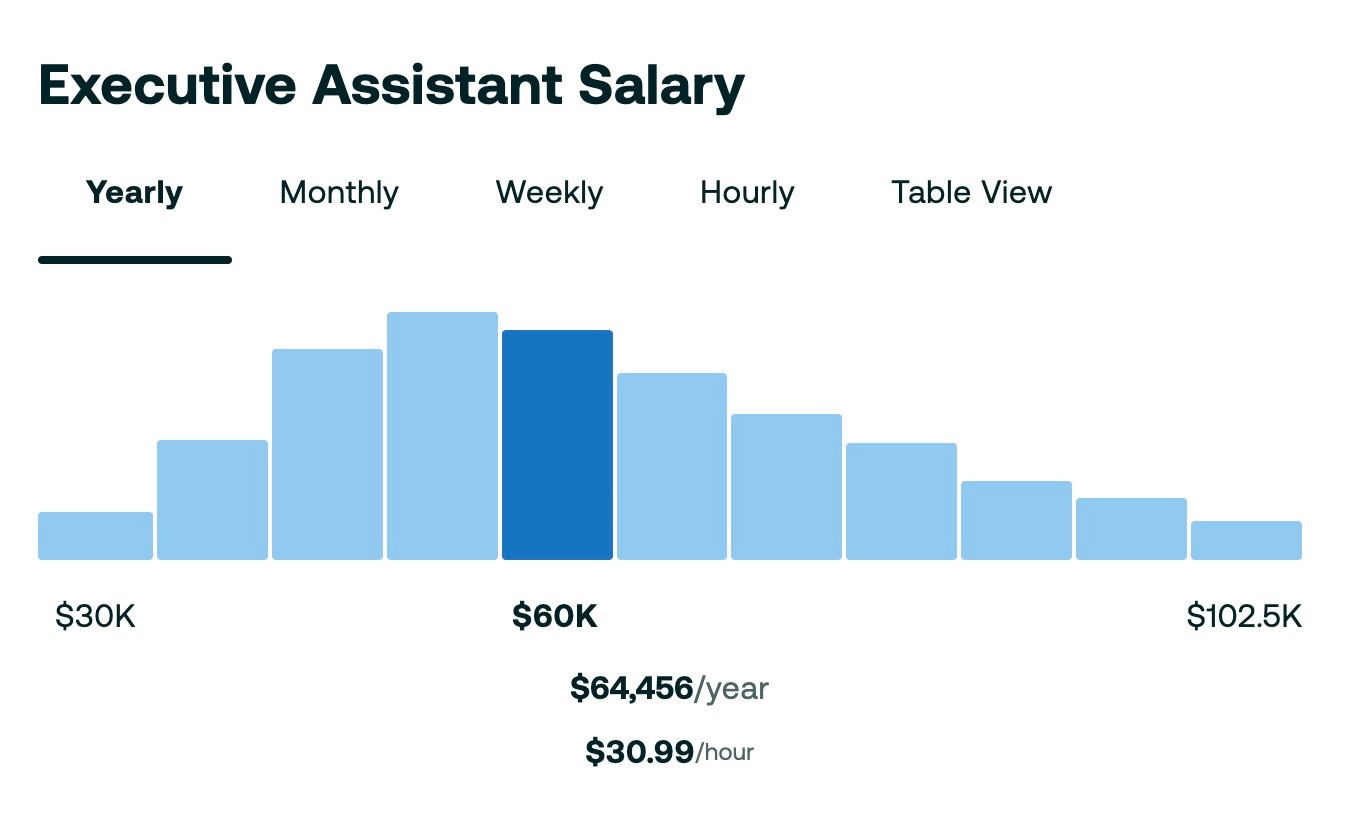
For context, the average US-based executive assistant earns around $64,000 to $100,000 per year, or roughly $5,300 to $8,300 per month. Even at the higher end of Filipino remote EA rates, you're looking at a 45-75% cost reduction compared to a US hire.
Through a staffing agency like Pearl Talent, the managed services model starts at $3,000/month per hire, which covers sourcing, vetting, payroll, compliance, pre-onboarding bootcamps, and ongoing performance coaching. Pearl pays talent roughly double the local rate, which is how they pull from the top of the talent pool rather than the middle.
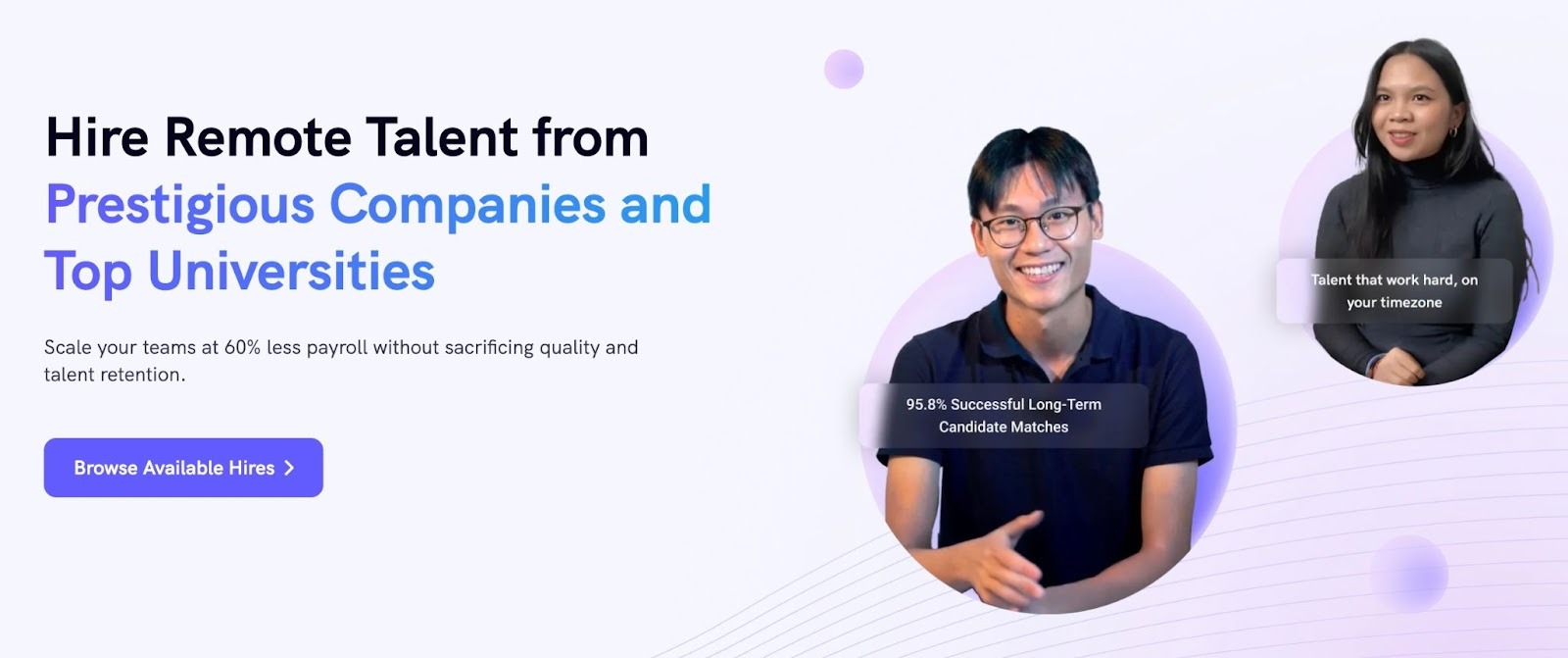
Hiring an executive assistant in the Philippines on your own is possible, but it takes time that most founders and executives don't have. Between sourcing from the right networks, vetting for communication and judgment (not just task execution), navigating payroll and compliance, and onboarding someone who's never met you in person, the process can stretch for weeks and still end in a mismatch.
Pearl Talent handles all of it. We place full-time executive assistants from the Philippines, Latin America, and South Africa with US startups and SMBs, managing everything from sourcing through onboarding and ongoing performance support.
Why choose Pearl Talent as your premium talent acquisition partner:
Browse available candidates who can be your executive assistants for the long-term.

.svg)