Catena is now Pearl Talent! Same mission, new name.
Latin America has quietly become one of the strongest talent markets for US companies hiring executive assistants remotely, and the reason isn't just cost.
The region sits in overlapping or near-overlapping time zones with every US city, which means your EA is working the same hours you are, not handing off tasks at the end of their day while yours is just getting started. That alone changes the dynamic of the role, because an executive assistant who can respond to a Slack message in real time, hop on an impromptu call, or rebook a flight while you're still in the air is fundamentally more useful than one operating on a 12-hour delay.
The talent pool has also matured significantly over the past few years. Countries like Mexico, Colombia, Argentina, and Brazil have large populations of university-educated, bilingual professionals who grew up consuming American media, working with US companies through the region's expanding tech and services sectors, and building fluency not just in English but in the tools and communication norms that US startups run on.
For founders and operators who've already decided to hire globally but want someone they can collaborate with in real time, Latin America is worth a serious look.
Compensation for executive assistants in Latin America varies by country, experience level, and whether you're hiring through a local employer or bringing someone on remotely for a US company. The numbers below are based on local employer salary data, which gives you a useful floor for understanding what the market looks like before the premium that comes with remote US-company roles.
In Mexico, SalaryExpert puts the national average for an executive assistant in Mexico at MX$330,310 per year, with entry-level roles (1 to 3 years of experience) at MX$237,526 per year and senior-level roles (8+ years) at MX$409,260 per year.
In USD terms, that's roughly $970 per month for entry-level, $1,340 per month at the average, and $1,670 per month for senior EAs.

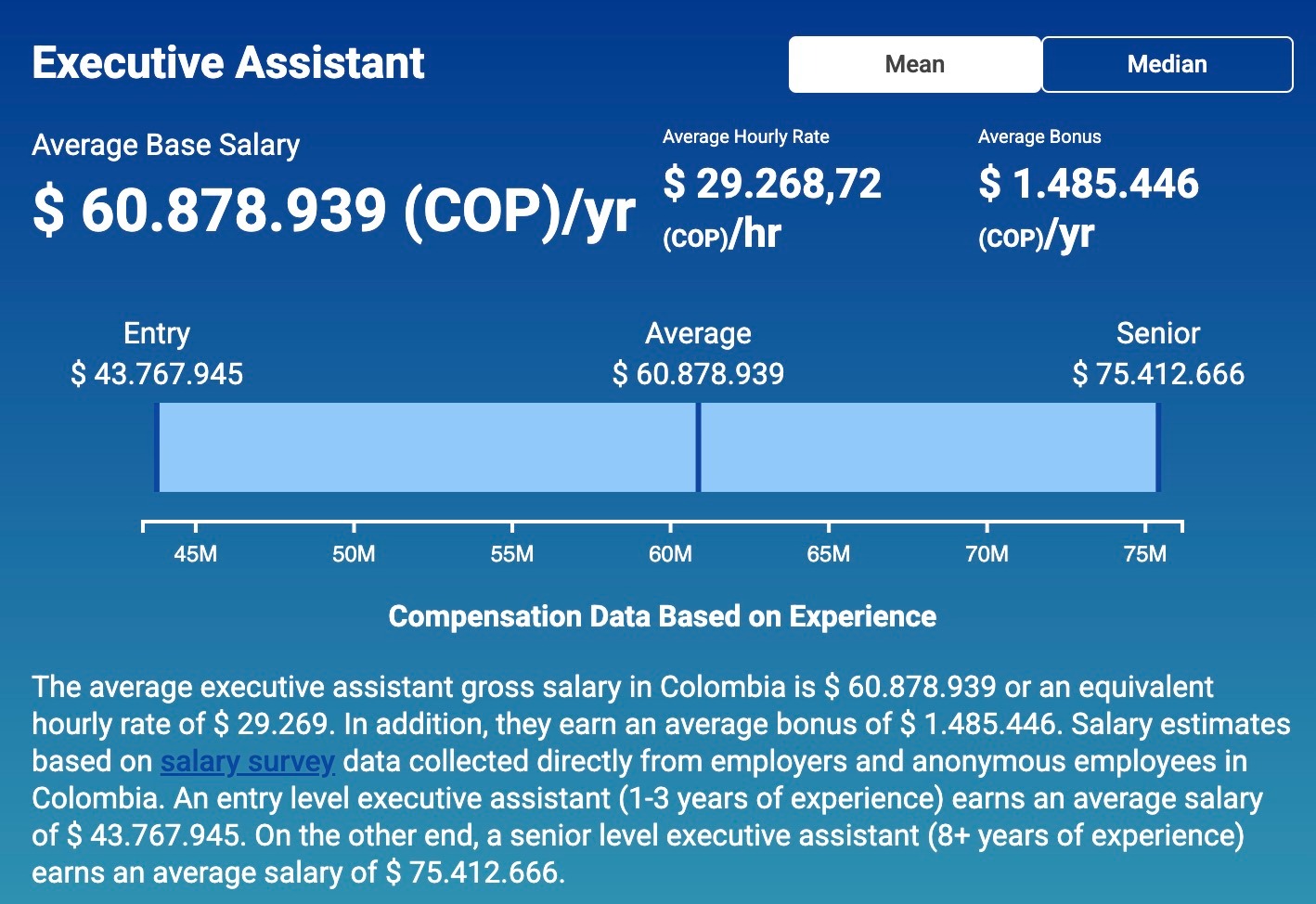
In Colombia, SalaryExpert reports an average executive assistant salary of COP 60,878,939 per year, based on salary survey data collected from employers and employees. Entry-level EAs (1 to 3 years) earn around COP 43,767,945 per year, while senior-level EAs (8+ years) earn roughly COP 75,412,666 per year (source: SalaryExpert, powered by ERI).
Converted to USD, that works out to approximately $880 per month at the entry level, $1,220 per month at the average, and $1,510 per month for senior roles.
Remote rates for US companies will sit above these local benchmarks, because you're competing with other international employers who are also hiring from the region.
Based on what the market currently looks like across LatAm, expect to pay in the range of $1,500 to $2,500 per month for a mid-level EA with solid English, experience with US business tools, and the ability to work US time zones. Senior EAs with direct C-suite support experience and strong independent judgment can command $2,500 to $3,500 or more per month.
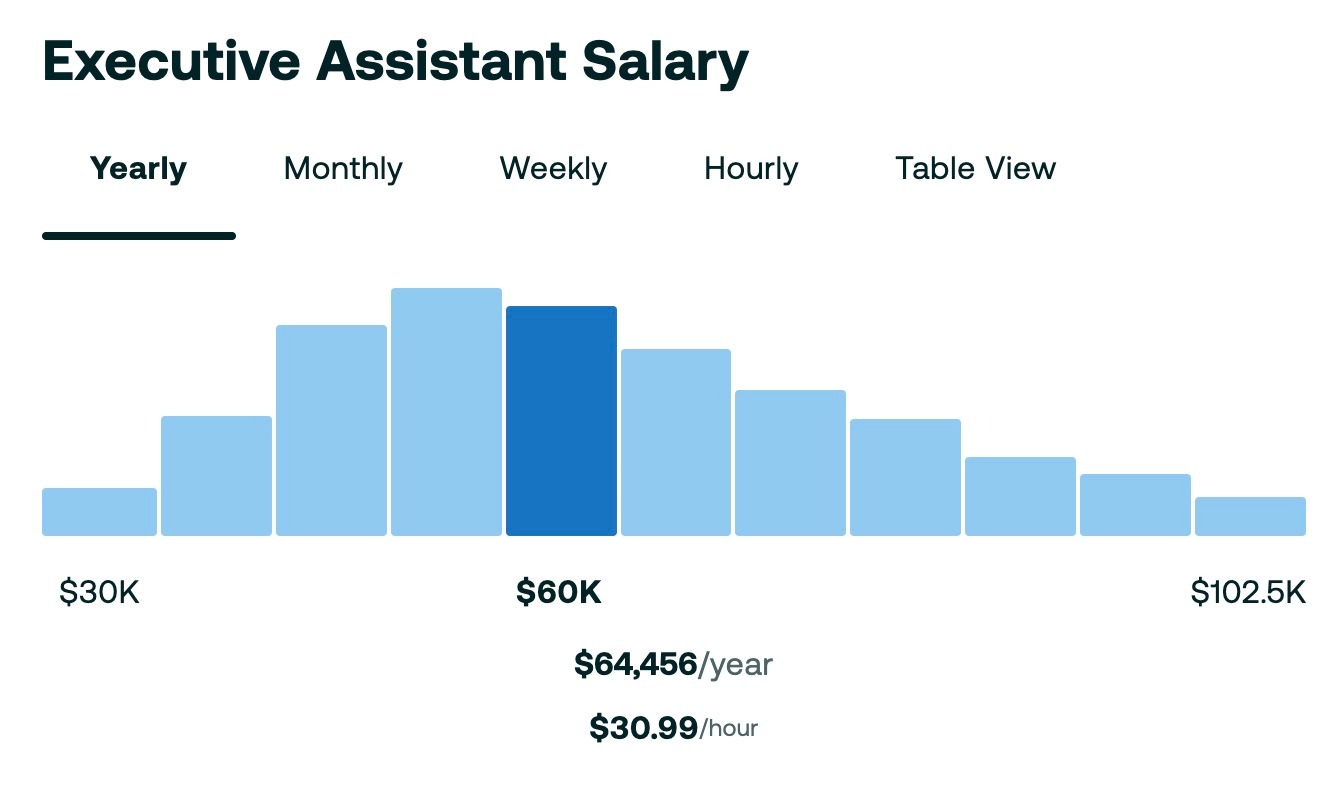
For comparison, the average US-based executive assistant earns around $64,000 to $71,000 per year (from ZipRecruiter), or roughly $5,300 to $5,900 per month. Even at the higher end of LatAm remote rates, you're looking at a 40 to 70% cost reduction compared to a domestic hire.
Through a staffing agency like Pearl Talent, the managed services model starts at $3,000 per month per hire, which covers sourcing, vetting, payroll, compliance, pre-onboarding bootcamps, and ongoing performance coaching. That sits right in the middle of the remote rate range, but includes the full infrastructure around the hire rather than just the salary.
A lot of LatAm candidates sound great on a video call because their conversational English is strong. But the EA role requires a lot of writing daily, things like drafting emails on your behalf, putting together briefs, writing Slack messages to your team, etc.
Send a short written exercise before the interview, something like drafting a reply to a client email or summarizing a set of messy meeting notes. It takes the candidate 15 minutes and saves you hours of interviewing people who speak well but can't write clearly.
Mexico, Colombia, Argentina, and Brazil each have different salary expectations, labor laws, and cultural norms around work. A few things that catch first-time hirers off guard:
An EA in Mexico City will also generally cost more than one in Bogotá or Medellín, because the local tech sector has pushed salaries up faster there. If you're hiring directly rather than through an agency, make sure you understand the specific rules for the country you're hiring in.
In your interview for the position of executive assistant, ask candidates to tell you about a time they made a call on behalf of their manager without being asked. Then ask what happened and what they'd do differently. That single question tells you more about how someone will perform in the role than any skills assessment or years-of-experience filter.
You can also give them a scenario during the interview to see how they think on the spot. For example: "I'm in a board meeting and a client emails asking to reschedule a call that's happening in two hours. What do you do?" There's no single right answer, but you want to see someone who thinks through the tradeoffs, considers what context they'd need, and leans toward resolving it rather than just flagging it for you to deal with later.
The best EAs treat ambiguity as something to work through, not something to forward to your inbox.
LatAm EAs working US hours are online at the same time as you, which is a major advantage over offshore regions with a 10 to 12-hour gap. But real-time overlap only works if you're clear about how you want to communicate.
Before they start, put together a short doc or Loom video that covers when and how you prefer to be reached, what kinds of decisions they can make on their own, and what your weekly rhythm looks like. This matters most in the first 30 days, when the EA is still learning how you think and what "good" looks like in your context.
Founders who skip this step usually end up frustrated that their EA keeps asking for permission on things they expected them to just handle, when the real problem is that no one ever told them where the line was.
Latin America has a massive pool of qualified EA talent. When you post a role across LatAm job boards and LinkedIn, you'll get hundreds of applicants from multiple countries, each with different employment norms, compensation expectations, and varying levels of English fluency.
Sifting through all of that, running interviews, evaluating communication quality, and figuring out payroll and compliance across borders takes weeks of focused effort. And if the first hire doesn't work out, you're back to square one. So it helps to have someone who already knows where the best talent is and how to vet for it.
That's what Pearl Talent does. We place full-time executive assistants from Latin America, the Philippines, and South Africa with US businesses – from early-stage startups to enterprises. Pearl Talent handles the entire process so you can stay focused on running your business.
Here's why we're different:
Browse available candidates to find your next executive assistant from Latin America.

.svg)











.png)