Catena is now Pearl Talent! Same mission, new name.
Hiring a virtual assistant is different from hiring an in-office employee. Most of the work happens across time zones, through written messages, and without constant supervision. Small gaps in communication can turn into missed deadlines or duplicated work.
The interview is where you test whether a candidate can operate well in that environment.
These questions are designed to show you how a virtual assistant prioritizes, communicates, and keeps work moving when context is incomplete and feedback is delayed.
Virtual assistant work lives in gaps. Time zones, async communication, incomplete context, and long stretches without real-time feedback are normal. These questions are designed to show you how someone operates inside those constraints.
Why ask this? This is a good place to start because it tells you how someone thinks about communication when you are not sitting in the same room. Remote work only functions when expectations around updates are clear, even if they are simple.
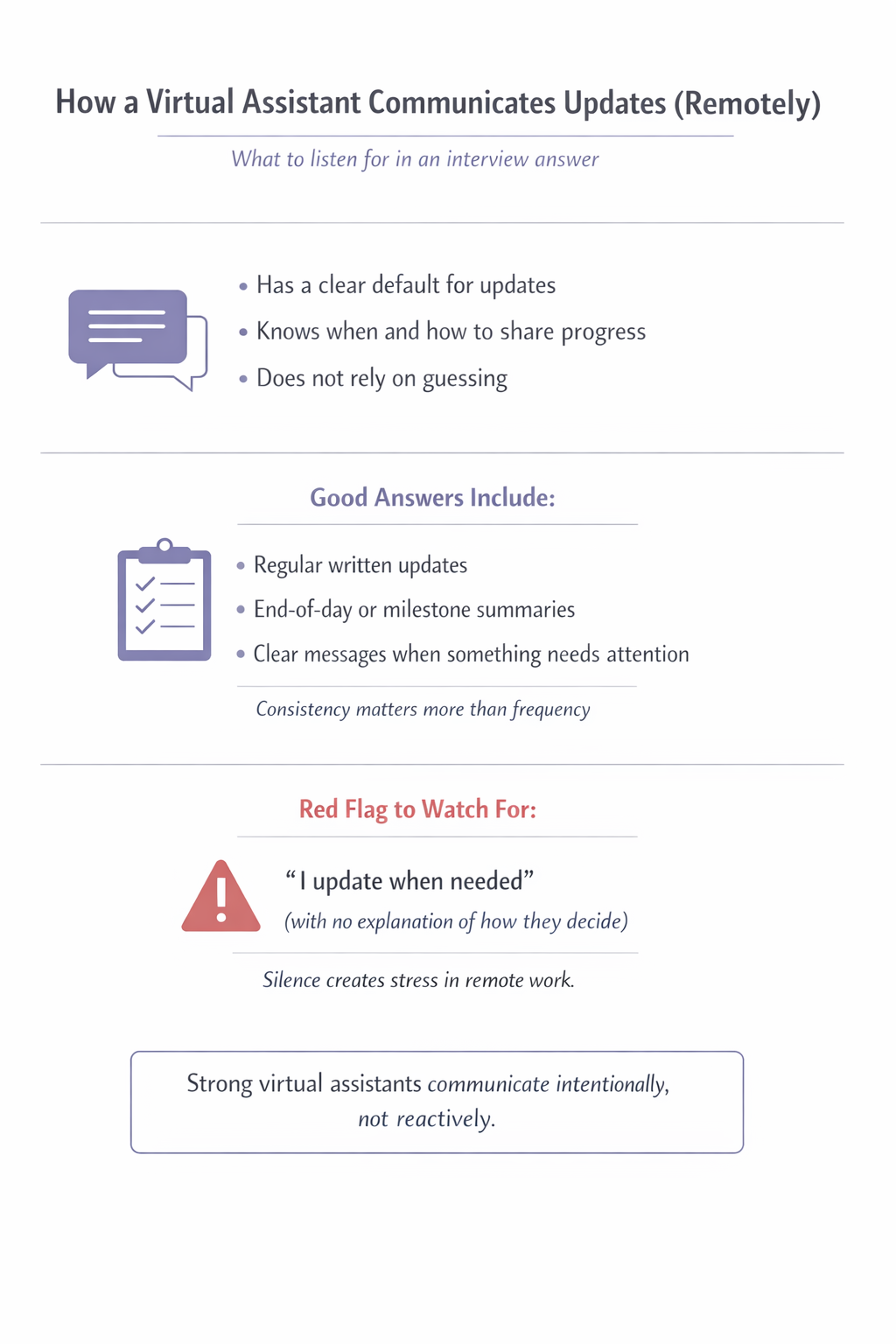
You are listening to whether the candidate has a default way of keeping people informed. That might be regular written updates, a summary at the end of the day, or clear messages when something needs attention. What matters is that they have thought about this before and are not deciding on the fly every time.
Be cautious of answers like “I update when needed” without any explanation. In remote work, what feels “not urgent” to one person can feel stressful to another. Silence often creates more anxiety than a short update that says everything is on track. A strong virtual assistant understands that and communicates accordingly.
Why ask this? This tests whether the VA can handle a common real-world constraint: the work depends on someone busy. The goal is not “send a reminder.” The goal is to keep the project moving without creating noise.
A strong answer here should describe a clear approach, like:
You are judging whether the candidate can keep work moving when they are blocked by someone else. Do they package decisions clearly, reduce back-and-forth, and use judgment about what truly needs escalation? Strong answers show they protect momentum without creating unnecessary urgency.
Why ask this? This question is not about testing tool knowledge for its own sake. It is about understanding how someone uses tools to stay reliable.
Strong answers focus on how tools fit into their workflow. They explain how they track tasks, set reminders, document work, or share visibility with others. The specific tools matter less than whether the person uses them intentionally.
If someone lists many tools without explaining how they actually work with them day to day, that can be a warning sign. What you want is consistency and follow-through, not familiarity with every platform.
Why ask this? Virtual assistants are close to day-to-day operations. They often see inefficiencies before anyone else does. This question tests whether they operate passively or think about improvement
Strong candidates explain that they would first understand why the process exists, then suggest a clearer or simpler way to handle it. They might propose a small change, create a template, automate part of it, or document a better workflow before raising it.
You are judging whether they take ownership beyond assigned tasks. Do they think in terms of systems and improvements, or do they simply execute instructions as given? A strong assistant looks for ways to reduce friction over time.
Why ask this? This question helps you understand how someone handles autonomy.
Strong candidates usually talk about checking assumptions early, setting small milestones, or sharing progress proactively. They do not wait until the end to find out they misunderstood something.
You are looking for signs that the person can stay productive without constant reassurance. Virtual assistants often work without immediate feedback, so the ability to self-correct matters a lot.
Why ask this? This question gets at prioritization and respect for attention.
Good answers show that the candidate thinks about impact, deadlines, and downstream effects. They understand that interrupting too often creates noise, but waiting too long can create problems.
You want someone who can explain how they make that judgment, not someone who either interrupts constantly or avoids reaching out altogether.
Why ask this? Misunderstandings are common in remote work, especially when everything is written.
Strong candidates acknowledge that tone and intent can be lost in text. They explain how they clarified the situation, adjusted how they communicated, or changed their approach going forward.

Be cautious if the answer focuses mainly on blaming tools or the other person. What matters is whether the candidate takes responsibility for improving communication, even when the misunderstanding was not entirely their fault.
Why ask this? This question helps you understand discipline and structure.
Good answers include some form of routine. That might be planning the day, prioritizing tasks in the morning, or reviewing progress before logging off. The specifics do not matter as much as the presence of a structure.
Remote work often breaks down without routines. You are listening for evidence that the candidate has found a way to manage their time and energy without external supervision.
Why ask this? This question reveals initiative, which can be hard to see on a resume.
Strong candidates usually talk about checking priorities, reviewing upcoming work, improving documentation, or asking thoughtful questions. They look for ways to stay useful without needing to be told what to do next.
In virtual roles, unused time often stays invisible. Initiative is how a virtual assistant moves from simply completing tasks to adding real value.
Why ask this? This question is about preventing mistakes before they happen.
Good candidates mention paraphrasing instructions, confirming expectations, or summarizing next steps. They do not assume that understanding is automatic just because something was written down.
You are judging whether the person actively works to reduce misunderstandings, especially when there is no chance to quickly clarify things in person.
Why ask this? This question tests coordination and planning.
Strong answers include things like planning, setting clear deadlines, and managing expectations around response times. They show awareness of how delays can affect others and how to design work around those constraints.
If someone treats time zones as an annoyance rather than a reality to work with, that can lead to problems later.
Why ask this? This question helps you check alignment.
Strong candidates describe outcomes rather than task volume. They talk about trust, reliability, smoother workflows, and fewer reminders. They frame success in terms of how the person they support experiences their work.
If success is defined only by being busy or completing tasks, the role may stay transactional. A strong virtual assistant understands that their real job is to reduce friction and make work easier over time.
Good interview questions help you assess how a virtual assistant thinks and works, but they do not solve the hardest part of hiring. The real challenge is finding candidates who already know how to operate remotely, communicate clearly without supervision, and stay reliable over time.
That is where Pearl Talent comes in.
Pearl Talent helps founders and operators hire full-time virtual assistants from the top 1% of global talent across the Philippines, Latin America, and South Africa. Every role is headhunted based on your needs, not filled from a pre-trained bench or recycled candidate pool.
Why Pearl Talent is different:
Browse virtual assistants available for hire with Pearl Talent.

.svg)